
Hatica
Hatica is an engineering analytics platform for examining software development processes, team productivity, and project performance.
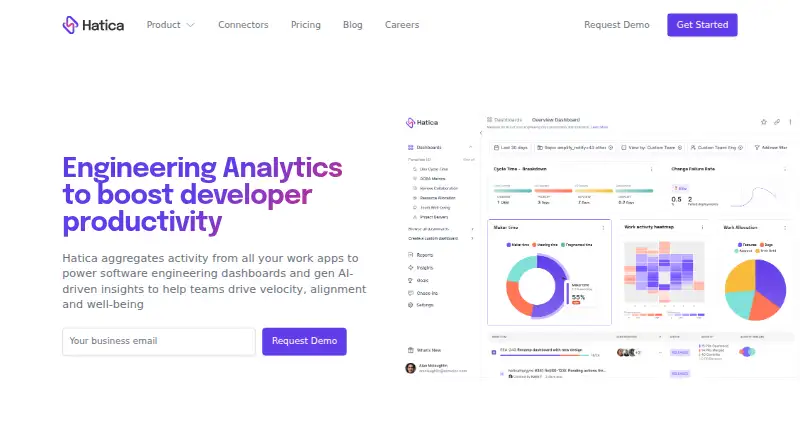
What Hatica is
Hatica is an engineering analytics platform for examining software development processes, team productivity, and project performance. Its dashboards cover projects, teams, organizations, activity tracking, and DevOps, including DORA and CI/CD insights. It brings activity from integrated work applications into dashboards and AI-generated insights about velocity, alignment, and well-being. Integrations include code-hosting, communication, calendar, and project-management services such as GitHub, Slack, Google Calendar, Jira, and Linear. Data typically syncs incrementally every 10–15 minutes, with a stated 24-hour data-sync SLA. Hatica is offered as a cloud service or self-hosted deployment. Self-hosted installations run as Docker containers on Linux/UNIX 64-bit x86 and can use Kubernetes, AWS ECS, bare metal, or VPS infrastructure. The free plan includes unlimited team members and data sources, with one month of history. Pro costs $19/member/mo and includes six months of history; Business costs $29/member per month and includes two years. Enterprise pricing is custom, with self-hosted or private-cloud deployment and up to five years of history listed among its features.
Good
- Dashboards include DORA and CI/CD insights.
- Cloud and self-hosted deployment options.
- Free plan has unlimited team members and data sources.
- Pro includes six months of history.
- Integrates with development and project-management tools.
Watch out
- Free plan limits history to one month.
- Pro costs $19/member/mo.
- Business costs $29/member per month.
- Enterprise pricing is custom.
Who it suits
Hatica is aimed at executives, engineering managers, and engineers seeking organization, team, or individual productivity insights. It offers both cloud and self-hosted deployment options.
Verdict
Hatica collects activity from work tools for engineering and delivery analytics, with dashboards and AI-generated insights. Its free tier has a one-month history limit; paid plans extend history and add capabilities.
Plans and prices
From Hatica's own pricing page, checked 28 Sep 2026.
| Plan | Price | What it gives you |
|---|---|---|
| Free | Free | Unlimited team members · Unlimited data sources · 1 month history · Docs and Email Support · Free |
| Pro | $19 a month | 6 month data history · Events API · SSO · Docs and Email Support · $19 /member/mo |
| Business | $29 a month | 2 year data history · Data exports · On-prem integrations · HRMS integrations · Dedicated Customer Success Manager · $29 /member per mo |
| Enterprise | Priced on request | Self-hosted/Private cloud · Product API · Data Warehouse sync · Custom metrics · Custom integrations · 5 year data history · Custom |
The facts
Each one read from Hatica's own pages, with the date it was checked.
What it does
- AI insights
- Hatica aggregates activity from work applications to power software engineering dashboards and generative-AI-driven insights for velocity, alignment, and well-being.checked 28 Sep 2026
- APIs
- Hatica offers a Product API for metrics and configuration and an Events API for sending work and system activity such as deployment events.checked 28 Sep 2026
- Compliance
- Hatica states that it uses encryption in transit and at rest, regular security audits, and compliance with SOC2 and GDPR standards.checked 28 Sep 2026
- Customer footprint
- Hatica says it is trusted by more than 600 companies globally.checked 28 Sep 2026
- Dashboards
- It provides project, team, organization-wide, activity-tracking, and DevOps dashboards including DORA and CI/CD insights.checked 28 Sep 2026
- Data sync
- Data from integrated tools typically syncs incrementally every 10–15 minutes, with a stated 24-hour data-sync SLA.checked 28 Sep 2026
- Deployment
- Deployment options include Hatica cloud, client-side cloud infrastructure, and on-premise Docker deployments; EU-based cloud deployment is available on request.checked 28 Sep 2026
- History limit
- Historical data import can cover up to five years depending on the selected plan.checked 28 Sep 2026
- Integrations
- Connectors include GitHub, GitLab, Bitbucket, Azure DevOps, Slack, Zoom, Google Meet, Microsoft Teams, Gmail, Outlook, Google Calendar, Jira, Asana, ClickUp, Trello, Linear, Opsgenie, PagerDuty, Jenkins, CircleCI, Harness, and others.checked 28 Sep 2026
- Product
- Hatica is an engineering analytics platform that provides visibility into software development processes, team productivity, and project performance.checked 28 Sep 2026
- Self-hosting
- Self-hosted Hatica runs as Docker containers supporting Linux/UNIX 64-bit x86 and can be deployed with Kubernetes, AWS ECS, bare metal, or VPS infrastructure.checked 28 Sep 2026
- Source-code handling
- Hatica says no customer code is retained, and repository access is secured with industry-standard encryption and strict access controls.checked 28 Sep 2026
- Support
- Priority support includes an assigned Customer Success Manager, a dedicated support channel, and white-glove onboarding led by the core engineering team.checked 28 Sep 2026
- Support channels
- email, chat, phone, docschecked 22 Sep 2026
- Target users
- Hatica positions its product for executives, engineering managers, and engineers seeking organization, team, and individual productivity insights.checked 28 Sep 2026
The company
- Company size fit
- small, mid market, enterprisechecked 22 Sep 2026
- Headquarters
- San Francisco, California, United States; Gurugram, Haryana, Indiachecked 28 Sep 2026
Money
- Free check-ins
- Check-ins and standups are free forever regardless of team size.checked 28 Sep 2026
The full review of Hatica
Hatica is an engineering analytics platform for connecting development, delivery and collaboration activity in one reporting layer. It suits engineering leaders, managers and teams that need organization-wide visibility across many work systems. The strongest case is its combination of dashboards, AI analysis, integrations and deployment options; the main compromise is that longer history and enterprise controls sit behind higher tiers.
Overview
Hatica brings project, team, organization, activity-tracking and DevOps information into shared dashboards, including DORA and CI/CD views. It also aggregates activity from connected work applications to produce generative-AI insights about velocity, alignment and well-being. That breadth is useful when leaders need a common picture across teams, but unnecessary for a group that only wants a narrow repository report.
Connections cover GitHub, GitLab, Bitbucket and Azure DevOps, alongside Slack, Zoom, Google Meet, Microsoft Teams, Gmail, Outlook and Google Calendar. Planning and product tools include Jira, Asana, ClickUp, Trello, Clubhouse, Aha!, Productboard, ProductPlan and Linear. Data normally syncs incrementally every 10–15 minutes, subject to a stated 24-hour data-sync SLA. This supports recurring management analysis, rather than real-time operational monitoring.
Key features
Engineering and delivery metrics
DORA, delivery, reliability and custom metrics let teams examine software performance from several angles. Project, team and organization dashboards can serve different audiences, while activity dashboards add individual and team-level context. The result is more useful for trend review and delivery conversations than for treating one metric as a complete measure of productivity.
AI, APIs and data handling
AI-generated insights turn aggregated activity from work applications into observations about velocity, alignment and well-being. Hatica’s Product API exposes metrics and configuration, while the Events API accepts work and system activity such as deployment events, giving organizations a way to extend the reporting model. Hatica says customer source code is not retained; repository access uses encryption and strict access controls.
Deployment and support
Cloud deployment is available, and the self-hosted edition runs in Docker containers on Linux/UNIX 64-bit x86. It can be deployed with Kubernetes, AWS ECS, bare metal or VPS infrastructure. Enterprise support can include an assigned Customer Success Manager, a dedicated support channel and white-glove onboarding led by the core engineering team. Email, chat, phone and documentation are available support channels. SOC 2, GDPR and SAML SSO address common security and identity requirements.
Pricing
Hatica has a free tier, a 14-day trial and paid plans starting at $19 per user per month.
| Plan | Price and terms | What it includes |
|---|---|---|
| Free | free, billed Free | Unlimited team members, unlimited data sources, one month of history, and docs and email support. Check-ins and standups remain free forever regardless of team size. |
| Pro | $19 a month, billed $19/member/mo | Six months of data history, Events API, SSO, and docs and email support. |
| Business | $29 a month, billed $29/member per mo | Two years of history, data exports, on-prem integrations, HRMS integrations and a dedicated Customer Success Manager. |
| Enterprise | Custom pricing | Self-hosted or private cloud deployment, Product API, data-warehouse sync, custom metrics, custom integrations and five years of history. |
Free is a practical way to connect many sources and evaluate the dashboards, but its one-month window limits longitudinal analysis. Pro is the sensible entry point for teams needing SSO, event ingestion or more than a short snapshot. Business adds export and enterprise-oriented integrations; Enterprise is for organizations that require private deployment, warehouse connectivity or the longest historical view. Historical imports can cover up to five years depending on plan.
Platforms
Hatica is offered through the web and API, with cloud and self-hosted deployment. Self-hosting is aimed at Linux/UNIX 64-bit x86 environments and supports Kubernetes, AWS ECS, bare metal and VPS infrastructure.
Who it's for
Executives can use organization-level views, engineering managers can compare team delivery patterns, and engineers can work with activity and project context. The fit spans small businesses, mid-market organizations and enterprises. It is particularly appropriate when work is distributed across several source-control, communication and planning tools, or when security requirements favor private deployment. A small team seeking only repository-level analytics may find the broader platform more than it needs.
Pros and cons
Pros
- Broad coverage: Source control, communication, calendar, planning and product tools can feed one analytics layer.
- Useful metric range: DORA, delivery, reliability and custom metrics support both standard reporting and tailored measurement.
- Flexible architecture: Cloud, self-hosted and private-cloud paths accommodate different infrastructure and compliance needs.
- Generous free access: Unlimited team members and data sources make initial evaluation possible without a seat cap.
Cons
- Short free history: One month is restrictive for trend and retrospective analysis.
- Staged advanced capabilities: SSO and Events API require Pro, while exports and on-prem integrations require Business.
- Sync is not immediate: A 10–15 minute typical interval and 24-hour SLA do not suit real-time response workflows.
- Enterprise features require custom pricing: Private deployment, warehouse sync and custom integrations are reserved for a bespoke tier.
Alternatives
For a broader directory of comparable products, see DevOps analytics software.
- Middleware is a better fit when you need cross-platform observability with Android, iOS, macOS and Windows support, plus a free allowance of up to 100GB of data.
- PanDev Metrics suits individuals who prefer a personal workspace with profile features, gamification and achievement statistics.
- DevDynamics is worth choosing for a small setup capped at nine contributors, one team and three Git repositories on its free plan.
- HCL DevOps Velocity offers an always-free Community Edition with two to three licenses and forum support.
- GitClear is aimed at repository-focused analysis, with a free Starter plan covering up to three repositories and six months of analysis.
- Pluralsight is a paid technology-learning service rather than an engineering analytics dashboard.
- CDviz is the alternative when an open-source collector, schemas and Grafana components that can be self-hosted for free are the priority.
- Deviera fits smaller teams wanting a free plan with one repository, five automations and three members.
Verdict
Choose Hatica if you need a single view of engineering activity and delivery across many tools, with DORA metrics, AI insights and a path to self-hosting or custom enterprise integration. Its principal weakness is the way analytical continuity and advanced controls scale with the plan: the free tier is best for an initial view, while serious historical, export or private-deployment requirements quickly point to paid tiers. Look elsewhere if your need is limited to a small repository set, real-time monitoring or a narrowly focused, lower-cost dashboard.
Alternatives to Hatica
- 1

Middleware
Free planAndroidiOSWebAPI8.2$0.30 usage-based - 2

Pluralsight
AndroidiOSWebAPI7.9From $299 a year - 3

DevDynamics
Free planWebAPILinuxmacOS7.8From $15 a month - 4

Allstacks
Free planWebAPI7.5From $200 a year - 5

Plandek
Free planWebAPISelf-hosted7.5From $2,555 a month - 6

Deviera
Free planWebAPISelf-hosted7.1From $25 a month