
FreeSWITCH
FreeSWITCH is an open-source framework for real-time voice and video communications.
What FreeSWITCH is
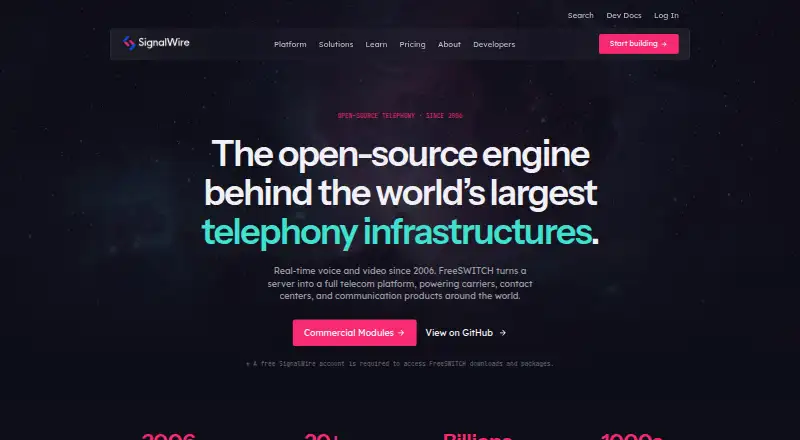
FreeSWITCH is an open-source framework for real-time voice and video communications. It can route calls, bridge video, transcode media, and connect protocols, and is used to power carriers, contact centers, and communication products. The software is available under the MPL license and can run in production at no cost. Its Event Socket exposes call control, channel management, and internal events to external processes over TCP. Integration options include HTTP backends, embedded Lua, Perl, Python, JavaScript, Java, and SignalWire connectivity. The mod_signalwire module connects FreeSWITCH to SignalWire for inbound and outbound PSTN calling over a persistent WebSocket session. Linux setup documentation covers Debian and Ubuntu installations using SignalWire packages or a source build. A free SignalWire account is required to access packages and downloads. Self-hosted deployments need dedicated resources to maintain on-premises infrastructure. Community support is available for the open-source edition; SignalWire offers commercial support, hardened builds, and priority patches through FreeSWITCH Pro. Commercial modules include answering machine detection and licensed G.729 Annex A encoding and decoding.
Good
- Open source under the MPL license.
- Can run in production at no cost.
- Supports call control through the Event Socket.
- Supports inbound and outbound calling.
- Integrates with several languages and backends.
Watch out
- A free SignalWire account is required for downloads.
- Self-hosting requires dedicated infrastructure resources.
- Open-source edition support is community-based.
Who it suits
FreeSWITCH may suit teams building voice or video communication systems that need call routing, media handling, and protocol connections. Self-hosting requires dedicated resources to maintain infrastructure.
Verdict
FreeSWITCH offers a no-cost, open-source foundation for real-time voice and video systems. Teams considering self-hosting should account for the infrastructure maintenance requirement.
Plans and prices
From FreeSWITCH's own pricing page, checked 3 Oct 2026.
| Plan | Price | What it gives you |
|---|---|---|
| FreeSWITCH Open Source | Free | Self-hosted · MPL 2.0 · Community support · Free to download, modify, and run in production |
| FreeSWITCH Advantage | Priced on request | Self-hosted · Commercial modules (G.729A, AMD) · Founder-level support · Talk to SignalWire |
| SignalWire Platform | Priced on request | Cloud-hosted · Programmable layer around FreeSWITCH media engines · Start building |
The facts
Each one read from FreeSWITCH's own pages, with the date it was checked.
What it does
- Call control
- The Event Socket exposes call control, channel management, and the internal event system over TCP to external processes.checked 3 Oct 2026
- Commercial modules
- The commercial modules include answering machine detection and licensed G.729 Annex A encoding and decoding for transcoding.checked 3 Oct 2026
- Downloads
- A free SignalWire account is required to access FreeSWITCH packages and downloads.checked 3 Oct 2026
- Integrations
- FreeSWITCH documents integrations through HTTP backends, embedded Lua, Perl, Python, JavaScript and Java, and SignalWire connectivity.checked 3 Oct 2026
- License
- FreeSWITCH is open source under the MPL license and can be run in production at no cost.checked 3 Oct 2026
- Maintainer
- SignalWire says it was founded by the original FreeSWITCH creators and is the project's primary maintainer.checked 3 Oct 2026
- Operational requirement
- For self-hosting, the maker says teams should have dedicated resources to maintain on-premises infrastructure.checked 3 Oct 2026
- Purpose
- FreeSWITCH is an open-source framework for real-time voice and video that can route calls, bridge video, transcode media, and connect protocols.checked 3 Oct 2026
- Security controls
- FreeSWITCH supports named IP allow and deny network lists that can be used by SIP profiles and the Event Socket.checked 3 Oct 2026
- SignalWire connectivity
- The mod_signalwire module connects FreeSWITCH to SignalWire for inbound and outbound PSTN calling over a persistent WebSocket session.checked 3 Oct 2026
- Support
- The open-source edition has community support, while SignalWire offers commercial support, hardened builds, and priority patches through FreeSWITCH Pro.checked 3 Oct 2026
- Use cases
- The maker describes FreeSWITCH as powering carriers, contact centers, and communication products.checked 3 Oct 2026
The company
- Founded
- 2006checked 28 Sep 2026
Where it runs
- Linux support
- The getting-started guide documents installation on Debian and Ubuntu using SignalWire packages or a source build.checked 3 Oct 2026
The full review of FreeSWITCH
FreeSWITCH is an open-source framework for building real-time voice and video systems, rather than a ready-made calling app. It suits teams that need control over call routing and media processing and can maintain their own infrastructure. Its production license costs nothing, but operating it is a meaningful technical commitment.
Overview
FreeSWITCH brings call routing, video bridging, media transcoding and protocol connectivity into a framework that can serve as the media core of a communications product. It supports inbound and outbound calling, SIP and call recording, and is used in systems such as carriers and contact centers. The project dates to 2006; SignalWire, founded by the original FreeSWITCH creators, is its primary maintainer.
The distinction from a packaged telephony service matters: teams get an open-source foundation they can run in production, but they also take responsibility for deployment and upkeep when self-hosting. The maker recommends dedicating resources to maintaining on-premises infrastructure. Accessing FreeSWITCH packages and downloads requires a free SignalWire account.
Key features
Call control and integration
The Event Socket exposes call control, channel management and internal events over TCP to external processes. That gives engineering teams a route to coordinate FreeSWITCH with other software, though it assumes they can build and maintain the surrounding integration. Documented options include HTTP backends and embedded Lua, Perl, Python, JavaScript and Java.
SignalWire connectivity and security
The mod_signalwire module connects FreeSWITCH to SignalWire for inbound and outbound PSTN calling over a persistent WebSocket session. Named IP allow and deny lists can be applied to SIP profiles and the Event Socket, providing network access controls for those interfaces.
Commercial modules add answering machine detection and licensed G.729 Annex A encoding and decoding for transcoding. These capabilities are not part of the no-cost open-source plan, so teams needing them should consider the commercial offering.
Pricing
FreeSWITCH Open Source — free. The MPL 2.0 edition can be downloaded, modified and run in production at no license cost, with community support. It is the fit for teams comfortable operating a self-hosted system; the trade-off is that commercial modules and commercial support are not included.
SignalWire Platform — custom pricing. This cloud-hosted option provides a programmable layer around FreeSWITCH media engines. It suits teams seeking that hosted layer rather than running the entire system themselves.
FreeSWITCH Advantage — custom pricing. This is self-hosted and includes commercial modules such as G.729A and answering machine detection, along with founder-level support. It is for operators who need those additions and a commercial support path while retaining self-hosting.
The open-source edition has community support. SignalWire offers commercial support, hardened builds and priority patches through FreeSWITCH Pro; teams that require those services should look beyond the community edition.
Platforms
FreeSWITCH supports Linux, macOS and Windows, as well as API and self-hosted use. Its getting-started guide covers Debian and Ubuntu installation through SignalWire packages or a source build. A free SignalWire account is required to access packages and downloads.
Who it's for
FreeSWITCH is best for communications developers and operators building voice or video products who need call and media control and have the engineering capacity to run the platform. Its protocol connectivity, external call-control interface and language integration options make it a flexible foundation. It is a poor fit for teams seeking a turnkey calling application or unwilling to commit people to infrastructure maintenance.
Pros and cons
- Pro: The open-source edition can be modified and used in production at no license cost, giving capable teams room to build around their requirements.
- Pro: Call control, channel management, event access and several documented integration paths support custom communications workflows.
- Pro: Inbound and outbound calling, SIP support and recording cover core telephony needs.
- Con: Self-hosting requires dedicated maintenance resources, raising the operational burden compared with a hosted service.
- Con: The open-source edition relies on community support; commercial modules and enhanced support require a paid commercial route.
- Con: Package access requires a free SignalWire account, adding an account step even for the free edition.
Alternatives
For a broader directory of interactive voice response options, browse Interactive Voice Response Software.
Telnyx Text-to-Speech API is worth considering when the requirement is specifically text-to-speech through an API: it has a free plan with a $0 monthly minimum, standard usage rates, automatic tier discounts and no contract. FreeSWITCH is the broader self-hosted voice and video framework.
Voicent may fit teams looking for a campaign-oriented telephony option with a defined allowance: its free plan covers 100 minutes or texts, while Starter is $179 a month for 6,500 minutes or texts per month and unlimited campaigns. FreeSWITCH instead offers a no-cost framework without those stated usage quotas.
Twilio Studio is an alternative for teams building flows through an API or web interface: its free tier includes 1,000 flow executions per month, with pay-as-you-go beyond that. FreeSWITCH is better suited to teams seeking a self-hosted media engine rather than a flow-execution service.
NCH IVM Telephone Answering Attendant is another option for Linux or Windows; consider it when a telephone answering attendant is the target rather than a general real-time communications framework.
Plum Fuse is an API and web alternative for teams comparing paid IVR products.
Zappix Visual IVR is an API and web alternative for teams considering paid visual IVR.
BizPlus IVR may suit teams that want a paid IVR plan with a stated entry tier: Launch costs ₹2,499 per month and includes one virtual number, up to five agents, a two-level IVR menu and three months of call recording, among other features. FreeSWITCH is the no-license-cost foundation for teams prepared to self-host.
Ozonetel IVR System is another web-based IVR option, with trial availability.
Verdict
Choose FreeSWITCH if you are building a voice or video system and want an open-source media foundation you can modify and run in production without license fees. Its strongest case is the combination of call control, media capabilities and integration flexibility. Look elsewhere if you need turnkey software or cannot dedicate resources to self-hosting and maintenance.
Getting started
- Create a free SignalWire account to access packages and downloads.
- Choose a self-hosted open-source installation or a SignalWire platform option.
- For Linux, follow the Debian or Ubuntu getting-started path using SignalWire packages or a source build.
- Use the Event Socket or documented integrations to connect external processes and applications.
- Add mod_signalwire for SignalWire connectivity and inbound or outbound PSTN calling.
Limits worth knowing
The open-source plan is free to download, modify, and run in production, with community support. Commercial modules such as answering machine detection and licensed G.729A, along with commercial support, hardened builds, and priority patches, are offered through FreeSWITCH Pro.
Questions
How much does FreeSWITCH cost?
The FreeSWITCH Open Source plan is free. It can be downloaded, modified, and run in production at no cost.
Is FreeSWITCH open source?
Yes. FreeSWITCH is open source under the MPL license.
What platforms does it support?
Listed platforms are API, Linux, macOS, self-hosted, and Windows. Linux setup documentation covers Debian and Ubuntu.
What support is available?
The open-source edition has community support. FreeSWITCH Pro offers commercial support, hardened builds, and priority patches.
What integrations does FreeSWITCH offer?
Documented options include HTTP backends, embedded Lua, Perl, Python, JavaScript, Java, and SignalWire connectivity.
How do I access the downloads?
A free SignalWire account is required to access FreeSWITCH packages and downloads.
Alternatives to FreeSWITCH
- 1

Telnyx SIP Trunking
Free planAndroidiOSWebAPI8.0Free plan - 2

Callr
AndroidiOSWebAPI7.6From €599 a month - 3
D7 Networks
Free planWebAPI7.5$0.01 one-time - 4

Wazo Platform
Free planAndroidiOSWebAPI7.5Free plan - 5

46elks
Free planWebAPI7.0From €3 a month - 6

Amazon Chime SDK PSTN Audio
Free planAndroidiOSWebAPI6.9Free plan