FORMNA
FORMNA is a self-hosted form builder and program management platform for handling submissions, review workflows, and reports.
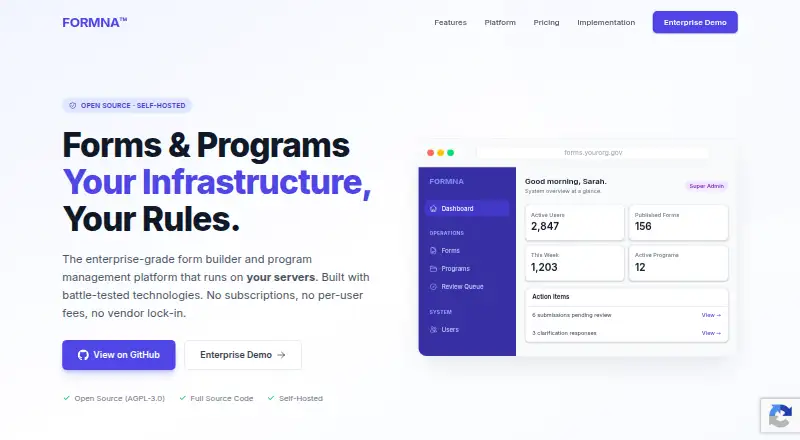
What FORMNA is
FORMNA is a self-hosted form builder and program management platform for handling submissions, review workflows, and reports. Its drag-and-drop builder supports 15 field types, conditional logic, validation, file uploads, draft auto-save, and version management. Programs can group forms with deadlines, submission rules, instructions, eligibility requirements, and permissions. Multi-stage reviews support assigned reviewers, weighted scoring, clarification requests, and approve, reject, or advance decisions. Four roles—Super Admin, Admin, Reviewer, and User—have scoped permissions and tailored dashboards. Security features include TOTP multi-factor authentication, encrypted data at rest, rate limiting, and session invalidation; actions are logged with who, what, and when. Optional AI summaries use a configurable provider while data remains on the organization's servers. Installation is documented for Docker or bare metal and requires PHP 8.2+, MySQL 8.0+ or MariaDB 10.6+, and Apache or Nginx. The open-source plan is free for qualifying organizations; specified commercial uses require licensing. Enterprise Annual License pricing is $25,000 per year.
Good
- Self-hosted deployment keeps AI-summary data on organization servers.
- Review workflows support weighted scores and clarification requests.
- Actions are logged with who, what, and when.
- Four roles have scoped permissions and tailored dashboards.
- Open-source plan is free for qualifying organizations.
Watch out
- Requires PHP 8.2+ and MySQL or MariaDB.
- Specified commercial uses require a license.
- Enterprise Annual License costs $25,000 per year.
Who it suits
FORMNA is aimed at government, enterprise, universities, healthcare, and financial-services organizations managing structured applications or reviews. It suits teams able to self-host and meet its installation requirements.
Verdict
FORMNA combines form creation with program administration, review decisions, and audit logs. Organizations should check whether they qualify for the open-source plan or need commercial licensing, and confirm they can support the documented deployment requirements.
Plans and prices
From FORMNA's own pricing page, checked 30 Sep 2026.
| Plan | Price | What it gives you |
|---|---|---|
| Open Source | Free | AGPL-3.0 · self-hosted · all features included · qualifying organizations · Free |
| Annual Maintenance | $2,500 a year | lifetime license holders only · security patches · upgrades · priority support · $2,500 / year |
| Enterprise Annual License | $25,000 a year | commercial use · priority support · implementation assistance · custom feature development · unlimited users & modifications · $25,000 / year |
| Enterprise Lifetime License | $67,500, paid once | commercial use · indefinite use · implementation assistance · priority support · custom feature development · unlimited users & modifications · $67,500 one-time |
The facts
Each one read from FORMNA's own pages, with the date it was checked.
What it does
- Access control
- FORMNA provides four roles—Super Admin, Admin, Reviewer, and User—with scoped permissions and tailored dashboards.checked 30 Sep 2026
- AI summaries
- Optional organization-level AI summaries use a configurable LLM provider while keeping data on the organization’s servers.checked 30 Sep 2026
- Auditability
- Every action is logged with who, what, and when, and submissions can be exported in CSV format.checked 30 Sep 2026
- Deployment
- The repository documents Docker and bare-metal installation with PHP 8.2+, MySQL 8.0+ or MariaDB 10.6+, and Apache or Nginx.checked 30 Sep 2026
- Form builder
- The drag-and-drop builder supports 15 field types, conditional logic, validation rules, regex patterns, file uploads, auto-save drafts, and version management.checked 30 Sep 2026
- Implementation
- Enterprise implementation pricing includes remote setup for up to 25 forms at $8,000—$15,000, additional form migration at $150—$300 per form, and additional training at $1,000—$1,500 per session.checked 30 Sep 2026
- Integrations
- Outgoing webhooks support submission events, automatic retries, delivery logs, SSRF-safe URL validation, and SMTP or SES email.checked 30 Sep 2026
- Languages
- The system includes English and Arabic plus French, Spanish, German, and Danish translations, with custom language support and full LTR and RTL support.checked 30 Sep 2026
- Program management
- Programs can bundle forms with deadlines, submission rules, instructions, eligibility rules, and custom permissions.checked 30 Sep 2026
- Purpose
- FORMNA is a self-hosted form builder and program management platform for managing forms, submissions, review workflows, and reports.checked 30 Sep 2026
- Review workflows
- Multi-stage reviews support assigned reviewers, weighted scoring, configurable actions, clarification requests, and approve, reject, or advance decisions.checked 30 Sep 2026
- Security
- Security features include TOTP multi-factor authentication, per-role MFA policies, encrypted data at rest, CSRF protection, IP-based rate limiting, and cross-device session invalidation.checked 30 Sep 2026
- Support
- Open-source users receive community support via GitHub, while commercial licensing includes priority support and maintenance.checked 30 Sep 2026
- Target organizations
- FORMNA is presented for government, enterprise, universities, healthcare, and financial-services organizations, with commercial licensing required for enterprises with revenue of at least $1M, healthcare providers, financial-services firms, public or commercial government use, and SaaS deployments.checked 30 Sep 2026
The full review of FORMNA
FORMNA is a self-hosted platform for building forms and running structured programs from submission through review and reporting. It is aimed at organizations with demanding intake or application processes, especially those able to operate their own infrastructure. The trade-off is clear: unusually broad workflow and control features come with deployment responsibility and, for many commercial users, a substantial license bill.
Overview
FORMNA combines a form builder with program rules, review decisions, reporting, and a permanent action history. That makes it more suitable for grants, regulated applications, institutional admissions, and other processes where eligibility, permissions, and accountability matter than for a quick public survey. Self-hosting gives an organization control over its environment and data, but it also makes installation, upgrades, security operations, and availability its responsibility.
Key features
The drag-and-drop builder supports 15 field types, conditional logic, validation rules, regex patterns, file uploads, auto-save drafts, and version management. Branching and validation can enforce detailed application requirements, while saved drafts help with lengthy submissions. Version management is valuable when a form changes over time, preserving a more controlled process than repeatedly editing a live questionnaire.
Programs bundle forms with deadlines, submission rules, instructions, eligibility rules, and custom permissions. Multi-stage review workflows support assigned reviewers, weighted scoring, configurable actions, clarification requests, and approve, reject, or advance decisions. This is a meaningful advantage for selection committees and approval chains: the system can represent a defined process instead of leaving decisions to email and spreadsheets.
Four roles—Super Admin, Admin, Reviewer, and User—provide scoped permissions and tailored dashboards. Security controls include TOTP multi-factor authentication, policies that can require MFA by role, encryption at rest, CSRF protection, IP-based rate limiting, and invalidation of sessions across devices. Every action records who did what and when, and submissions can be exported to CSV, giving administrators a practical audit trail and a portable reporting format.
Optional organization-level AI summaries can use a configurable LLM provider while keeping data on the organization’s servers. Outgoing webhooks cover submission events with automatic retries, delivery logs, and SSRF-safe URL validation; SMTP and SES support email delivery. English and Arabic are included alongside French, Spanish, German, and Danish translations, with custom language support and both left-to-right and right-to-left layouts.
Pricing
The Open Source plan costs nothing and is billed Free under AGPL-3.0. It is self-hosted, includes all features, and is for qualifying organizations. That can be an excellent route for eligible institutions with the technical staff to run the software, but it is not a general commercial-use grant.
Annual Maintenance costs $2,500 a year and is available to lifetime license holders. It adds security patches, upgrades, and priority support, making it an operating budget for organizations that already bought a perpetual license rather than an entry plan.
The Enterprise Annual License is $25,000 a year. It covers commercial use, priority support, implementation assistance, custom feature development, and unlimited users and modifications. The Enterprise Lifetime License costs $67,500.00 USD once and provides indefinite commercial use with the same implementation, support, custom-development, user, and modification allowances. Enterprises should also budget for implementation: remote setup for up to 25 forms costs $8,000–$15,000, additional form migration $150–$300 per form, and additional training $1,000–$1,500 per session.
Commercial licensing is required for enterprises with revenue of at least $1 million, healthcare providers, financial-services firms, public or commercial government use, and SaaS deployments. Open-source users receive community support through GitHub; commercial customers receive priority support and maintenance.
Platforms
FORMNA runs self-hosted on the web. The documented deployment options are Docker and bare metal, using PHP 8.2 or newer, MySQL 8.0 or newer or MariaDB 10.6 or newer, and Apache or Nginx. This suits organizations that need infrastructure control, but it is a poor fit for teams seeking a vendor-managed, hands-off service.
Who it's for
Government bodies, enterprises, universities, healthcare organizations, and financial-services firms are the intended audience, provided they can meet the licensing and operational requirements. It is particularly compelling where forms, eligibility, staged review, and audit records must live in one controlled system. Small teams with simple collection needs, or organizations without PHP and database administration capacity, should look to a hosted alternative.
Pros and cons
Pros
- End-to-end process coverage: Forms, program rules, review decisions, reports, and audit logs are integrated.
- Deep workflow controls: Conditional routing, weighted scoring, clarification requests, and configurable decisions support formal approvals.
- Strong governance: Scoped roles, role-based MFA policies, encryption, and who-what-when logs address accountability requirements.
- Deployment flexibility: Docker or bare-metal installation and multilingual LTR/RTL support accommodate varied environments.
Cons
- Operational burden: Self-hosting leaves infrastructure, updates, and security operations to the organization.
- High commercial cost: A $25,000 annual license or $67,500 lifetime license is far beyond lightweight form tools.
- Implementation can add materially: Setup, migration, and training fees may be necessary for a serious rollout.
- Eligibility constraints: The free AGPL plan is limited to qualifying organizations, while several major sectors require commercial licensing.
Alternatives
For a broader shortlist, see Nonprofit Program Management Software and Form Automation Software.
KoNote is a free, MIT-licensed self-hosted option for organizations that want to run and secure their own instance without FORMNA’s commercial license structure. Alleviate ImpactOps OS is a web-based freemium alternative, with a free Starter plan and a $150-per-month Growth plan. eSuivi offers self-hosted, web, and API access, including a free Starter plan for up to two users and one project. Kinaki is a freemium web option for teams considering a hosted impact-measurement product. Kindora provides a forever-free web Starter tier for up to five team members. Salesforce Nonprofit Cloud is a hosted commercial ecosystem with eligible nonprofits receiving 10 free licenses through its Power of Us Program. OpenSPP SP-MIS is a free option spanning API, desktop, web, and self-hosted deployments. TraxSolutions is a paid alternative for Android, iOS, and web.
Verdict
Choose FORMNA when your organization needs self-hosted control over complex forms, eligibility rules, multi-stage approvals, and auditability in one platform. Its main reason to look elsewhere is the combination of infrastructure ownership and high commercial licensing costs; teams wanting a managed service or simpler intake should choose a lighter alternative.
Alternatives to FORMNA
- 1
Salesforce Nonprofit Cloud
Free planAndroidiOSWebAPI8.1From $70 a month - 2

ActivityInfo
AndroidiOSWebAPI7.7From €545 a year - 3

eSuivi
Free planWebAPISelf-hosted7.3From $229 a year - 4
KoNote
Free planOpen sourceWebLinuxSelf-hosted7.2Free plan - 5

CharityTracker
WebAPI7.1From $216 a year - 6
Hibox for Nonprofits
AndroidiOSWeb7.1From $99 a month