KoNote
KoNote is a free, web-based participant outcome management system for nonprofits.
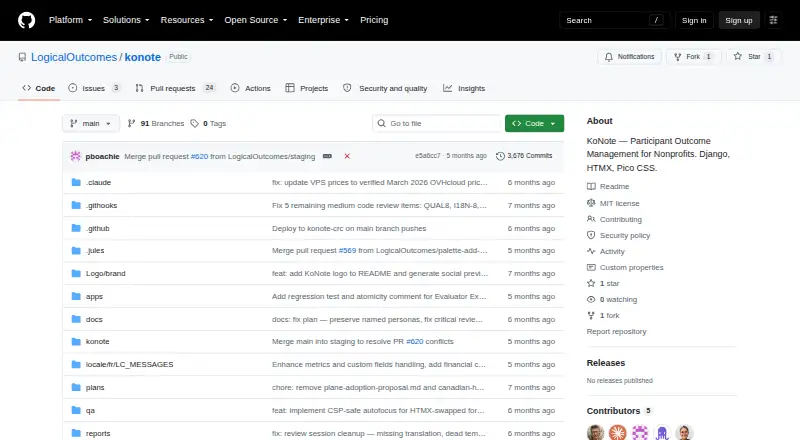
What KoNote is
KoNote is a free, web-based participant outcome management system for nonprofits. Each organization runs its own instance on its infrastructure or local network. It provides encrypted client records, custom intake fields, program enrollment tracking, and role-based client search. Teams can set goals and targets, attach measurable indicators, track revisions, and reuse plan templates. Progress notes may be quick or structured with templates, include metric recording, and be backdated with audit trails. Messaging supports SMS through Twilio and email through SMTP, with consent tracking; calendar subscriptions use iCal feeds. Authentication can use Azure AD single sign-on or local Argon2 authentication. Security features include field-level personal information encryption, role-based access control, configurable session timeouts, and a separate immutable audit database. KoNote also offers selectable CSV or PDF client exports, monitored exports, multi-manager erasure approval, and secure download links for privacy processes. Optional AI can suggest goals, metrics, note structures, and outcome narratives; personal information is scrubbed before data leaves the server. The project uses the MIT License. Organizations configure and secure their own infrastructure.
Good
- Free MIT-licensed software.
- Tracks goals, metrics, and revisions over time.
- Supports consent-tracked SMS and email.
- Provides encrypted records and audit trails.
Watch out
- Each organization must run its own instance.
- Organizations configure and secure their infrastructure.
- No mobile access is listed.
Who it suits
KoNote suits nonprofits that need to track participant records, program enrollment, goals, outcomes, and progress notes. It is for organizations able to run and secure their own instance.
Verdict
KoNote combines participant record management and outcome tracking with privacy and audit features. Its self-hosted model means organizations must take responsibility for their own infrastructure.
Plans and prices
From KoNote's own pricing page, checked 15 Oct 2026.
| Plan | Price | What it gives you |
|---|---|---|
| Self-hosted KoNote | Free | Run on your own infrastructure · Python 3.12+ · PostgreSQL 16+ · Git · Docker-capable deployment · No subscription price is published; hosting infrastructure is separate |
| Self-hosted MIT-licensed KoNote | Free | run your own instance · organization configures and secures infrastructure |
The facts
Each one read from KoNote's own pages, with the date it was checked.
What it does
- Access control
- Role-based access is program-scoped, with middleware, decorators and view filtering enforcing restrictions.checked 15 Oct 2026
- Accessibility
- The README says KoNote follows WCAG 2.2 AA practices including semantic HTML, labels, keyboard navigation, contrast and screen-reader support.checked 15 Oct 2026
- AI features
- Optional AI tools suggest goals, metrics, note structures and outcome narratives; personally identifying information is scrubbed before external processing.checked 15 Oct 2026
- API and SDK status
- The public repository describes integrations and AI API-key configuration but does not publish a standalone REST API, SDK or API reference.checked 15 Oct 2026
- Authentication
- Authentication can use local Argon2 credentials or Azure AD single sign-on.checked 15 Oct 2026
- Automatic security checks
- Production startup blocks when encryption keys, secret keys or security middleware are unsafe; demo mode only warns.checked 15 Oct 2026
- Calendar integration
- Meetings can publish privacy-safe iCal feeds for Outlook, Google Calendar and Apple Calendar and send reminders.checked 15 Oct 2026
- Calendar integrations
- Users can subscribe to iCal feeds in Outlook, Google Calendar, or Apple Calendar.checked 30 Sep 2026
- Client records
- It stores encrypted participant records, agency-defined intake fields, program enrolments and role-controlled search.checked 15 Oct 2026
- Customisation
- Administrators can change terminology, enable feature toggles, define custom fields, build templates and configure programs.checked 15 Oct 2026
- Deployment model
- Each organization runs its own KoNote instance on its own infrastructure or local network.checked 30 Sep 2026
- Deployment requirements
- The documented prerequisites are Python 3.12 or newer, PostgreSQL 16 or newer and Git; Docker Compose is supplied for deployment.checked 15 Oct 2026
- Documentation
- Repository documentation is organized into deployment, administration, frontline usage and technical-reference guides, with a separate backup and restore runbook.checked 15 Oct 2026
- Independent history
- Canadian Healthcare Technology reports that Gotlib launched KoNote in 2014 after finding existing mental-health EMRs too structured.checked 15 Oct 2026
- Licence
- The repository is released under the MIT License, allowing use, modification, distribution and sublicensing subject to the license notice.checked 15 Oct 2026
- License
- KoNote is released under the MIT License, which grants permission free of charge to use, copy, modify, publish, distribute, sublicense, and sell copies.checked 30 Sep 2026
- Limit: audit storage
- The security documentation warns that the audit database grows continuously and requires periodic archival planning.checked 15 Oct 2026
- Limit: demo security
- The Docker demo uses default keys and is explicitly unsuitable for real client data.checked 15 Oct 2026
- Limit: encrypted search
- Encrypted PII cannot be searched in SQL; the documented in-memory search approach is considered acceptable only up to about 2,000 clients.checked 15 Oct 2026
- Limit: external documents
- When documents link to SharePoint or Google Drive, access control on those external systems is separate from KoNote.checked 15 Oct 2026
The company
- Company facts
- LinkedIn lists LogicalOutcomes as a Toronto nonprofit with 11–50 employees founded in 2013.checked 15 Oct 2026
- Company finances
- LogicalOutcomes' 2021 annual report says revenue was under $1 million and therefore did not require a statutory financial audit.checked 15 Oct 2026
- Founded
- 2013checked 28 Sep 2026
- Headquarters
- Toronto, Ontario, Canadachecked 28 Sep 2026
The full review of KoNote
Overview
KoNote is a web-based participant outcome management system for nonprofits, designed for organizations that need to manage client records and track progress against goals. It is best suited to teams prepared to run and secure their own software infrastructure. Its MIT license makes the software free to use and adapt, but hosting and operational responsibility remain with the organization.
Key features
KoNote brings participant records, program enrollment and outcome tracking together. Teams can encrypt client records, create custom intake fields and control client search by role. For organizations with varied programs or reporting needs, configurable fields and enrollment tracking offer a more tailored record system than a fixed intake process.
Outcome plans support targets, goals and quantifiable metrics, with revisions tracked over time and templates reusable across plans. Notes can be quick or structured with templates, and can record metrics. Backdated notes retain audit trails, a useful safeguard when staff need to enter earlier work without losing the history of changes.
Messaging can run through Twilio for SMS and SMTP for email, with consent tracking. Calendar feeds can be subscribed to in Outlook, Google Calendar or Apple Calendar. Authentication can use Azure AD single sign-on or local accounts secured with Argon2. Optional AI can help build goals, suggest metrics and note structures, and draft outcome-insight narratives; PII is scrubbed before data leaves the server. That makes these features potentially useful for drafting while keeping personal identifiers out of outbound AI requests.
Privacy and oversight are central strengths: field-level PII encryption, role-based access, configurable session timeouts, web security protections and a separate immutable audit database support careful handling of sensitive records. CSV and PDF client exports, export monitoring, secure download links and multi-manager approval for erasure address PIPEDA and GDPR workflows. Organizations still need the expertise to configure and maintain their own deployment.
Pricing
Self-hosted MIT-licensed KoNote: free. The plan includes the software under the MIT License, which permits use, modification and distribution, including selling copies. There is no paid KoNote plan in this offering; each organization runs its own instance and configures and secures the infrastructure. The zero software price therefore does not remove the work of operating a server or local-network deployment.
Platforms
KoNote is available on the web and is self-hosted on Linux. It supports a participant portal, forms and surveys, and reporting dashboards. There is no mobile access, so teams needing a dedicated mobile experience should look elsewhere.
Who it's for
KoNote fits nonprofits that need structured participant records, outcome plans, progress notes and privacy controls, and have the capacity to manage their own infrastructure. LogicalOutcomes, its maker, is a Canadian nonprofit focused on evaluation consulting and organizational learning capacity, a focus aligned with KoNote’s outcome-tracking capabilities. Organizations seeking vendor-managed hosting or mobile access should consider another system.
Pros and cons
- Pros: Configurable intake, reusable outcome-plan templates and metric tracking support programs that need more than basic participant lists.
- Pros: Field-level encryption, immutable audit records and multi-manager erasure approval give teams meaningful controls for sensitive client information and privacy workflows.
- Pros: The MIT license allows organizations to adapt and redistribute the software without a license fee.
- Cons: Each organization must host, configure and secure its own instance, making infrastructure capability a prerequisite rather than an optional extra.
- Cons: No mobile access limits its fit for teams that need staff to work through a mobile app.
Alternatives
Browse Nonprofit Program Management Software for more options. Choose Alleviate ImpactOps OS if you want a web-based alternative with a free plan or a Growth plan at $150 a month; that plan includes three programmes and 25 funding alerts per month. Kinaki is another web-based option, with a free plan and free trial, for teams considering a MEAL-focused provider brought to users by social enterprise Salanga.
FORMNA may suit organizations seeking a self-hosted, web-based open-source alternative: its Open Source plan is free for qualifying organizations, with all features included under AGPL-3.0; annual maintenance is $2,500 a year. Salesforce Nonprofit Cloud offers eligible nonprofits 10 free licenses through its Power of Us Program and a free trial, making it worth considering when those licenses fit the organization’s needs. Hibox for Nonprofits is a paid option with Android, iOS and web access; its Starter plan is $99 a month for up to five staff users, unlimited participants and parents or guardians, and 5GB of storage.
eSuivi is another web-based option with a free plan. LiveImpact is a paid web-based alternative whose Starter plan is $150 a month, billed annually. MELR is another web-based option with a free plan.
Verdict
Choose KoNote if your nonprofit needs configurable participant records, outcome tracking and strong privacy controls, and can take responsibility for self-hosting. Its free, adaptable software is compelling for infrastructure-ready teams; organizations that need mobile access or do not want to operate their own deployment should choose another tool.
Getting started
- Open the KoNote GitHub website.
- Prepare Linux or other self-hosted infrastructure on your own network.
- Run your organization's own KoNote instance and configure its infrastructure.
- Choose Azure AD single sign-on or local Argon2 authentication.
Limits worth knowing
The free plan is self-hosted, so the organization configures and secures its own infrastructure. KoNote has no mobile access listed.
Questions
Is KoNote free?
Yes. The self-hosted MIT-licensed plan is free.
Which platforms does KoNote support?
The listed platforms are Linux, self-hosted, and web. Mobile access is listed as none.
Is KoNote open source?
Yes. KoNote is released under the MIT License.
Who makes KoNote?
LogicalOutcomes is a Canadian nonprofit focused on evaluation consulting and building organizational learning capacity.
Can KoNote connect to calendars and messaging services?
It supports SMS through Twilio, email through SMTP, and calendar subscriptions through iCal feeds for Outlook, Google Calendar, or Apple Calendar.
Does KoNote offer AI features?
Optional AI features can suggest goals, metrics, note structures, and outcome narratives. PII is scrubbed before data leaves the server.
Alternatives to KoNote
- 1
Salesforce Nonprofit Cloud
Free planAndroidiOSWebAPI8.1From $70 a month - 2

ActivityInfo
AndroidiOSWebAPI7.7From €545 a year - 3

eSuivi
Free planWebAPISelf-hosted7.3From $229 a year - 4

CharityTracker
WebAPI7.1From $216 a year - 5
Hibox for Nonprofits
AndroidiOSWeb7.1From $99 a month - 6
FORMNA
Free planWebSelf-hosted6.8From $25,000 a year