
Fibery
Fibery is a platform for connecting company work and information in one workspace.
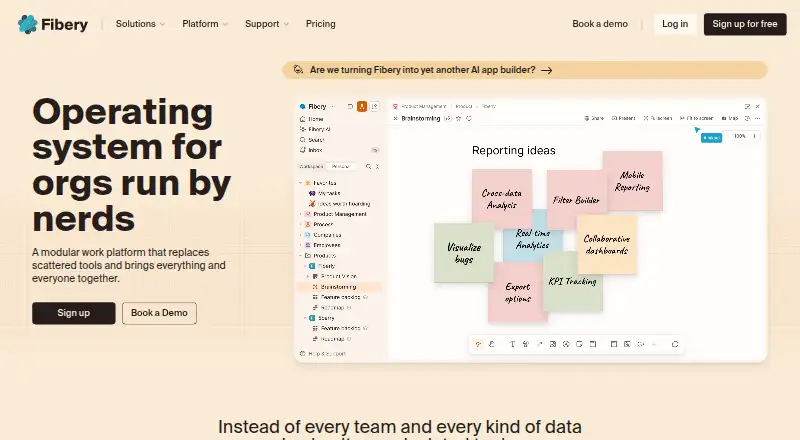
What Fibery is
Fibery is a platform for connecting company work and information in one workspace. Teams can model processes with custom entities, fields, and relations, then build databases, views, formulas, reports, and automations. Its views include Board, Timeline, Gantt, Table, List, Calendar, Gallery, Feed, and Map, alongside collaborative documents and whiteboards. Fibery names product and software development teams, digital agencies, and startups among its audiences. Integrations include Slack, GitLab, GitHub, Jira, Trello, Airtable, ClickUp, Discourse, HubSpot, Braintree, Intercom, Make, and Zapier; users can also create custom integration templates. It offers an API, custom apps, and an MCP server for AI agents to query data, create or update entities, and build reports. Access is available through web, Windows and macOS desktop apps, iOS and Android apps, and Chrome and Firefox extensions. The free plan has limits on users, guests, databases, storage, and version history.
Good
- Offers timeline, Gantt, and calendar views.
- Supports custom entities, fields, and relations.
- Provides web, desktop, mobile, and browser extension access.
- Includes an API and workflow automation.
Watch out
- Free plan is limited to 10 databases.
- Free plan includes 1 GB file storage.
- Enterprise requires at least 25 paid users.
Who it suits
Fibery suits teams that want configurable workspaces for processes, records, reporting, and automation. Its stated audiences include product teams, software development teams, digital agencies, and startups.
Verdict
Fibery combines configurable data structures, multiple views, and collaboration tools in a single workspace. Compare the free plan’s limits with paid options and the 14-day trial.
Plans and prices
From Fibery's own pricing page, checked 14 Oct 2026.
| Plan | Price | What it gives you |
|---|---|---|
| Free | Free | up to 10 users · 10 databases · unlimited entities · 1 GB storage |
| Standard | €12 a month | per user · unlimited databases · AI · charts · whiteboards · human support · billed annually |
| Pro | €20 a month | per user · custom apps · advanced permissions · JavaScript automations · unlimited version history · billed annually |
| Enterprise | €40 a month | per user · unlimited automations · unlimited integrations · SAML SSO · SCIM · regional data residency · billed annually |
The facts
Each one read from Fibery's own pages, with the date it was checked.
What it does
- AI data use
- Fibery says content submitted to its AI features is not used by Fibery or its AI providers to train AI models.checked 9 Oct 2026
- AI features
- Fibery AI provides workspace questions, natural-language workspace building, text assistance, semantic search and audio/video transcription.checked 14 Oct 2026
- API
- The developer documentation describes an HTTP API for querying, creating and updating workspace data.checked 14 Oct 2026
- Audience
- Fibery presents the product for teams and organizations, including product teams, software development teams, digital agencies, and startups.checked 9 Oct 2026
- Automations
- Automation rules, buttons and JavaScript scripted actions can update Fibery and call external APIs.checked 14 Oct 2026
- Compliance
- Fibery says it has a SOC 2 Type II report and is committed to GDPR compliance.checked 9 Oct 2026
- Custom integration SDK
- Fibery offers a custom integrations SDK for building connectors that synchronize data from other tools.checked 14 Oct 2026
- Custom workspace
- Users can model processes with custom entities, fields, and relations, and create databases, views, formulas, reports, and automations.checked 9 Oct 2026
- Desktop and mobile
- Official downloads are provided for macOS and Windows, with web, iOS and Android access also offered.checked 14 Oct 2026
- Documentation and support
- Support channels include a user guide, community forum, chat, email, webinars, videos and live help.checked 14 Oct 2026
- Documents
- Collaborative documents support real-time editing, comments, embeds, linked entities, table of contents and change history.checked 14 Oct 2026
- Formulas
- Formula fields can calculate metrics across related entities and hierarchies, including measures such as MRR and cycle time.checked 14 Oct 2026
- Google Play listing
- The Google Play listing shows 1K+ downloads but no aggregate star rating in the opened page.checked 14 Oct 2026
- Hosting and encryption
- Fibery runs on AWS, encrypts web traffic with TLS, encrypts data at rest and uses AWS RDS backups.checked 14 Oct 2026
- Hosting and security
- Fibery says its servers run on AWS, web communications use TLS, and data is encrypted at rest.checked 9 Oct 2026
- Integrations
- Native or supported connectors include Slack, GitHub, GitLab, Jira, Trello, Airtable, ClickUp, Discourse, HubSpot, Intercom, Zendesk, Make and Zapier.checked 14 Oct 2026
- Legal entity and funding
- Crunchbase identifies Fibery Inc. as the legal name, lists Nicosia, Cyprus as headquarters, and names Tal Ventures and AltaIR Capital as investors.checked 14 Oct 2026
- Licence
- The Fibery service itself is proprietary; a company representative said Fibery had no intention to open source it.checked 14 Oct 2026
- Limit: learning curve
- Review summaries say Fibery's flexibility can make setups complicated and that new users face a learning curve.checked 14 Oct 2026
- Limit: missing workflow controls
- GetApp's review analysis reports complaints about missing required fields and fine-grained workflow capabilities.checked 14 Oct 2026
Where it runs
- Apps and AI
- Fibery lists custom apps and an MCP server that can connect AI agents to query data, create or update entities, and build reports.checked 9 Oct 2026
The company
- Company facts
- LinkedIn lists Fibery as privately held, founded in 2017, headquartered in Nicosia and employing 11–50 people.checked 14 Oct 2026
- Founded
- 2016checked 28 Sep 2026
- Headquarters
- Cypruschecked 28 Sep 2026
The full review of Fibery
Fibery is a configurable workspace that connects company information and work through databases, views, documents, and automation. It suits product, software-development, agency, and startup teams willing to design their own processes. Its breadth is valuable for varied workflows, but a simpler task manager is a better fit when extensive configuration is unnecessary.
Overview
Fibery lets teams define custom entities, fields, and relationships, then build databases, formulas, reports, and automations around them. This structure can reflect different departments and processes instead of forcing everyone into one project template. The tradeoff is organizational effort: teams must decide how information should be modeled and maintained.
Structured data sits alongside collaborative documents and whiteboards, dashboards, and numerous work views. That combination is strongest when planning, reference material, and reporting need to connect. For straightforward task lists, its capabilities may exceed what a small team needs.
Key features
Configurable data and views
Custom entities, fields, and relations support tailored databases. Board, Timeline, Gantt, Table, List, Calendar, Gallery, Feed, and Map views let teams present the same information in different ways. Formulas, dashboards, reports, timeline views, custom fields, and workflow automation extend the workspace from record keeping into planning and analysis. This breadth suits processes that do not fit a fixed project structure, though it can make initial design more involved.
Collaboration and connections
Collaborative documents and whiteboards keep discussion and visual work near structured records. Integrations include Slack, GitLab, GitHub, Jira, Trello, Airtable, ClickUp, Discourse, HubSpot, Braintree, Intercom, Make, and Zapier, with custom integration templates for specialized setups. The API can connect external systems, create workflows, and automate routine tasks, making Fibery more suitable for teams with integration requirements than for isolated personal use.
Apps, AI, and protection
Custom apps and an MCP server allow AI agents to query data, create or update entities, and build reports. Fibery says content sent to its AI features is not used by Fibery or its AI providers to train AI models. Servers run on AWS, communications use TLS, and data is encrypted at rest. A SOC 2 Type II report and a commitment to GDPR compliance support organizations with formal security expectations.
Pricing
Fibery uses a freemium model. The Free plan costs nothing and allows up to 10 users plus 10 guests, 10 databases, unlimited entities, 1 GB of file storage, and 14-day version history. It is a useful way for a small team to establish a workspace, but the database, storage, and history caps can constrain growing projects.
Standard costs €12 a month, billed annually. It adds unlimited users, databases, entities, and file storage, with 90-day version history; observers and guests are free, and human support is included. This is the practical choice for teams that need room to grow without retaining every historical version indefinitely.
Pro costs €20 a month, billed annually, and keeps the same unlimited user, database, entity, and storage allowances while adding unlimited version history. Choose it when retaining a complete record of changes matters. Enterprise costs €40 a month, billed annually, requires at least 25 paid users, and includes unlimited version history plus the same unlimited core allowances. It is aimed at larger organizations rather than small groups.
A 14-day trial provides a limited period to assess paid capabilities before committing. Annual billing applies to the published paid prices.
Platforms
Fibery provides a web app, desktop applications for macOS and Windows, mobile apps for iOS and Android, and Chrome and Firefox extensions. An API supports connections from external systems, giving teams options across desktop, mobile, browser, and integration workflows.
Who it's for
Product teams can connect roadmaps, requirements, and reporting in one model. Software-development teams benefit from links to GitHub, GitLab, and Jira, while digital agencies and startups can adapt entities and views as their processes change. Teams that want a predefined, minimal task board should look elsewhere; Fibery rewards deliberate workspace design.
Pros and cons
- Pro: Custom entities, fields, and relations let teams represent specialized processes instead of adapting to a rigid template.
- Pro: Many views, documents, whiteboards, dashboards, and reports keep operational and reference work together.
- Pro: Broad integrations, custom templates, an API, and MCP-based AI connectivity support connected workflows.
- Pro: Paid plans remove the Free plan's database, user, storage, and history ceilings.
- Con: The flexibility requires teams to design and govern their own information model.
- Con: Free users face 10 databases, 1 GB storage, and only 14-day history, which may become restrictive quickly.
- Con: Enterprise requires at least 25 paid users, excluding smaller organizations from that tier.
Alternatives
Consider KanBo when you want a freemium work manager with task management, Kanban, list, and calendar views, plus broad platform coverage including Linux and self-hosting. Nifty is a better fit for a simpler project setup, with a free plan for unlimited members, 100 MB storage, and two active projects. Choose Asana for conventional project management, including a Personal plan aimed at one or two people. Basecamp suits teams preferring a capped, straightforward free workspace of one project, 1 GB storage, and five users. ClickUp is an alternative when unlimited free-plan members and unlimited tasks matter more than Fibery's custom data model. Hive offers a free tier with up to 10 workspace members, unlimited tasks, and monthly AI credits. Wrike is worth considering for a free plan with unlimited users, 2 GB account storage, and 200 active tasks. Binfire provides a free forever plan with unlimited projects, boards, tasks, and milestones for up to three users.
Browse more options in Work Management Software.
Verdict
Choose Fibery if your team needs one adaptable system for connected data, multiple work views, collaboration, reporting, and automation. Its main advantage is the ability to shape the workspace around real processes; look elsewhere if you want an immediately prescriptive task manager or if the Free plan's storage and history limits are too tight.
Alternatives to Fibery
- 1
EGroupware
Free planOpen sourceAndroidiOSWebAPI8.6From €21.90 a month - 2
Teamwork.com
Free planAndroidiOSWebAPI8.4From $9.99 a month - 3

Wrike
Free planAndroidiOSWebAPI8.4From $10 a month - 4

Hive
Free planAndroidiOSWebAPI8.3From $5 a month - 5

Nifty
Free planAndroidiOSWebAPI8.3Free plan - 6

Asana
Free planAndroidiOSmacOSWindows8.1From $10.99 a month