
ezeep
ezeep is a cloud printing platform for teams that need to print across locations and devices.
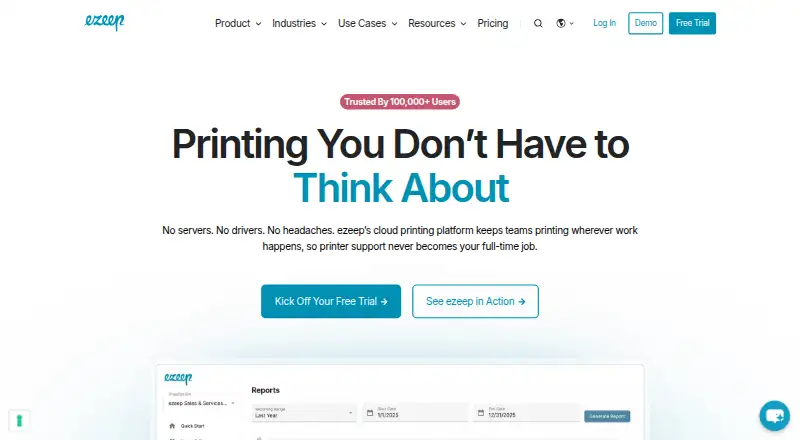
What ezeep is
ezeep is a cloud printing platform for teams that need to print across locations and devices. Its server-free, driverless design removes the need to run print servers or install printer drivers. The service supports Windows, macOS, ChromeOS, iOS, Android, Linux, and web browsers. With Secure Pull Printing, a job waits at the printer until its user authenticates; unreleased jobs are discarded after 72 hours, while released jobs are deleted after printing. Print data is encrypted in transit using HTTPS with TLS 1.2 minimum and at rest with AES-256 through Azure Storage Service Encryption. Integrations include Microsoft 365, Google Workspace, Zapier, Make, Pabbly Connect, Jamf, Zebra, and Lexmark. Its REST API can submit jobs, manage printers and users, and automate document output; an MCP server is also available. The free Personal plan supports up to 10 users and unlimited user print jobs, with 50 API-triggered pages per organization each month.
Good
- Print from Windows, macOS, ChromeOS, iOS, Android, Linux, and browsers
- Secure Pull Printing requires printer-side authentication
- Integrates with Microsoft 365 and Google Workspace
- Free Personal plan allows up to 10 users
Watch out
- Free plan limits API-triggered printing to 50 pages monthly
- Pro and Business plans require 10 users minimum
- Enterprise pricing is not listed
Who it suits
ezeep suits IT teams, developers, hybrid teams, multi-site organizations, shared spaces, and administrators seeking centralized cloud printing. Its free plan is aimed at smaller groups, with paid options for larger connector and API needs.
Verdict
ezeep combines broad device support with printer-side release controls and integrations for common work tools. The free tier covers basic user printing, while API page limits and plan minimums matter when choosing a paid tier.
Plans and prices
From ezeep's own pricing page, checked 30 Sep 2026.
| Plan | Price | What it gives you |
|---|---|---|
| Personal (Free) | Free | Up to 10 users · 1 connector · Unlimited user print jobs · 50 API pages/month per organization |
| Pro | €3.45 a month | 10 users minimum · Up to 10 connectors · 1,000 API pages/month per organization · Support response time up to next business day · Billed monthly; €2.75 per user/month billed annually |
| Business | €5.95 a month | 10 users minimum · Up to 80 connectors · 1,000+ API pages/month per organization; contact for quote for more · Billed monthly; €4.75 per user/month billed annually |
| Enterprise | Priced on request | Unlimited connectors · Custom API package · Custom support package |
The facts
Each one read from ezeep's own pages, with the date it was checked.
What it does
- API quota
- The Personal plan includes 50 API-triggered print pages per month per organization, while regular user printing is unlimited.checked 30 Sep 2026
- Compliance
- ezeep states that its Information Security Management System is ISO/IEC 27001 certified and that it operates under GDPR principles.checked 30 Sep 2026
- Data retention
- Unreleased Pull Printing jobs are discarded after 72 hours, and released jobs are deleted after printing completes.checked 30 Sep 2026
- Deployment
- Its cloud printing platform is designed to remove the need for print servers and printer drivers.checked 30 Sep 2026
- Developer tools
- The REST API can submit print jobs, manage printers and users, and automate document output; an MCP server is also available.checked 30 Sep 2026
- Encryption
- Print data is encrypted in transit over HTTPS with TLS 1.2 minimum and at rest with AES-256 through Azure Storage Service Encryption.checked 30 Sep 2026
- Integrations
- Listed integrations include Microsoft 365, Google Workspace, Zapier, Make, Pabbly Connect, Jamf, Zebra, and Lexmark.checked 30 Sep 2026
- Intended users
- The company describes ezeep for IT teams, developers, hybrid teams, multi-site organizations, shared spaces, and administrators.checked 30 Sep 2026
- Product
- ezeep is a driverless, server-free cloud printing platform for teams printing across locations and devices.checked 30 Sep 2026
- Secure release
- Secure Pull Printing holds print jobs until the user authenticates at the printer.checked 30 Sep 2026
- Support
- The Pro plan includes customer support with a response time up to the next business day.checked 30 Sep 2026
The company
- Founded
- 1999checked 28 Sep 2026
- Headquarters
- Berlin, Germanychecked 28 Sep 2026
Where it runs
- Supported devices
- The product page lists support for Windows, macOS, ChromeOS, iOS, Android, Linux, and web browsers.checked 30 Sep 2026
The full review of ezeep
ezeep is a cloud printing platform for organizations that need to manage printing across locations and devices. It is best suited to IT teams, hybrid workplaces and multi-site organizations that want centralized controls without maintaining print servers or printer drivers. Its free tier makes basic user printing accessible, but API quotas and paid-plan minimums can change the economics for larger or automated deployments.
Overview
ezeep is designed to connect teams and printers through the cloud, removing the need for print servers and printer drivers. That can simplify infrastructure for organizations with users working across offices, shared spaces or different devices, though its value depends on whether a cloud-managed approach fits their print environment.
Secure Pull Printing holds a job until its user authenticates at the printer, a useful safeguard where documents should not sit unattended in an output tray. ezeep states that print data is encrypted in transit over HTTPS with TLS 1.2 minimum and at rest with AES-256 through Azure Storage Service Encryption. Unreleased jobs are discarded after 72 hours, and released jobs are deleted after printing completes. The company says its Information Security Management System is ISO/IEC 27001 certified and it operates under GDPR principles.
Key features
- Printer-side release: Pull Printing requires authentication at the printer before a held job is released. This is a practical control for shared printers and sensitive documents.
- Administrative controls: Print quotas, policy rules and detailed reporting give administrators tools to govern usage rather than simply route jobs.
- Integrations: Connections include Microsoft 365, Google Workspace, Zapier, Make, Pabbly Connect, Jamf, Zebra and Lexmark, covering common productivity, automation and device-management contexts.
- Developer tools: The REST API can submit jobs, manage printers and users, and automate document output; an MCP server is also available. The Personal plan’s 50-page monthly API allowance is modest for recurring automation.
- Mobile printing: Support for Android and iOS extends printing beyond desktop workflows.
Pricing
ezeep has a free Personal plan and a 14-day trial. The free plan supports up to 10 users, one connector, unlimited user print jobs and 50 API-triggered pages per month per organization. It is a strong starting point for ordinary user printing, but the shared API allowance is a clear constraint for automated workflows.
Pro costs €3.45 a month when billed monthly, or €2.75 per user/month billed annually, with a 10-user minimum. It allows up to 10 connectors, 1,000 API pages per month per organization and support with a response time up to the next business day. The annual rate is lower, but the minimum means even a small team pays for at least 10 users.
Business costs €5.95 a month when billed monthly, or €4.75 per user/month billed annually, also with a 10-user minimum. It raises the connector allowance to 80 and includes 1,000+ API pages per month per organization, with a quote required for more. Choose it when the additional connector capacity or API volume justifies the higher rate; the stated support terms are attached to Pro, not Business.
Enterprise has custom pricing, unlimited connectors, and custom API and support packages. It is the tier for organizations that need capacity or support arrangements beyond fixed plans, but requires a quote. The cheaper plans give up connector capacity and, compared with Enterprise, tailored API and support packages.
Platforms
ezeep supports Windows, macOS, Linux, ChromeOS, iOS, Android and web browsers. That breadth is useful for mixed-device teams; the product’s platform list also includes API access and an extension.
Who it's for
ezeep is a sensible fit for IT administrators managing printers across multiple sites, hybrid teams, shared spaces and developers automating print output. Its server-free design and secure release controls are most relevant when reducing print infrastructure and controlling where jobs are collected matter. It is less compelling for a small organization that needs substantial API volume or several connectors but cannot justify a 10-user paid minimum.
Pros and cons
- Pro: Driverless, server-free cloud printing can reduce the infrastructure an organization has to maintain.
- Pro: Printer-side authentication, job deletion rules and stated encryption protections address both release control and data handling.
- Pro: Broad operating-system support and integrations with common work tools suit mixed-device environments.
- Con: Paid Pro and Business plans require at least 10 users, which can make them a poor fit for smaller teams.
- Con: Personal’s 50 API pages per month per organization limits its usefulness for sustained automated printing.
- Con: Business pricing requires a larger commitment than Pro while API volume above the included allowance needs a quote.
Alternatives
For a wider comparison, browse Print Management Software. MyQ X is another freemium option with a free plan and support for self-hosted deployment; consider it if self-hosting is important. Pharos Uniprint is an on-premises print management option for colleges and universities, making it the more relevant choice for that setting.
PrinterLogic is a paid alternative priced by print queue, including usage-based plans for 25–49 or 50–99 queues; compare it when queue-based pricing is a better fit. QZ Tray has a free plan and supports web, desktop and mobile platforms, so it is another option to consider for a no-cost starting point. PaperCut MF is a paid alternative with custom partner quotes and licensing based on devices running embedded MF software; look to it when that licensing model suits your deployment.
Printix is a paid service with a Starter plan at $2.09 a month per user, billed monthly by credit card for 15 to 50 users, and includes the first month free. PrintNode offers a free plan and supports web, Windows, macOS and Linux. Tungsten Power PDF is a paid PDF editor rather than a direct print-management comparison.
Verdict
Choose ezeep if your organization needs cloud-managed printing across locations, broad device support and printer-side release controls, especially when centralized administration or automation is part of the job. The free tier is generous for user printing, but the API page limits and 10-user minimum on paid plans are reasons to look elsewhere if you need heavier automation or a smaller paid deployment.
Getting started
- Visit the ezeep website.
- Choose the free Personal plan or review the paid plans.
- Start the listed 14-day trial if you want to try a trial first.
- Use the platform on a supported device: Windows, macOS, Linux, ChromeOS, iOS, Android or a web browser.
Limits worth knowing
Personal is limited to 10 users, 1 connector and 50 API-triggered print pages per organization per month, although user print jobs are unlimited. Pro requires at least 10 users and includes 1,000 API pages per organization monthly; Business also requires 10 users and includes 1,000+ pages, with larger packages available by quote.
Questions
Is ezeep free?
Yes. The Personal plan is free and supports up to 10 users, 1 connector and unlimited user print jobs.
Is there a free trial?
Yes, a 14-day trial is listed.
Which platforms does ezeep support?
It supports Windows, macOS, Linux, ChromeOS, iOS, Android and web browsers.
What printing integrations and developer options are available?
Listed integrations include Microsoft 365, Google Workspace, Zapier, Make, Pabbly Connect, Jamf, Zebra and Lexmark. The REST API can submit print jobs, manage printers and users, and automate document output; an MCP server is also available.
Alternatives to ezeep
- 1
Print Manager Plus
Free planAndroidiOSWebAPI8.0Free plan - 2
QZ Tray
Free planAndroidiOSWebAPI7.3From $749 a year - 3
PrintNode
Free planWebAPILinuxmacOS7.0From $90 a year - 4

Printix
AndroidiOSWebLinux6.9From $2.09 a month - 5
Microsoft Universal Print
AndroidiOSWebAPI6.8From $90 a month - 6
Print Manager
WebLinuxmacOSWindows6.6$495 one-time