EdgeCase Equalizer
EdgeCase Equalizer is free, open-source practice management software for solo therapists who want to keep their practice data under their control.
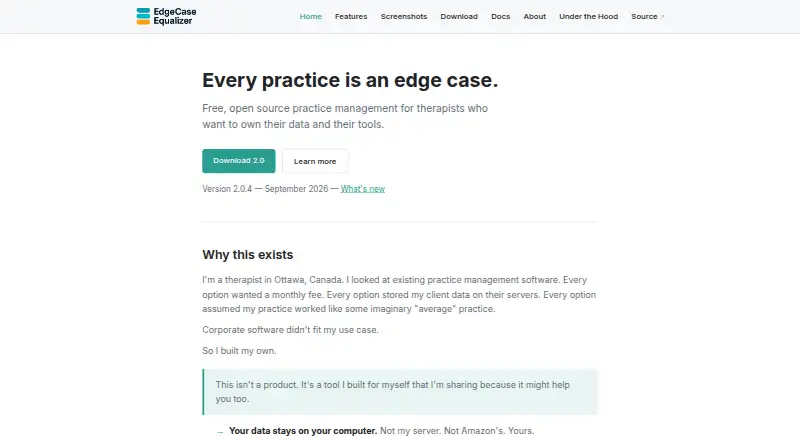
What EdgeCase Equalizer is
EdgeCase Equalizer is free, open-source practice management software for solo therapists who want to keep their practice data under their control. Client records bring sessions, communications, absences, items, and uploads together in a timeline with an edit history. Billing covers per-client fees, sliding scales, guardian splits, couples and family therapy, statements, partial payments, and write-offs. The app also tracks income and expenses, stores receipts, and produces financial reports by category. An optional AI scribe uses a local language model to draft or edit session notes, keeping session content on the computer. Practice data and attachments are encrypted locally, and backups can be stored on the computer or synced to a cloud folder. Appointments can be exported as .ics files or added to Apple Calendar; the user's calendar remains the scheduling source of truth. It runs on Linux and macOS, but is designed for one practitioner on one computer without multi-user support or a cloud service.
Good
- Free plan with no subscription.
- Client files include timelines and full edit history.
- Billing supports partial payments and write-offs.
- Local encrypted storage with backup and restore options.
- Optional AI scribe keeps session content on the computer.
Watch out
- One practitioner on one computer; no multi-user support.
- No online booking, client portal, or insurance billing.
- No integrated telehealth or mobile app coverage.
- Compliance remains the user's responsibility.
Who it suits
It suits solo therapists providing private-pay talk therapy who want locally stored records and billing tools. It is not designed for multi-practitioner practices or users who need online booking, insurance billing, or a client portal.
Verdict
EdgeCase Equalizer brings records, billing, financial tracking, and local backups into a desktop tool for a solo therapist. Check its missing client-facing and multi-practitioner features, and the user's responsibility for compliance, before choosing it.
Plans and prices
From EdgeCase Equalizer's own pricing page, checked 7 Oct 2026.
| Plan | Price | What it gives you |
|---|---|---|
| EdgeCase Equalizer | Free | Desktop software for Mac and Linux; one practitioner on one computer; optional AI model requires ~7 GB · No subscription; download and use |
The facts
Each one read from EdgeCase Equalizer's own pages, with the date it was checked.
What it does
- Backups
- Full and incremental backups can be stored locally or synced to a cloud folder, and the app can restore from the login screen.checked 7 Oct 2026
- Calendar integration
- Appointments can be exported as .ics files or added to Apple Calendar via AppleScript; the user's calendar remains the scheduling source of truth.checked 7 Oct 2026
- Client records
- Client files bring sessions, communications, absences, items, and uploads together in a timeline with a full edit history.checked 7 Oct 2026
- Compliance
- The maker says PHIPA, PIPEDA, and HIPAA compliance is the user's responsibility and depends on more than the software.checked 7 Oct 2026
- Data storage
- Practice data is stored locally in an encrypted SQLite database with encrypted attachments, and the app states that it does not phone home.checked 7 Oct 2026
- Encryption and recovery
- The maker describes SQLCipher database encryption, AES-256-GCM attachment encryption, password and recovery-key protection, and configurable session timeouts.checked 7 Oct 2026
- Financial tracking
- The app records income and expenses, attaches receipts, and generates financial reports by category.checked 7 Oct 2026
- Intended user and limits
- The maker describes EdgeCase as designed for solo therapists doing private-pay talk therapy, and says it runs on one computer for one practitioner without multi-user support or cloud service.checked 7 Oct 2026
- Local AI scribe
- The optional AI scribe uses a local language model to draft or edit session notes, and session content stays on the computer.checked 7 Oct 2026
- Not included
- The product does not include online booking, a client portal, insurance billing, multi-practitioner management, video conferencing, waitlists, or intake forms.checked 7 Oct 2026
- Purpose
- EdgeCase Equalizer is free, open-source practice management software for therapists who want to keep their data and tools under their control.checked 7 Oct 2026
- Support and license
- The maker directs questions, bug reports, and ideas to email or a GitHub issue, and licenses the software under AGPL-3.0.checked 7 Oct 2026
- Supported downloads
- The maker offers a macOS 12+ Apple Silicon DMG and a Debian/Ubuntu x86_64 DEB; source is available for Python 3.11+ on any platform.checked 7 Oct 2026
Money
- Billing
- Billing supports guardian splits, couples and family therapy, per-client fees, sliding scale, statements, partial payments, and write-offs.checked 7 Oct 2026
The company
- Founded
- 2025checked 28 Sep 2026
- Headquarters
- Ottawa, Canadachecked 28 Sep 2026
The full review of EdgeCase Equalizer
EdgeCase Equalizer is a free, open-source desktop practice manager for therapists who want to keep practice records on their own computer. It is aimed at solo practitioners doing private-pay talk therapy. Its local storage and flexible billing are strong fits for that work, but it is not a connected platform for booking, client access, or team practice.
Overview
Client files bring sessions, communications, absences, items, and uploads into a single timeline with an edit history. That gives a solo therapist a consolidated record without relying on a cloud service. The boundary is substantial: the app runs on one computer for one practitioner, with no multi-user support.
EdgeCase Equalizer is licensed under AGPL-3.0, and questions, bug reports, and ideas can go to the maker by email or GitHub issue. The maker puts responsibility for PHIPA, PIPEDA, and HIPAA compliance on the user; the app's security measures do not by themselves establish compliance.
Key features
Billing accommodates guardian splits, couples and family therapy, per-client fees, sliding scales, statements, partial payments, and write-offs. That range suits varied private-pay arrangements, and payment processing is supported. There is no insurance billing, so practices that depend on claims will need another system.
Income and expense tracking, receipt attachments, and category-based financial reports give practitioners a way to organize practice finances alongside client records. The optional AI scribe uses a local language model to draft or edit session notes, keeping session content on the computer; the model requires about 7 GB, which is a meaningful resource requirement for a feature some users may not need.
Practice data lives in an encrypted SQLite database, with encrypted attachments. The maker describes SQLCipher database encryption, AES-256-GCM attachment encryption, password and recovery-key protection, and configurable session timeouts, and says the app does not phone home. Full and incremental backups can be saved locally or synced to a cloud folder, and restoration is available from the login screen. These controls support a local-first workflow, but they also make backup custody and recovery the practitioner's responsibility.
Appointments can be exported as .ics files or added to Apple Calendar through AppleScript. The user's own calendar remains the scheduling source of truth: EdgeCase has no online booking, client portal, waitlists, or intake forms. It also lacks video conferencing and multi-practitioner management, leaving several common workflows to other tools.
Pricing
The EdgeCase Equalizer plan costs nothing, with no subscription. It includes desktop software for Mac and Linux for one practitioner on one computer, with an optional AI model requiring about 7 GB. There is no free trial because the software is free to use. The one-practitioner, one-computer ceiling is the key limitation; there is no higher tier for adding staff or moving to a cloud service.
Platforms
Supported downloads are a macOS 12+ Apple Silicon DMG and a Debian/Ubuntu x86_64 DEB. Source is available for Python 3.11+ on any platform, but the supported packaged downloads are narrower than that source availability. There is no mobile app.
Who it's for
EdgeCase is a sensible choice for a solo therapist providing private-pay talk therapy who values local records, detailed billing options, and control over backups. It is a poor fit for practices needing multiple practitioners, client-facing tools, insurance claims, integrated telehealth, or a mobile workflow. Calendar export is available, but scheduling stays in the user's calendar rather than becoming a client booking system.
Pros and cons
- Pros: Free, open-source software keeps records and session content on the practitioner's computer, with database and attachment encryption.
- Pros: Billing handles household splits, sliding scales, partial payments, and write-offs, while financial reports organize income and expenses by category.
- Pros: Local and cloud-folder backup options, including incremental backups and login-screen restoration, give the user control over recovery.
- Cons: One practitioner on one computer, with no multi-user support or cloud service, rules it out for shared and growing practices.
- Cons: No booking, client portal, insurance billing, telehealth, waitlists, or intake forms means practitioners must assemble those workflows elsewhere.
- Cons: PHIPA, PIPEDA, and HIPAA compliance remains the user's responsibility, and the optional local AI model requires about 7 GB.
Alternatives
Consider therapy scheduling software if choosing among dedicated scheduling tools is the priority. Carepatron is worth comparing for users who want Android, iOS, or web access and a free plan with up to 100 appointments, 1GB storage, and 1M AI tokens. PracticeRunner may suit a single clinician who wants a web or mobile option and a 30-day trial capped at 10 active clients. ICANotes is a web-based alternative with a free first user and paid telehealth add-on, for practices willing to use a connected service. hoito is another option to compare for a web-based therapy practice. Halaxy is worth considering for readers looking for a web platform with a free core plan and support for unlimited practitioners. CliniForm is a web/API alternative with a free plan capped at five active clients. Sessions Health offers a web-based free tier capped at three clients and one practitioner, with a paid Professional plan. TherapyAppointment is an alternative for readers who want broad device coverage, including mobile and desktop platforms.
Verdict
Choose EdgeCase Equalizer if you are a solo private-pay therapist who wants free, locally stored records and flexible billing, and is prepared to manage backups and compliance. Its strongest reason to choose is the combination of local control and practice-specific billing without a subscription. Look elsewhere if you need client booking or portals, insurance claims, telehealth, multiple practitioners, or a mobile app.
Getting started
- Download the macOS 12+ Apple Silicon DMG or Debian/Ubuntu x86_64 DEB
- Install and open EdgeCase Equalizer on one computer
- Use the encrypted local database for practice records
- Configure local or cloud-folder full and incremental backups
- Export appointments as .ics files or add them to Apple Calendar
- Optionally provide the local AI model, which requires about 7 GB
Limits worth knowing
The software is limited to one practitioner on one computer, without multi-user support or a cloud service. It does not include online booking, client portals, insurance billing, multi-practitioner management, video conferencing, waitlists, or intake forms.
Questions
What does EdgeCase Equalizer cost?
The EdgeCase Equalizer plan is free with no subscription; download and use are included.
Which operating systems are supported?
Downloads are offered for macOS 12+ on Apple Silicon and Debian or Ubuntu on x86_64. Source is available for Python 3.11+ on any platform.
Is the software open source?
Yes. EdgeCase Equalizer is licensed under AGPL-3.0.
Does it support multiple practitioners?
No. It runs on one computer for one practitioner and has no multi-user support.
Does it include telehealth or a client portal?
Integrated telehealth and a client portal are not included.
How does calendar integration work?
Appointments can be exported as .ics files or added to Apple Calendar via AppleScript, while your calendar remains the scheduling source of truth.
Alternatives to EdgeCase Equalizer
- 1

Carepatron
Free planAndroidiOSWebAPI8.2From $15.50 a month - 2

Halaxy
Free planAndroidiOSWebAPI8.1From A$25 a month - 3
PracticeRunner
Free planAndroidiOSWeb7.9From $8 a month - 4

CliniForm
Free planWebAPI7.4From £239.88 a year - 5
hoito
Free planWeb7.3From £18 a month - 6

Zanda
AndroidiOSWebmacOS7.3From $4.99 a month