
Diversion
Diversion is a cloud-native version control system for code, game assets, and media, with real-time collaboration.
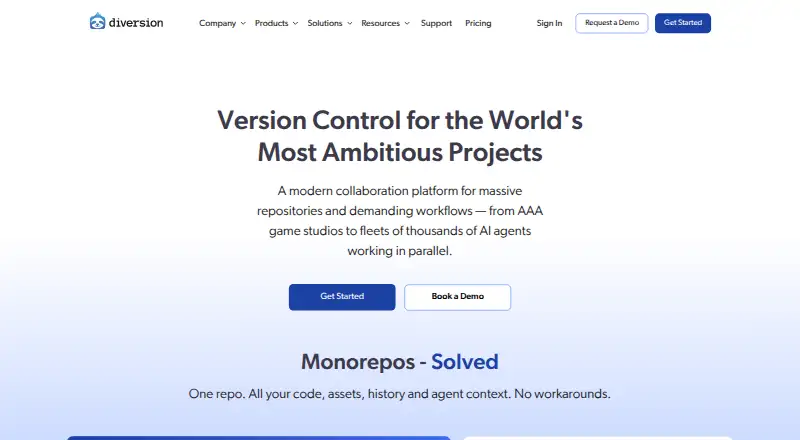
What Diversion is
Diversion is a cloud-native version control system for code, game assets, and media, with real-time collaboration. It tracks changes automatically and syncs them to the cloud without manual push or pull. Repositories can contain tens of millions of files and hundreds of terabytes, with partial and shallow checkouts available. Alongside source code, it versions large binary files such as textures, 3D models, audio, video, and datasets. Its Unreal Engine integration supports UGS and Horde workflows, while Diversion Connect brings sync status, commits, branches, and change history into Unity Editor. Jenkins and TeamCity integrations and a RESTful Web API are also listed. Studio and higher plans include code and asset reviews, hard locks, and granular permissions. Diversion says it encrypts data in transit and at rest and has completed a SOC 2 Type I audit. Enterprise deployment options include on-premises and private-cloud arrangements. Desktop platforms include Windows, macOS, and Linux. Education is free for eligible academic institutions for up to 10 users; Pro - A costs $25/user/mo.
Good
- Versions source code alongside large binary files
- Supports partial and shallow checkouts
- Includes Unreal Engine and Unity integrations
- Offers on-premises and private-cloud deployment
Watch out
- Education plan requires eligibility
- Pro - A costs $25/user/mo
- Custom Enterprise pricing is not listed
Who it suits
Diversion suits game developers, virtual production and architectural visualization studios, AI/ML teams, and creative teams working with large files. It also offers integrations for Unreal Engine, Unity, Jenkins, and TeamCity workflows.
Verdict
Diversion is geared toward teams combining code with large creative assets, and it supports desktop systems across Windows, macOS, and Linux. Pro - A starts at $25/user/mo, while eligible academic institutions can use the Education plan free for up to 10 users.
Plans and prices
From Diversion's own pricing page, checked 14 Oct 2026.
| Plan | Price | What it gives you |
|---|---|---|
| Indie | Free | Eligibility required · 100GB storage · $10 per additional 100GB/month · up to 5 repositories · unlimited repository size · CI/CD · Discord and email support · $0 per user/month for first 5 users; $12 per user/month for users 6-10; $25 per user/month for users 11-20 |
| Education | Free | Academic eligibility required · free for up to 10 users |
| Pro | $25 a month | 21-day free trial · 50 seats · 100GB storage · unlimited repositories · API · CI/CD · 3 webhooks · art previews · pre-commit hooks · email and Discord support · per user/month |
| Pro - A | $25 a month | Scale up to 50 seats · 100GB storage · $10/m each additional 100GB · unlimited repositories · up to 3 webhooks · per user/month |
| Studio - AA | $35 a month | Up to 200 users · everything in Pro · code and asset reviews · unlimited webhooks · granular permissions · hard locks · per user/month |
| Studio | $35 a month | 21-day free trial · 200 users · 100GB storage · unlimited repositories · code and asset reviews · unlimited webhooks · granular permissions · hard locks · priority Slack support · training · account manager · per user/month |
| Enterprise | Priced on request | Unlimited users · on-premises/private-cloud deployment · custom storage · multi-site proxy · SAML SSO · custom integrations · 24/7 support SLA · custom quote |
| Enterprise - AAA | Priced on request | Unlimited users · on-prem/private cloud · multi-site deployment · SAML SSO · custom integrations · 24/7 support SLA · Custom pricing; contact for a quote |
The facts
Each one read from Diversion's own pages, with the date it was checked.
What it does
- API examples and SDK coverage
- Diversion's API documentation is described as having working examples in Python, TypeScript, Go, C# and cURL.checked 14 Oct 2026
- Art previews
- Diversion advertises in-product previews for UAsset, FBX, GLB and OBJ files.checked 14 Oct 2026
- Audience
- Diversion says it is built for game developers, virtual production and architectural visualization studios, AI/ML teams, and other creative teams working with large files.checked 2 Oct 2026
- Backups
- The security page says backups run point-in-time, hourly, daily, and monthly across multiple regions, with regular recovery testing.checked 2 Oct 2026
- Branching and merging
- Diversion provides Git-like branching and merging for flexible workflow strategies.checked 14 Oct 2026
- Code and asset reviews
- Reviews allow engineers, artists and QA users to compare branches, comment on files or lines, approve changes and merge from the review.checked 14 Oct 2026
- Collaboration
- Studio and higher include code and asset reviews, hard locks, and granular permissions.checked 2 Oct 2026
- Conflict prevention
- The product offers cross-branch conflict alerts and exclusive file locks for assets that cannot be merged safely.checked 14 Oct 2026
- Deployment
- Enterprise options include on-premises and private-cloud deployment, while the security page also lists hybrid hosting.checked 2 Oct 2026
- Documentation and support
- Support is provided through documentation, in-product help, Discord and support email.checked 14 Oct 2026
- Funding news
- GamesBeat reported in 2025 that Diversion raised $12 million for its version-control platform for creative industries.checked 14 Oct 2026
- Game-engine integrations
- Official integrations are offered for Unreal Engine and Unity, and the company says Godot and other engines can also be used.checked 14 Oct 2026
- Git interoperability
- The Fab listing says users can import Git projects and keep them synchronized with Diversion.checked 14 Oct 2026
- Installation
- The official GitHub quickstart installs macOS/Linux with a shell script and Windows with an installer, then uses dv login, clone, status and commit commands.checked 14 Oct 2026
- Integrations
- The product page names Jenkins and TeamCity CI/CD integrations and a RESTful Web API for custom integrations.checked 2 Oct 2026
- Large files
- Diversion versions source code alongside large binary files such as game assets, textures, 3D models, audio, video, and datasets.checked 2 Oct 2026
- Large-file support
- Diversion versions binaries such as textures, 3D models, audio, video, datasets and engine files in the same repository as source code.checked 14 Oct 2026
- Large repositories
- The company says Diversion can clone five million files in under five minutes and commit 400,000 files in under 30 seconds.checked 14 Oct 2026
- Licence
- Diversion's terms treat the service and software as company-owned proprietary material and prohibit sublicensing, reverse engineering, modification and unauthorized copying.checked 14 Oct 2026
- Limit: incomplete web UI
- During its Hacker News launch discussion, the company acknowledged that the CLI was then its most complete interface and the web UI could not yet do everything.checked 14 Oct 2026
The company
- Company founding
- Y Combinator lists Diversion as founded in 2021 and part of its Summer 2022 batch.checked 14 Oct 2026
- Company headquarters and size
- LinkedIn lists San Francisco headquarters and an 11-50 employee company size.checked 14 Oct 2026
- Company legal name
- The legal entity is Diversion Company, Inc., a Delaware company.checked 14 Oct 2026
Where it runs
- Desktop app
- The desktop app can log in, create or clone repositories and show synchronization status without using the terminal.checked 14 Oct 2026
The full review of Diversion
Overview
Diversion brings source code and large creative assets into a single distributed version-control workflow, with changes syncing to the cloud automatically. It is most compelling for game and other creative teams whose repositories strain tools built around code alone; the trade-off is that its collaboration features and higher-scale plans quickly become paid territory.
Its intended projects range from game assets and media to datasets. Diversion says repositories can reach tens of millions of files and hundreds of terabytes, with partial and shallow checkouts for working with a subset. Self-hosted deployment is also an option alongside cloud use. For a category-wide comparison, see Version Control Software.
Key features
Code alongside large assets
Diversion versions code with binary files such as textures, 3D models, audio, video, and datasets. Native large-file handling, sparse checkout, and file locking address practical problems in shared asset workflows: teams can keep those files with code, limit what they check out, and lock files when concurrent edits would be risky. The scale claims are ambitious, but the stated repository capacity and partial checkout options make the product particularly relevant to projects with very large working sets.
Game-engine workflows
An Unreal Engine integration supports UGS and Horde workflows. Diversion Connect puts sync status, commits, branches, and change history in the Unity Editor, reducing the need to leave the editor to check those version-control details. This focus is useful to game teams; teams outside those engines should weigh it alongside the broader file and collaboration capabilities.
Integrations and controls
Jenkins and TeamCity integrations cover named CI/CD workflows, and a RESTful Web API gives teams a route to custom integrations. Code and asset reviews, hard locks, and granular permissions are included from Studio upward, so teams needing formal review and access controls must budget for that tier rather than assume they come with Pro.
Security and deployment
Diversion says it completed a SOC 2 Type I audit and encrypts data in transit and at rest. Backups run hourly, daily, and monthly as well as point-in-time across multiple regions, with regular recovery testing. Enterprise options include on-premises and private-cloud deployment, while hybrid hosting is also supported. These choices suit organizations with hosting or operational requirements beyond a standard cloud setup, though the most extensive deployment options sit behind custom Enterprise pricing.
Pricing
The free plans make Diversion approachable for small or eligible groups, but their caps matter: storage and repository limits can make them short-lived options for asset-heavy projects. Paid plans add scale and team controls, with per-user costs that should be considered against the number of collaborators.
- Education: Free for up to 10 users, for eligible academic institutions. It is the clearest fit for qualifying educational teams that need no-cost access.
- Indie: Free for the first 5 users and eligible groups of up to 20 users; includes 100GB storage and up to 5 repositories. Each additional 100GB costs $10/m. This works for smaller eligible teams, but repository and storage limits constrain larger asset libraries.
- Pro - A: $25 a month per user, scaling to 50 seats. It includes 100GB storage, unlimited repositories, up to 3 webhooks, and $10/m for each additional 100GB. This is the practical starting point for teams that have outgrown the free caps but do not need Studio's review and permission controls.
- Studio - AA: $35 a month per user for up to 200 users. It includes everything in Pro plus code and asset reviews, unlimited webhooks, granular permissions, hard locks, and priority support with a dedicated Slack channel. The extra cost makes sense when structured reviews, tighter controls, or higher webhook needs are central to the workflow.
- Enterprise - AAA: Custom pricing by quote for unlimited users, on-premises or private-cloud deployment, multi-site deployment, SAML SSO, custom integrations, and 24/7 support SLA. It is aimed at organizations needing those deployment and support terms rather than just more seats.
A 21-day trial is available. The free plans are not interchangeable: Education requires academic eligibility, while Indie has user, storage, and repository ceilings.
Platforms
Diversion supports Windows, macOS, and Linux desktops, as well as web access and API use. Its platform options also include self-hosted deployment, giving teams a choice beyond a cloud-only setup.
Who it's for
Diversion is a strong fit for game developers and teams in virtual production, architectural visualization, AI/ML, and other creative work where large files sit beside code. Its engine integrations, asset locking, and high stated repository capacity align especially well with game production. A small code-only team that does not need large-file handling, specialist integrations, or collaboration controls may find its asset-oriented scope and paid tiers unnecessary.
Pros and cons
- Pro: Code and large binary assets share one version-control system, avoiding a separate workflow for common creative files.
- Pro: Partial and shallow checkouts address the practical burden of repositories that Diversion says can reach hundreds of terabytes.
- Pro: Unreal and Unity integrations, plus Jenkins, TeamCity, and a RESTful API, connect the product to named production and CI/CD workflows.
- Pro: Studio adds reviews, granular permissions, hard locks, and priority support for teams that need stronger collaboration controls.
- Con: Free plans impose eligibility, user, storage, or repository limits, which can be restrictive for large asset libraries.
- Con: Pro charges per user and starts with 100GB storage; additional storage is billed in 100GB increments, so growing teams must account for both seats and assets.
- Con: Reviews and key access controls begin at Studio, while advanced deployment, SSO, and 24/7 SLA support require Enterprise custom pricing.
Alternatives
Unity Version Control is worth considering for teams comparing another freemium option with unlimited cloud seats and 25 GB of included storage, though that smaller stated allowance is a different starting point for asset-heavy work.
Fossil may suit readers who prefer free, open-source software they can self-host. Apache Subversion is another free open-source version-control option. Mercurial is a free software alternative for readers considering another distributed version-control tool. GitButler offers a free, open-source standalone client for readers seeking a client rather than Diversion's cloud-native service.
Perforce P4 (Helix Core) is an alternative to compare for teams considering a service with a free tier capped at 5 users, 20 workspaces, and 3 Git repositories, or a Cloud plan priced at $39.00 per month. VisualSVN Server may suit Windows-focused teams looking for self-hosted software with a free Community plan for up to 15 users. Accessibility Test Framework for Android is another free alternative in the category.
Verdict
Choose Diversion if your team needs code and large creative assets managed together, especially in game or visual-production workflows where engine integrations, file locking, and selective checkouts matter. Its chief advantage is a single workflow designed for very large repositories; its chief drawback is that storage, seat, and collaboration needs can push teams from free access into paid tiers, with enterprise-grade deployment and support requiring a quote. For code-only projects without those demands, compare a simpler or free alternative first.
Getting started
- Open the Diversion website.
- Choose a plan: Education and Indie have eligibility requirements; Pro and Studio are paid per user, and Enterprise requires a quote.
- Use the 21-day trial if you want to try the service first.
- Choose a supported environment: Windows, macOS, Linux, web, API, or self-hosted.
- Connect an Unreal Engine or Unity workflow if applicable.
Limits worth knowing
Education is free for eligible academic institutions for up to 10 users. Indie is free for the first five users and allows up to 20 users, 100GB storage, and five repositories; additional storage is $10/m per 100GB. Pro costs $25 per user/month and includes 100GB storage and up to three webhooks.
Questions
Does Diversion have a free plan?
Yes. Education is free for eligible academic institutions for up to 10 users. Indie is free for the first five users, with eligibility required.
How much do the paid plans cost?
Pro costs $25 per user/month, and Studio costs $35 per user/month. Enterprise uses custom pricing by quote.
Is there a free trial?
Yes, Diversion offers a 21-day trial.
Which platforms does Diversion support?
Listed platforms are API, Linux, macOS, self-hosted, web, and Windows.
Does it support large files and game engines?
It versions large binary files alongside source code and provides Unreal Engine and Unity integrations.
Can Diversion be self-hosted?
Yes. Enterprise options include on-premises and private-cloud deployment; hybrid hosting is also listed.
Alternatives to Diversion
- 1

Unity
Free planAndroidiOSWebAPI8.4Free plan - 2

Unity Version Control
Free planWebAPILinuxmacOS8.1Free plan - 3

Perforce P4 (Helix Core)
Free planWebAPILinuxmacOS7.9From $39 a month - 4

GitHub CodeQL
Free planWebExtensionLinuxmacOS7.5From $30 a month - 5
GitUI
Free planOpen sourceAndroidLinuxmacOSSelf-hosted7.5Free plan - 6

Gitnuro
Free planOpen sourceLinuxmacOSWindows7.4Free plan