
Apache Subversion
Apache Subversion is a free, open-source centralized version control system for users from individuals to large-scale enterprise operations.
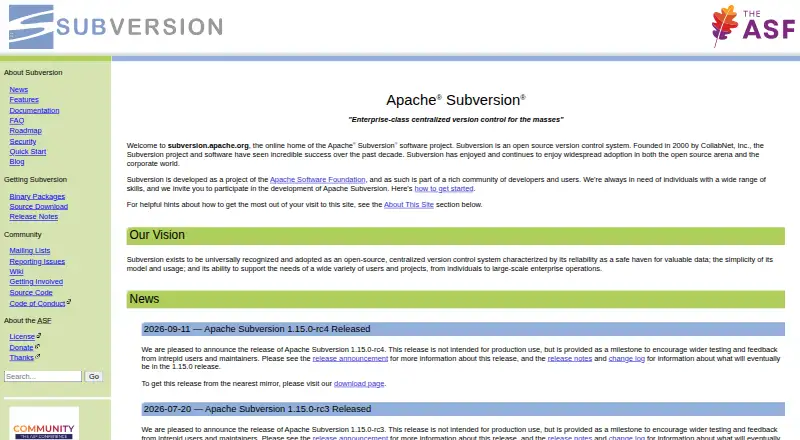
What Apache Subversion is
Apache Subversion is a free, open-source centralized version control system for users from individuals to large-scale enterprise operations. It can version directories, files, and their free-form key/value properties. Commits are atomic: a change takes effect only if the whole commit succeeds. Branches and tags use copy operations with a small, constant space cost, and merge tracking assists with changes between development lines. File locking is optional, and selected files can require a lock before editing. Repositories can be served through Apache HTTP Server using WebDAV/DeltaV, or through svnserve, including over SSH. Subversion runs on Windows, macOS, and Linux and supports self-hosted deployment. The project provides source code; binary packages are maintained by volunteers or their respective projects rather than officially endorsed or maintained by Subversion. Community support is available through user and developer mailing lists. Archived releases outside currently supported versions do not receive community support, and experimental features in the 1.14 release notes have no promise of backward compatibility.
Good
- Versions directories, files, and key/value properties
- Atomic commits prevent partial changes from taking effect
- Branching and tagging use constant-space copy operations
- Supports Windows, macOS, and Linux
Watch out
- Binary packages are maintained by third parties
- Archived releases outside supported versions lack community support
- Experimental 1.14 features have no backward-compatibility promise
Who it suits
Subversion suits individuals or organizations that want a self-hosted, centralized version control system. Its optional file locking can suit projects where some files should require a lock before editing.
Verdict
Subversion offers centralized versioning, atomic commits, and several repository-serving options. Note that binary packages are maintained outside the core project, and older archived releases may not receive community support.
Plans and prices
From Apache Subversion's own pricing page, checked 30 Sep 2026.
| Plan | Price | What it gives you |
|---|---|---|
| Apache Subversion | Free | Open-source version control software · project provides source code; binary packages are maintained by third parties |
The facts
Each one read from Apache Subversion's own pages, with the date it was checked.
What it does
- Branches and tags
- Branching and tagging use copy operations that take a small, constant amount of space.checked 30 Sep 2026
- Commits
- Commits are atomic: no part takes effect until the entire commit succeeds.checked 30 Sep 2026
- Experimental features
- The 1.14 release notes state that experimental features have no promise of backward compatibility.checked 30 Sep 2026
- File locking
- File locking is optional, and files can be configured to require a lock before editing.checked 30 Sep 2026
- Integrations
- The project site identifies TortoiseSVN and IDE integrations such as Eclipse and NetBeans as separate third-party projects outside the core Subversion offering.checked 30 Sep 2026
- Merge tracking
- Subversion provides automated assistance for tracking changes between development lines and merging branches.checked 30 Sep 2026
- Purpose
- Apache Subversion is an open-source, centralized version control system intended for users ranging from individuals to large-scale enterprise operations.checked 30 Sep 2026
- Release support limits
- The download page says archived releases other than currently supported versions are not supported by the community.checked 30 Sep 2026
- Release verification
- The download page recommends verifying source downloads with PGP signatures and provides checksums as an alternative.checked 30 Sep 2026
- Security
- The project directs vulnerability reports to the Apache Software Foundation security process and publishes a list of past advisories.checked 30 Sep 2026
- Server options
- Repositories can be served through Apache HTTP Server using WebDAV/DeltaV or through the standalone svnserve server, which can also be tunneled over SSH.checked 30 Sep 2026
- Support
- The project offers community support through user and developer mailing lists; binary packages are maintained by volunteers or their respective projects, not officially endorsed or maintained by Subversion.checked 30 Sep 2026
- Versioned items
- Directories, files, and their free-form key/value properties can be versioned.checked 30 Sep 2026
The company
- Founded
- 2000checked 28 Sep 2026
Where it runs
- Platforms
- The project distributes source code and lists third-party binary packages for Windows, macOS, Linux distributions, and other operating systems.checked 30 Sep 2026
The full review of Apache Subversion
Apache Subversion is an open-source, centralized version control system for tracking changes to files, directories, and their properties. It suits individuals and large organizations that want a self-hosted repository with atomic commits. Its strongest case is a clear, centralized workflow; teams seeking a distributed model should look elsewhere.
Overview
Subversion versions directories and files alongside free-form key/value properties, giving teams a way to manage more than file contents alone. Its centralized model makes the repository the shared point of record. That can suit teams that prefer a single source of truth, but it is not the right fit for those who want distributed version control.
Commits are atomic: a change either succeeds in full or has no effect. That protects the repository from partially applied commits. Branches and tags are created through copy operations that use a small, constant amount of space, while merge tracking assists with changes between development lines. These are practical strengths for teams maintaining parallel work, though they do not remove the need to manage merges.
Key features
- Optional file locking: Teams can require a lock before editing particular files, a useful safeguard where simultaneous edits are undesirable.
- Repository serving choices: Repositories can use Apache HTTP Server with WebDAV/DeltaV or the standalone svnserve server, which can also be tunneled over SSH. This gives self-hosting teams deployment options without changing the centralized model.
- Large files and selective checkout: Subversion supports native large-file handling and sparse checkout, letting users work with selected parts of a repository rather than checking out everything.
- Nested repositories: Support for nested repositories can help organize related projects within a larger working structure.
- Third-party tools: TortoiseSVN and integrations such as Eclipse and NetBeans are separate projects, not part of the core Subversion offering. Teams should account for that distinction when choosing their client and development environment.
The project routes vulnerability reports through the Apache Software Foundation security process and publishes past advisories. It recommends checking source downloads with PGP signatures, with checksums as an alternative. Community help is available through user and developer mailing lists; binary packages are maintained by volunteers or their respective projects, rather than officially maintained or endorsed by Subversion. Archived releases beyond currently supported versions do not receive community support, and experimental features in the 1.14 release carry no promise of backward compatibility.
Pricing
Subversion is free and open source. The Apache Subversion plan costs nothing and provides the project’s source code. There is no free trial because the software is free to use. Binary packages are maintained by third parties, so users may need to rely on those maintainers or build from source rather than expect an official Subversion binary package.
Platforms
Subversion supports Windows, macOS, and Linux, as well as self-hosted deployment and an API. Self-hosting gives organizations control over repository serving, but also leaves repository operation and binary-package choices with the team or its chosen maintainers.
Who it's for
Subversion is a sensible choice for individuals or organizations that want free, self-hosted centralized version control, atomic commits, and repository-level control over files and directories. Its locking option and sparse checkout can be useful in workflows where selective access or exclusive editing matters. It is less suitable for teams that require officially maintained binaries or community support for archived releases.
Pros and cons
- Pro: Atomic commits prevent partial changes from taking effect.
- Pro: Branches and tags use copy operations with constant, small space overhead.
- Pro: Optional locking, sparse checkout, and native large-file handling address specific repository workflow needs.
- Con: The centralized model will not suit teams looking for distributed version control.
- Con: Binary packages and integrations are outside the core project, so users must choose and rely on separate maintainers or projects.
- Con: Archived releases outside currently supported versions lack community support.
Alternatives
Consider Git if you want a free, open-source alternative with a different version-control model. Mercurial is another free software option, available for Linux, macOS, Windows, and self-hosted use. For a free self-hosted option under a 2-clause BSD license, consider Fossil.
Diversion offers a free plan for eligible academic institutions of up to 10 users, alongside a free trial; consider it if those terms and its broader platform availability fit your needs. Perforce P4 (Helix Core) has a free plan capped at five users, 20 workspaces, three Git repositories, and three lifetime support cases; its paid Cloud plan may suit teams that need a larger hosted offering.
GitButler offers a free, open-source client for standalone use, with a paid supporter contribution option. platypusgit is a free GPLv3 option with no account, paywall, or feature tiers. Jujutsu is another free option for Linux, macOS, and Windows.
Browse Version Control Software or Game Version Control Software for more options.
Verdict
Choose Apache Subversion if you want free, centralized version control with atomic commits and self-hosted repository options. Its limits are just as clear: teams wanting distributed version control, officially maintained binaries, or support for archived releases should choose another tool.
Alternatives to Apache Subversion
- 1

Unity
Free planAndroidiOSWebAPI8.4Free plan - 2

Unity Version Control
Free planWebAPILinuxmacOS8.1Free plan - 3

Perforce P4 (Helix Core)
Free planWebAPILinuxmacOS7.9From $39 a month - 4

Diversion
Free planWebAPILinuxmacOS7.8From $25 a month - 5

GitHub CodeQL
Free planWebExtensionLinuxmacOS7.5From $30 a month - 6
GitUI
Free planOpen sourceAndroidLinuxmacOSSelf-hosted7.5Free plan