Fossil
Fossil is a free, distributed software configuration management system for tracking software projects and their development history.
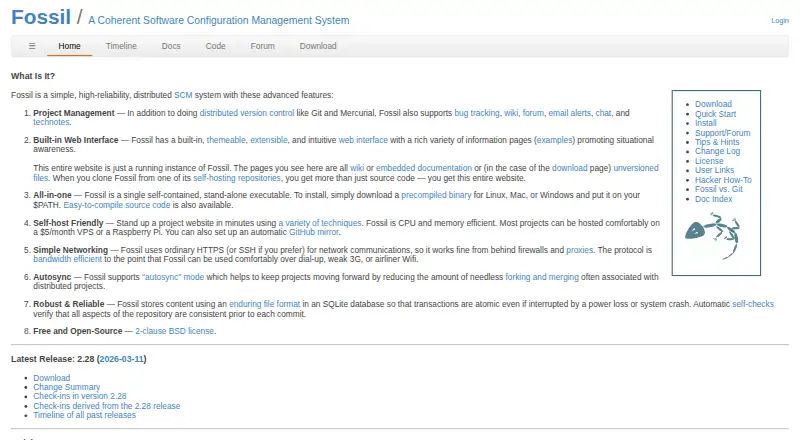
What Fossil is
Fossil is a free, distributed software configuration management system for tracking software projects and their development history. It combines version control with project tools including bug tracking, a wiki, forums, chat, email alerts, and technical notes. Its built-in web interface supports ticketing, documentation, timelines, full-text search, histories, diffs, ZIP downloads, and access management. Fossil is distributed as a single self-contained executable and can operate as a standalone server or through CGI, SCGI, inetd, or stunnel. Official precompiled binaries are provided for Linux, Mac, and Windows, and it can be self-hosted. Network communication uses HTTPS or SSH, and synchronization supports autosync as well as manual merges; autosync is on by default. Repositories use an SQLite database with atomic transactions and consistency checks before commits. The project originated as a tool for SQLite and has also been adopted by other projects. Its license is 2-clause BSD. Listed limitations include no file locking, large-file handling, sparse checkout, or nested repositories.
Good
- Combines version control with bug tracking and project tools.
- Built-in web interface includes timelines and full-text search.
- Distributed as a single self-contained executable.
- Supports HTTPS or SSH network communication.
- Free and open-source under a 2-clause BSD license.
Watch out
- No file locking.
- No large-file handling.
- No sparse checkout or nested repositories.
Who it suits
Fossil may suit software projects seeking distributed version control alongside built-in project discussion and tracking tools. It is also an option for teams that want to self-host and use Linux, Mac, or Windows binaries.
Verdict
Fossil brings distributed version control and project coordination features together, with a built-in web interface and self-hosting options. Consider its stated gaps in large-file handling, file locking, sparse checkout, and nested repositories before choosing it.
Plans and prices
From Fossil's own pricing page, checked 1 Oct 2026.
| Plan | Price | What it gives you |
|---|---|---|
| Free and Open-Source | Free | 2-clause BSD license · self-hosted |
The facts
Each one read from Fossil's own pages, with the date it was checked.
The company
- Founded
- 2007checked 28 Sep 2026
What it does
- GitHub integration
- The project supports setting up an automatic GitHub mirror.checked 1 Oct 2026
- Networking
- Fossil uses HTTPS or SSH for network communications and is designed to work behind firewalls and proxies.checked 1 Oct 2026
- Original use
- Fossil was originally designed to support the SQLite project and has since been adopted by other projects.checked 1 Oct 2026
- Project management
- It combines distributed version control with bug tracking, wiki, forum, email alerts, chat, and technical notes.checked 1 Oct 2026
- Repository reliability
- Repositories are stored in an SQLite database with atomic transactions and automatic consistency checks before each commit.checked 1 Oct 2026
- Security
- TLS encrypts Fossil communications and protects credentials, against eavesdropping, in-flight modification, and server-identity spoofing.checked 1 Oct 2026
- Self-contained
- Fossil is distributed as a single self-contained executable and does not require other software to use effectively.checked 1 Oct 2026
- Self-hosting
- Fossil can run as a standalone server, CGI, SCGI, inetd, or stunnel service.checked 1 Oct 2026
- Support model
- The official site provides a Support/Forum entry as part of the project documentation and navigation.checked 1 Oct 2026
- Synchronization
- Fossil supports autosync and manual-merge workflows, with autosync enabled by default.checked 1 Oct 2026
- Web features
- The web interface provides ticketing, wiki, documentation, technical notes, forums, timelines, full-text search, histories, diffs, ZIP downloads, and access management.checked 1 Oct 2026
- Web interface
- Fossil includes a built-in, themeable and extensible web interface for project development.checked 1 Oct 2026
- What it does
- Fossil is a distributed software configuration management system for controlling and tracking software-project development and history.checked 1 Oct 2026
Where it runs
- Supported desktop platforms
- Official precompiled binaries are provided for Linux, Mac, and Windows.checked 1 Oct 2026
The full review of Fossil
Fossil is a free, distributed version-control system for software projects, with a built-in web interface for coordination. It is best for teams who want to self-host code history and project tools together; repository limitations make it a less suitable choice for some file-heavy or specialized workflows.
Overview
Fossil brings source history together with project coordination: bug tracking, wiki, forum, email alerts, chat and technical notes sit alongside version control. That integrated model can keep everyday project work in one place, while its self-hosting options give teams control over deployment. Fossil was created for the SQLite project and has since been adopted elsewhere.
Key features
Its themeable, extensible web interface includes ticketing, wiki pages, documentation, technical notes, forums, timelines, full-text search, histories, diffs, ZIP downloads and access management. This breadth is useful to teams that value a shared home for code and project records; it is less compelling if they already rely on separate tools and do not need the bundled collaboration functions.
Fossil is packaged as a single executable and does not require other software to work effectively. Official precompiled binaries cover Linux, macOS and Windows. A repository can be served standalone or through CGI, SCGI, inetd or stunnel, giving self-hosters several deployment approaches. An automatic GitHub mirror is also supported when a project needs a copy there.
Network communication uses HTTPS or SSH, and Fossil is designed to work behind firewalls and proxies. TLS protects credentials and traffic from eavesdropping, in-flight changes and server impersonation. Autosync is enabled by default, though manual merging is supported for teams that prefer to control synchronization. Repositories use SQLite transactions and receive automatic consistency checks before each commit, a useful safeguard for project history.
Pricing
Fossil is free and open-source under a 2-clause BSD license, with self-hosted deployment. Its Free and Open-Source plan costs nothing. There is no paid tier or seat-based plan to weigh; teams take responsibility for running their own service.
Platforms
Official desktop binaries are provided for Linux, macOS and Windows. Fossil also supports web access and self-hosting, so it can serve as a project’s web-facing collaboration environment as well as its version-control system.
Who it's for
Fossil is a strong fit for software teams that want distributed version control and project coordination in a self-hosted package, particularly when a compact executable and multiple server modes suit their setup. It is not a good match for workflows that require large-file handling, file locking, sparse checkout or nested repositories: those capabilities are absent.
Pros and cons
- Integrated project workspace: tickets, documentation, forums and other coordination tools are built into the web interface, reducing the need to separate those activities from source history.
- Flexible self-hosting: standalone, CGI, SCGI, inetd and stunnel modes accommodate different service setups.
- Lightweight distribution: a single self-contained executable and official desktop binaries simplify the software footprint.
- Workflow gaps: no large-file handling, file locking, sparse checkout or nested repositories means teams depending on any of those must look elsewhere.
Alternatives
Diversion is another free-plan option, with an Education plan billed free for up to 10 users at eligible academic institutions and an Indie plan also listed as free. Unity Version Control may suit teams that prefer a free tier with unlimited cloud seats and 25 GB of storage, with usage beyond included limits billed pay-as-you-go. Accessibility Test Framework for Android is a free alternative. GitUI is a free open-source terminal Git client. Apache Subversion is free open-source version-control software. BitKeeper is free and open source under the Apache 2.0 License. GitButler offers a free, open-source client for standalone use, with a Supporter option at $5 a month. Mercurial is free software under GNU GPL version 2 or later.
Browse the Version Control Software category or Game Version Control Software list for more options.
Verdict
Choose Fossil if you want free, self-hosted distributed version control with project coordination built in and value its single-executable design. Look elsewhere if your repository depends on large-file handling, locking, sparse checkout or nested repositories.
Getting started
- Open the Fossil website
- Download the precompiled binary for Linux, macOS, or Windows
- Run Fossil as a standalone server or configure CGI, SCGI, inetd, or stunnel
- Choose self-hosted deployment and connect repositories over HTTPS or SSH
- Enable automatic GitHub mirroring if needed
Questions
Is Fossil free?
Yes. The Free and Open-Source plan costs nothing and uses a 2-clause BSD license.
Which platforms does Fossil support?
Fossil supports Linux, macOS, Windows, web, and self-hosted use.
Can Fossil be self-hosted?
Yes. It can run as a standalone server, CGI, SCGI, inetd, or stunnel service.
Does Fossil integrate with GitHub?
Yes. The project supports setting up an automatic GitHub mirror.
How does Fossil synchronize repositories?
It supports autosync and manual-merge workflows, with autosync enabled by default.
Alternatives to Fossil
- 1

Unity
Free planAndroidiOSWebAPI8.4Free plan - 2

Unity Version Control
Free planWebAPILinuxmacOS8.1Free plan - 3

Perforce P4 (Helix Core)
Free planWebAPILinuxmacOS7.9From $39 a month - 4

Diversion
Free planWebAPILinuxmacOS7.8From $25 a month - 5

GitHub CodeQL
Free planWebExtensionLinuxmacOS7.5From $30 a month - 6
GitUI
Free planOpen sourceAndroidLinuxmacOSSelf-hosted7.5Free plan