Accessibility Test Framework for Android
Accessibility Test Framework for Android is a free library for developers who want automated accessibility checks in Android app testing.
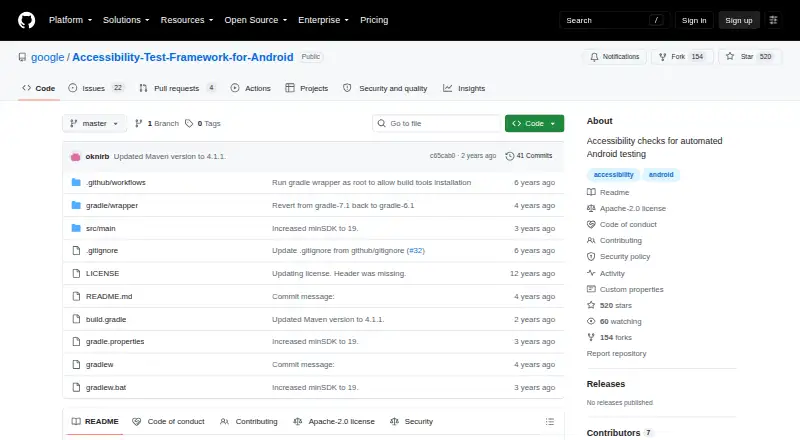
What Accessibility Test Framework for Android is
Accessibility Test Framework for Android is a free library for developers who want automated accessibility checks in Android app testing. It collects checks on Android View and AccessibilityNodeInfo objects, including whether an item is missing a contentDescription. A sample demonstrates running checks throughout the hierarchy beneath a chosen view using the latest check preset; the sample throws an exception when it finds errors. The project provides a Gradle wrapper and build.gradle file, and its repository can be imported into Android Studio. It is licensed under Apache-2.0 and hosted in Google’s public GitHub organization. The framework is aimed at developers checking how apps are presented to accessibility services. Automated checks do not settle every accessibility question: for instance, deciding whether a content description makes sense to users requires human judgment. The library therefore offers a way to catch certain issues in automated tests, but it does not replace human review of accessibility decisions.
Good
- Free Apache-2.0 licensed library.
- Checks Android View and AccessibilityNodeInfo objects.
- Can run checks across a view hierarchy.
- Repository can be imported into Android Studio.
Watch out
- Some accessibility rules require human judgment.
- The library is for Android app testing.
Who it suits
This library suits developers building Android apps who want accessibility checks in their automated test workflow. It is also relevant to teams reviewing how apps appear to accessibility services.
Verdict
The framework can help Android developers catch certain accessibility issues during automated testing. Human review remains necessary for questions such as whether descriptions make sense to users.
Plans and prices
From Accessibility Test Framework for Android's own pricing page, checked 3 Oct 2026.
| Plan | Price | What it gives you |
|---|---|---|
| Accessibility Test Framework for Android | Free | Apache-2.0 licensed library · automated Android accessibility checks |
The facts
Each one read from Accessibility Test Framework for Android's own pages, with the date it was checked.
Where it runs
- Android Studio
- The repository says the project can be imported into Android Studio.checked 3 Oct 2026
- Browser extension
- Nochecked 23 Sep 2026
What it does
- Audience
- The project is for developers building Android apps who want to check how apps are presented to accessibility services.checked 3 Oct 2026
- Automated checks
- The README gives a missing contentDescription as an example of a practice automated tools can check.checked 3 Oct 2026
- Automated scans
- Yeschecked 23 Sep 2026
- Build
- The project provides a Gradle wrapper and build.gradle file for building the library.checked 3 Oct 2026
- Check presets
- The sample uses AccessibilityCheckPreset.LATEST to obtain the hierarchy checks for the latest preset.checked 3 Oct 2026
- Hierarchy checks
- Its sample runs checks across the view hierarchy rooted at a given view and throws an exception when errors are found.checked 3 Oct 2026
- Human review
- The README says some accessibility rules require human judgment, such as whether a contentDescription makes sense to all users.checked 3 Oct 2026
- License
- The repository lists an Apache-2.0 license.checked 3 Oct 2026
- Limit
- The project documentation notes that some accessibility rules cannot be fully checked by automated tools and require human judgment.checked 3 Oct 2026
- Mobile testing
- Yeschecked 23 Sep 2026
- Purpose
- The library provides accessibility checks for automated Android app testing.checked 3 Oct 2026
- What it checks
- It collects accessibility-related checks on Android View objects and AccessibilityNodeInfo objects.checked 3 Oct 2026
The company
- Founded
- 2025checked 28 Sep 2026
- Maker
- The code is hosted in Google's public GitHub organization under the repository name Accessibility-Test-Framework-for-Android.checked 3 Oct 2026
Money
- Free plan
- Yeschecked 23 Sep 2026
The full review of Accessibility Test Framework for Android
Overview
Accessibility Test Framework for Android is a free, open-source library for developers who want automated accessibility checks in Android app testing. It evaluates Android View objects and AccessibilityNodeInfo objects, helping teams spot issues in how an app is presented to accessibility services.
Automation has a limited but useful role: a missing contentDescription is one example of a problem a check can flag. The framework cannot decide whether a description is clear and meaningful to all users. That kind of judgment remains part of human accessibility review.
The project is hosted in Google's public GitHub organization, and its repository lists an Apache-2.0 license.
Key features
Checks across a view hierarchy
The documented example runs checks across the view hierarchy rooted at a given view. It uses AccessibilityCheckPreset.LATEST to obtain the checks in the latest preset and throws an exception if errors are found. This makes detected issues visible to the surrounding test workflow.
Automated checks, with a human boundary
The library collects accessibility-related checks for Android views and accessibility nodes. It can identify some detectable patterns, but it is not a substitute for assessing whether content and interactions make sense to people. Developers should treat automated findings as one part of accessibility work, not a complete verdict on an app.
Build and editor setup
The project includes a Gradle wrapper and a build.gradle file for building the library, and the repository says it can be imported into Android Studio. These details make it relevant to Android development workflows that already use those tools.
Pricing
Accessibility Test Framework for Android is free, with no free trial. The listed plan costs free. It is an Apache-2.0-licensed library.
Platforms
The framework is for Android app accessibility checks. The project is described as self-hosted, and the listed desktop platforms are Windows, macOS, and Linux. Those desktop entries describe the supported environment, not additional mobile targets.
Who it's for
This library is aimed at developers building Android apps who want to check how their apps are presented to accessibility services. It is most relevant when an Android testing workflow can incorporate hierarchy checks and when developers can follow automated findings with human review.
Pros and cons
Pros
- Free and open source under an Apache-2.0 license.
- Provides automated checks for Android view and accessibility-node objects.
- Can run checks across a view hierarchy and surface errors by throwing an exception.
- Includes a Gradle wrapper and supports import into Android Studio.
Cons
- Automated checks cannot fully assess accessibility; some rules require human judgment.
- Its purpose is Android app testing, rather than a general-purpose accessibility review tool for other app platforms.
Verdict
Accessibility Test Framework for Android offers Android developers a focused way to bring automated accessibility checks into app testing. Its hierarchy-based checks and integration with a Gradle-based project are practical strengths, while the human-review limitation is central to using it responsibly. It can help expose certain detectable problems, but developers still need to judge whether the experience works for users.
Getting started
- Open the project's GitHub repository.
- Import the project into Android Studio or build it with the provided Gradle wrapper.
- Add the library to your Android app testing workflow.
- Run hierarchy checks from a view, using the latest preset if desired.
- Review automated findings and assess content descriptions that need human judgment.
Limits worth knowing
Automated checks cannot fully cover every accessibility rule; judging whether a contentDescription makes sense to users requires human judgment.
Questions
Is Accessibility Test Framework for Android free?
Yes. The library is listed as free and is licensed under Apache-2.0.
What does the framework check?
It runs accessibility-related checks on Android View objects and AccessibilityNodeInfo objects. A missing contentDescription is one example of an issue an automated check can identify.
Can it check a whole view hierarchy?
Yes. Its sample runs checks across the hierarchy rooted at a given view and throws an exception when errors are found.
Does it replace human accessibility review?
No. Some rules need human judgment, including whether a contentDescription makes sense to users.
Who makes the framework?
The project is hosted in Google's public GitHub organization under the repository name Accessibility-Test-Framework-for-Android.
How do developers build or open the project?
The project provides a Gradle wrapper and build.gradle file, and the repository can be imported into Android Studio.
Alternatives to Accessibility Test Framework for Android
- 1

Unity
Free planAndroidiOSWebAPI8.4Free plan - 2

Unity Version Control
Free planWebAPILinuxmacOS8.1Free plan - 3

Perforce P4 (Helix Core)
Free planWebAPILinuxmacOS7.9From $39 a month - 4

Diversion
Free planWebAPILinuxmacOS7.8From $25 a month - 5

GitHub CodeQL
Free planWebExtensionLinuxmacOS7.5From $30 a month - 6
GitUI
Free planOpen sourceAndroidLinuxmacOSSelf-hosted7.5Free plan