
Byteria Game Anti-Cheat
Byteria Game Anti-Cheat is software for detecting tampering and cheating in mobile games.
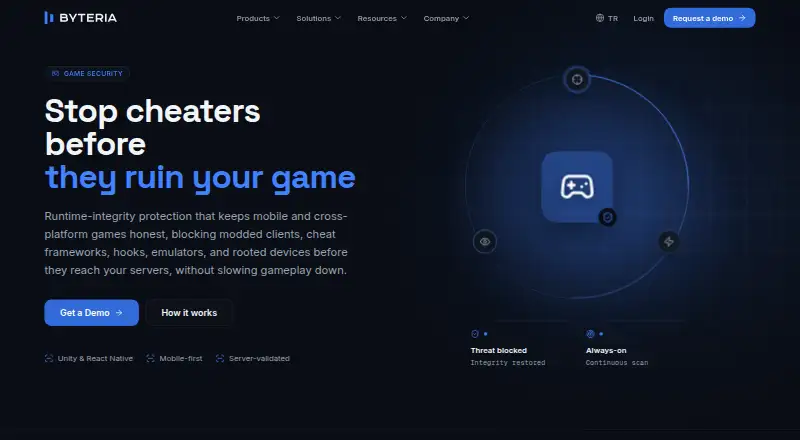
What Byteria Game Anti-Cheat is
Byteria Game Anti-Cheat is software for detecting tampering and cheating in mobile games. Its checks cover altered or repackaged game builds, cheat frameworks and hooks such as Frida and Xposed/LSPosed, emulators and virtual devices, rooted or jailbroken devices, and debugger or runtime changes. It also supports server-side device attestation using Android KeyStore key attestation and Apple App Attest, verified against Google and Apple roots.
The SDK is described for Unity, React Native, and native iOS and Android games. Game teams can set different responses by mode or player segment, choosing to log, warn, kick, or ban. Verified signals and telemetry can go to a game backend for action, review, or appeals. Device checks work offline; server-side attestation and enforcement apply when a player connects. Byteria names competitive and PvP games, real-money and iGaming, free-to-play economies, and esports as intended settings. The product is paid, with pricing on request. It has no PC or desktop or Unreal build today.
Good
- Checks for altered and repackaged game clients.
- Detects hooks, emulators, and rooted devices.
- Supports Unity, React Native, iOS, and Android.
- Teams choose log, warn, kick, or ban responses.
- On-device detection works offline.
Watch out
- No PC or desktop build today.
- No Unreal build today.
- Pricing is available on request.
Who it suits
It suits teams building competitive, PvP, real-money, free-to-play, or esports games for iOS or Android. It is not currently suited to teams that need a PC/desktop or Unreal build.
Verdict
Byteria offers layered integrity checks and configurable responses for supported mobile game builds. Teams should account for the lack of PC/desktop and Unreal builds and request pricing.
The facts
Each one read from Byteria Game Anti-Cheat's own pages, with the date it was checked.
What it does
- Attestation
- The page says server-side attestation uses Android KeyStore key attestation and Apple App Attest, verified against Google and Apple roots.checked 4 Oct 2026
- Backend signals
- The product streams verified cheat signals and telemetry to a game backend for real-time action, review, and appeals.checked 4 Oct 2026
- Client integrity
- It checks builds against expected signatures and structure to detect cracked, patched, or repackaged clients.checked 4 Oct 2026
- Detection
- Its six detection layers cover modified clients, cheat frameworks and hooks, emulators and virtual devices, rooted or jailbroken devices, debugger and runtime tampering, and server-side device attestation.checked 4 Oct 2026
- False positives and bans
- The game operator controls response policies, and Byteria says verified signals and telemetry support review, appeals, and graduated actions.checked 4 Oct 2026
- Game genres
- Byteria names competitive and PvP, real-money and iGaming, free-to-play economies, and esports and tournaments as intended use cases.checked 4 Oct 2026
- Hook detection
- It detects Frida, Xposed/LSPosed, injected libraries, and runtime hooks in native and managed layers.checked 4 Oct 2026
- Integration
- The SDK can be added to Unity, React Native, or native iOS and Android builds, then configured to log, warn, kick, or ban based on game mode and player segment.checked 4 Oct 2026
- Integrations
- The SDK is described for Unity, React Native, and native iOS and Android builds.checked 4 Oct 2026
- Offline behavior
- On-device detection works offline; server-side attestation and enforcement apply when players connect.checked 4 Oct 2026
- Performance
- The maker says the SDK runs alongside the game loop with minimal runtime overhead and is designed for mobile performance constraints.checked 4 Oct 2026
- Purpose
- Byteria describes the product as runtime-integrity protection for mobile and cross-platform games that blocks modded clients, cheat frameworks, hooks, emulators, and rooted devices.checked 4 Oct 2026
- Response controls
- Teams can choose per game mode and player segment whether to log, warn, kick, or ban based on detections.checked 4 Oct 2026
- Security certification
- The product page displays an ISO 27001:2022 certification badge and an IAS accreditation badge for management systems certification body MSCB-134.checked 4 Oct 2026
- Support
- The product page provides contact by email at [email protected] and telephone at 0850 303 7067.checked 4 Oct 2026
The company
- Company founded
- The maker pages opened do not state a founding date.checked 4 Oct 2026
- Company headquarters
- Byteria lists its address as Altınşehir Mah. 207(280) Sk. No: 87/1B, Nilüfer, Bursa, Turkey.checked 4 Oct 2026
- Company location
- Byteria lists an address in Nilüfer, Bursa, Turkey on the product page.checked 4 Oct 2026
- Headquarters
- Nilüfer, Bursa, Turkeychecked 28 Sep 2026
Where it runs
- Device checks
- It identifies emulators, virtual devices, rooted or jailbroken devices, Magisk, su binaries, custom ROMs, and verified-boot state.checked 4 Oct 2026
- Platform limit
- The product page says there is no PC/desktop or Unreal build today.checked 4 Oct 2026
- Supported platforms
- The game anti-cheat page supports native iOS and Android, React Native, and Unity, and says there is no PC/desktop or Unreal build today.checked 4 Oct 2026
The full review of Byteria Game Anti-Cheat
Byteria Game Anti-Cheat is a runtime-integrity SDK for mobile and cross-platform game builds. It fits teams using Unity, React Native, or native iOS and Android projects, especially competitive and economy-sensitive games. Its layered detection and graduated enforcement are compelling for mobile-first studios, while teams shipping PC or Unreal should choose another route.
Overview
Byteria combines local integrity checks with server-side attestation and a stream of verified cheat signals and telemetry. The backend can use those signals for immediate intervention, later investigation, or player appeals instead of treating every alert as an automatic ban. That policy control is important in PvP, real-money and iGaming, free-to-play economy, esports, and tournament environments, where both cheating and mistaken penalties are costly.
On-device detection continues offline. Attestation and connected enforcement apply when a player reaches the server, adding a server-verified layer to local checks.
Key features
Six detection layers
Checks cover modified clients, cheat frameworks and hooks, emulators and virtual devices, rooted or jailbroken devices, debugger and runtime tampering, and server-side attestation. Build signatures and structure expose cracked, patched, or repackaged clients. Hook checks include Frida, Xposed/LSPosed, injected libraries, and native or managed runtime hooks. Device checks identify emulators, virtual devices, Magisk, su binaries, custom ROMs, root or jailbreak status, and verified-boot state.
Attestation and response controls
Server-side verification uses Android KeyStore key attestation and Apple App Attest against Google and Apple roots. Teams can add the SDK to Unity, React Native, or native iOS and Android builds, then choose whether a detection logs, warns, kicks, or bans for each game mode and player segment. Verified signals and telemetry give operators a record for review and appeals, supporting graduated enforcement rather than a single blunt response.
Operational fit
The maker positions the SDK to run alongside the game loop with minimal overhead for mobile constraints. That design suits performance-sensitive mobile games, although the product page provides no PC/desktop or Unreal build today, making it unsuitable for those release targets.
Pricing
Byteria uses paid, custom pricing; teams must request a quote. This can suit studios that need a tailored deployment and policy discussion, but it gives small teams no published entry price for budgeting or direct plan comparison.
Platforms
The SDK supports native iOS and Android, Unity, and React Native integrations. The service also lists Android, iOS, Linux, macOS, Windows, and API platforms. There is no PC/desktop or Unreal build today, so a desktop-led or Unreal production cannot use the supported game SDK as its primary fit.
Who it's for
Choose Byteria when a mobile-first team needs client, device, hook, and attestation checks together, with backend signals and per-segment enforcement. It is particularly appropriate for competitive PvP, real-money, iGaming, free-to-play economies, and esports where reliable integrity evidence and an appeals path matter. It is a poor match for PC-only, desktop-heavy, or Unreal projects, and custom pricing may be a hurdle for small studios seeking a self-serve start.
Pros and cons
- Pros: Six complementary detection layers address both tampered builds and compromised devices.
- Pros: Android KeyStore and Apple App Attest verification add server-side assurance beyond local checks.
- Pros: Offline local detection, backend telemetry, and log-to-ban controls support flexible enforcement and appeals.
- Cons: No PC/desktop or Unreal build limits platform coverage.
- Cons: Custom pricing provides no published cost for initial planning.
Alternatives
Browse Game Anti-Cheat Software for a wider category comparison. Pick Easy Anti-Cheat instead if you want a freemium option with a free Basic plan, no usage limits, and support spanning Android, iOS, Linux, macOS, web, and Windows. AGINUZ Anti-Cheat Infrastructure is a better fit for Linux, macOS, or Windows projects seeking a free Protected plan for single-player or offline games. Choose Epic Online Services when free anti-cheat-related services across Android, iOS, Linux, macOS, and Windows are more important than a dedicated mobile SDK. Anybrain is another paid option with Android, iOS, macOS, web, Windows, and API coverage.
GuardingPear Anti-Cheat suits buyers wanting a one-time Pro purchase at 34.99 USD for one seat, while RoSentry targets web games with a free tier for up to 100 concurrent players and one active game. OZeroSecurity Anti-Cheat SDK is a paid alternative with a 159.00 USD perpetual Standard license and ten security modules. UltimateAntiCheat is free and open source under AGPL-3.0, with commercial reuse requiring the project to remain open source.
Verdict
Byteria is a strong choice for mobile game teams that need layered integrity checks, server-verified attestation, and controlled responses across Unity, React Native, or native builds. Choose it for serious competitive or monetized play where reviewable signals matter; look elsewhere if you require PC or Unreal support or need transparent, self-serve pricing.
Alternatives to Byteria Game Anti-Cheat
- 1

Epic Online Services
Free planAndroidiOSWebAPI7.6Free plan - 2

Easy Anti-Cheat
Free planAndroidiOSWebAPI7.5Free plan - 3
AGINUZ Anti-Cheat Infrastructure
Free planLinuxmacOSWindows7.3From $50 a month - 4
RoSentry
Free planWebAPI7.3From $19 a month - 5
EA app
WebmacOSWindows7.2From $39.99 a year - 6
GuardingPear Anti-Cheat
AndroidiOSWebAPI7.2$34.99 one-time