
Brex
Brex is a spend-management platform for companies, with tools to set spending policies, automate expense work, and track budgets.
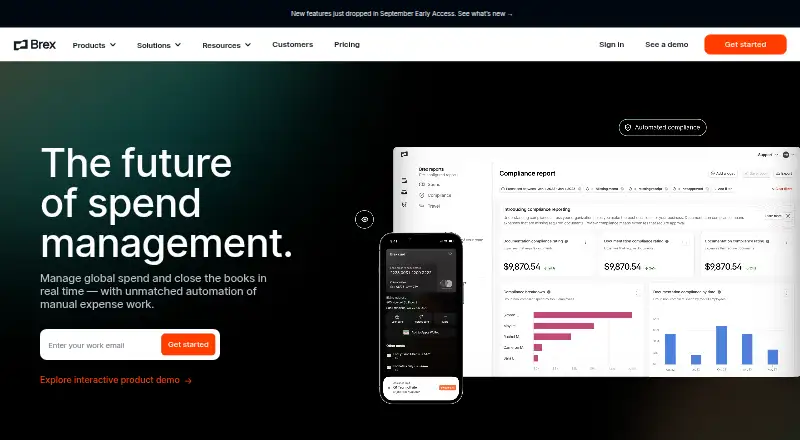
What Brex is
Brex is a spend-management platform for companies, with tools to set spending policies, automate expense work, and track budgets. Policies can be tailored by use case, level, department, or entity, with selected merchants or categories blocked or requiring approval. Expense automation can collect documents, prepare memos, populate fields, assign departments and GLs, and match receipts through OCR across languages and currencies. Live Budgets lets department heads allocate spending to people or teams and monitor usage; Brex AI can flag anomalous activity. Accounting features include QuickBooks and NetSuite integrations and suggested GL coding rules and mappings. Reimbursements can go to local currencies and bank accounts across 40 countries, without per-transaction reimbursement fees. The mobile app supports expense tracking, travel booking and management, spend-limit requests, and payments. Essentials is free and supports up to two entities; Premium is listed at $12 a month. Brex serves startups, scaled companies, and ecommerce brands, including finance leaders and their teams.
Good
- Custom policies can block or require merchant approvals.
- Automates receipt matching across languages and currencies.
- Live Budgets tracks team spending in real time.
- Reimbursements support local accounts in 40 countries.
- Mobile app includes travel and payment tools.
Watch out
- Essentials supports up to two entities.
- Enterprise pricing is custom.
- Some integrations may be add-ons.
Who it suits
Brex suits startups, scaled companies, and ecommerce brands managing organizational spending. Its policy, budget, accounting, and reimbursement tools are relevant to founders, CFOs, and their teams.
Verdict
Brex combines spending controls, expense automation, budgets, and reimbursements for businesses. The free Essentials plan has an entity limit, while the listed Premium plan costs $12 a month.
Plans and prices
From Brex's own pricing page, checked 15 Oct 2026.
| Plan | Price | What it gives you |
|---|---|---|
| Essentials | Free | global cards · AI custom rules · up to two entities · accounting integrations · local currency wires · travel · reporting · API · bill pay · reimbursements · $0 user/month |
| Premium | $12 a month | Essentials plus customizable policies · dynamic review chains · AI compliance audit · advanced approvals · multi-entity · VAT documentation · group travel · live budgets · $12 user/month |
| Enterprise | Priced on request | Premium plus unlimited entities · local card issuance and reimbursements · named account manager · admin center · implementation services · Custom pricing |
| Smart Card | Priced on request | global acceptance · local-currency cards in 50+ countries · merchant controls · custom approvals · Custom pricing |
The facts
Each one read from Brex's own pages, with the date it was checked.
What it does
- Accounting integrations
- Brex names QuickBooks and NetSuite as ERP integrations and says its accounting automation can suggest GL coding rules and mappings.checked 30 Sep 2026
- AI expense automation
- Brex uses AI to generate receipts, memos and attendees, match receipts to transactions, route expenses and suggest accounting coding.checked 15 Oct 2026
- API access terms
- Use of Brex APIs is governed by a Brex Access Agreement that restricts commercialization, marketing use and reverse engineering of Brex data.checked 15 Oct 2026
- API architecture
- The public API is REST-based, specified with OpenAPI, uses JSON over HTTPS and standard HTTP verbs and response codes.checked 15 Oct 2026
- API changelog
- The October 2026 changelog records payment-transfer fields for IMAD and OMAD, while September 2026 added extensive team, department, location and cost-center endpoints and filters.checked 15 Oct 2026
- API coverage
- Published APIs cover accounting, budgets, expenses, fields, onboarding, payments, teams, transactions, travel and webhooks.checked 15 Oct 2026
- Budgets
- Live Budgets lets department heads provision spend to people or teams and track usage in real time, with Brex AI flagging anomalous activity.checked 30 Sep 2026
- Budgets and reporting
- Real-time budget and spend reports cover cards, reimbursements, travel and payments, with configurable filters and AI alerts for unusual spending.checked 15 Oct 2026
- Cards
- The platform supports global cards accepted in more than 210 countries and territories, with local-currency card programs available in more than 50 countries on higher tiers.checked 15 Oct 2026
- Current service status
- On October 15, 2026 the public status page reported all systems operational and no incidents reported that day.checked 15 Oct 2026
- Customers and investors
- Brex says more than 30,000 companies use its products and names Greenoaks, IVP, Tiger Global, Y Combinator, Kleiner Perkins, DST Global, PayPal co-founders and Ribbit Capital among its backers.checked 15 Oct 2026
- Deployment
- TrustRadius classifies Brex as SaaS and lists Apple iOS and Android mobile applications.checked 15 Oct 2026
- Developer documentation
- Brex provides quickstart guidance, endpoint guides, API references, authentication instructions and a developer Slack community.checked 15 Oct 2026
- ERP integrations
- Direct ERP connections include NetSuite, QuickBooks Online, Xero, Sage Intacct, Microsoft Dynamics 365 Business Central, Rillet, Puzzle and Campfire, with additional HRIS and enterprise connectors on paid tiers.checked 15 Oct 2026
- Expense automation
- Brex says it can automatically collect documents, generate memos, populate fields, set departments and GLs, and match receipts using OCR in any language or currency.checked 30 Sep 2026
- Expense controls
- Administrators can create policy rules and spend limits by use case, department, role, entity and other conditions, with controls enforced at purchase time.checked 15 Oct 2026
- Integrations
- Brex says it offers thousands of native integrations; examples on its integrations page include NetSuite, QuickBooks, Slack, Rippling, Workday, and Xero.checked 30 Sep 2026
- Limit: geographic and payment restrictions
- Capterra feedback reports support for only USD accounts, no check payments and relatively high international payment fees.checked 15 Oct 2026
- Limit: negative service experiences
- Trustpilot reviewers repeatedly report unexplained account closures or freezes, sudden credit-limit reductions, verification friction and difficult international wires.checked 15 Oct 2026
- Limit: workflow gaps
- TrustRadius reviewers mention difficulty tracking team usage and submitting reimbursements, plus limited suspicious-spend flagging and confusing transfers between card and bank functions.checked 15 Oct 2026
The company
- Company facts
- Brex is listed as founded in 2017, headquartered in San Francisco, privately held and employing 1,001–5,000 people.checked 15 Oct 2026
- Company ownership
- LinkedIn identifies Brex LLC as a wholly owned subsidiary of Capital One, N.A.checked 15 Oct 2026
- Founded
- 2017checked 23 Sep 2026
Where it runs
- Mobile app
- The Brex mobile app supports expense tracking, travel booking and management, spend limit requests, and payments.checked 30 Sep 2026
The full review of Brex
Brex is a business spend-management platform for teams that need to coordinate company spending, expenses and accounting workflows. It suits startups, scaled companies and ecommerce businesses, particularly finance teams managing multiple departments or entities. Its strongest case is the combination of configurable controls and automated expense work; the Essentials plan’s entity limit is a meaningful constraint as a company grows.
Overview
Brex brings spending policies, budgets, reimbursements and accounting tools into one platform, with mobile support for expense tracking, travel booking and management, spend-limit requests and payments. That breadth is useful for teams seeking a shared process rather than separate tools for each workflow. The trade-off is that plan choice matters: Essentials supports only a limited number of entities, while broader multi-entity coverage starts with Premium.
Key features
Spend controls and budgets
Policies can be set by use case, level, department or entity, and can block specified merchants or categories or require approval. This gives finance teams a way to prevent out-of-policy purchases as well as review them later. Live Budgets lets department heads allocate spending to individuals or teams and monitor use in real time; Brex AI can flag anomalous activity. These controls are a strong fit for organizations that need visibility across teams, though Essentials’ entity cap may not suit a complex corporate structure.
Expense and accounting automation
Brex can collect expense documents, create memos, populate fields, assign departments and general-ledger codes, and match receipts using OCR across languages and currencies. Automating these routine steps can reduce manual expense handling, especially for teams working across currencies. QuickBooks and NetSuite are supported ERP integrations, and accounting automation can suggest GL coding rules and mappings.
Reimbursements, integrations and security
Employees can receive reimbursements in local currency to bank accounts across 40 countries, with no per-transaction reimbursement fees. Brex says it offers thousands of native integrations, including Slack, Rippling, Workday and Xero, alongside its named accounting integrations; some integrations may be add-ons. Its mobile app covers expense tracking, travel booking and management, spend-limit requests and payments.
Brex states that it is SOC 1 Type II, SOC 2 Type II and PCI-DSS compliant, and describes encryption, two-factor authentication and fraud monitoring. It also offers 24/7 support for fraud protection, with support contact through the dashboard or mobile app.
Pricing
Essentials
Essentials costs nothing (billed $0 user/month). It includes up to two entities (1 global entity) and 1 local card program. This is the sensible starting point for a smaller business that can operate within those entity limits; it gives up the multi-entity coverage of Premium and above.
Premium
Premium costs $12 a month (billed $12 user/month) and supports multi-entity operations in the US and internationally. It is the paid step up for a company that has outgrown Essentials’ entity allowance. Some integrations may cost extra.
Enterprise and Smart Card
Enterprise has custom pricing and includes unlimited US or global entities, making it the fit for organizations that need broader entity coverage. Smart Card also has custom pricing and offers local-currency cards in 50+ countries. Choose between them according to whether the priority is unlimited entities or local-currency card coverage.
Platforms
Brex supports Android, iOS, web and API access, giving employees mobile and browser options while allowing connections with other software. Its mobile app also handles expense tracking, travel booking and management, spend-limit requests and payments.
Who it's for
Brex is aimed at startups, scaled companies and ecommerce brands, including founders, CFOs and their teams. It is particularly suited to finance groups that need policy-based approvals, live budget visibility, automated expense processing and reimbursements across countries. A small company with one operating entity may find Essentials sufficient; a business with more entities should account for Premium or custom-priced Enterprise.
Pros and cons
- Pros: Policies can block or route specified categories and merchants for approval, helping teams enforce spending rules before purchases proceed.
- Pros: Expense document collection, receipt matching and accounting-field automation can reduce recurring manual work, including across languages and currencies.
- Pros: Reimbursements reach local bank accounts in 40 countries without per-transaction fees.
- Cons: Essentials is limited to two entities, including one global entity, so companies with more complex structures need a higher tier.
- Cons: Some integrations may be add-ons, which can increase the cost of assembling a preferred software setup.
- Cons: Enterprise and Smart Card use custom pricing, so their cost cannot be compared directly with the fixed-price plans.
Alternatives
Consider Ramp AP if a smaller team wants to simplify finances with a free plan that includes accounts-payable features and automated invoice entry.
Float is worth comparing if a free option with up to 20 physical and unlimited virtual cards, plus QuickBooks Online, Xero or custom exports, better fits your card and accounting needs; conditions and fees apply.
Mesh Payments offers a free Pro plan for up to 3 users and a Premium plan at $13 a month, billed per user, per month. It may suit a very small team that can stay within that free user limit.
Moss has a free plan for up to 3 users, with unlimited cards and up to 20 invoices per month, making it an option for a small team with modest invoice volume.
Rho may suit readers prioritizing a free platform with no subscription, per-user or platform fees, while noting its 1% foreign-currency transfer fee.
BILL Accounts Payable is a paid alternative with a free trial and a $49 a month Essentials plan for Accounts Payable and Accounts Receivable subscription.
PEX is another option to compare for card accounts and reimbursements, with additional cards costing $8 each and ACH reimbursements costing $1 per payment on its Base plan.
ExpenseOnDemand is a paid alternative with an Essential plan at $6.87 a month, billed at $6.87 per active user/month on an annual contract.
For more options, see Spend Management Software, Corporate Card Software, Expense Reimbursement Software, Travel and Expense Management Software and Mileage Tracking Software.
Verdict
Brex is a strong choice for startups and growing or global businesses that want spending controls, budget visibility, expense automation and international reimbursements in one platform. Its main reason to choose it is the breadth of those connected finance workflows; its main reason to look elsewhere is that Essentials stops at two entities and broader coverage requires a paid or custom-priced plan.
Getting started
- Visit the Brex spend management website.
- Choose Essentials at $0 per user/month or Premium at $12 per user/month; Enterprise pricing is custom.
- Use the web, Android, iOS, or API access route.
- Set up policies by use case, level, department, or entity and configure approval or blocking rules.
- Connect accounting tools such as QuickBooks or NetSuite as needed.
Limits worth knowing
Essentials includes up to two entities, including one global entity, and one local card program. Enterprise includes unlimited US or global entities; some integrations may be add-ons.
Questions
Is Brex free?
Yes. Essentials is $0 per user/month. Premium is $12 per user/month, and Enterprise pricing is custom.
Which platforms does Brex support?
Brex is available on Android, iOS, the web, and through an API.
What accounting integrations does Brex name?
Brex names QuickBooks and NetSuite as ERP integrations. Its broader integrations examples also include Slack, Rippling, Workday, and Xero.
Can Brex handle reimbursements internationally?
Brex says employees can be reimbursed in local currency to bank accounts across 40 countries, with no per-transaction reimbursement fees.
What is the difference between Essentials and Enterprise entity limits?
Essentials supports up to two entities, including one global entity. Enterprise supports unlimited US or global entities.
Who makes Brex?
Brex was founded in 2017.