
Baltu
Baltu is a web-based product adoption platform for creating in-app flows, product tours, and onboarding checklists.
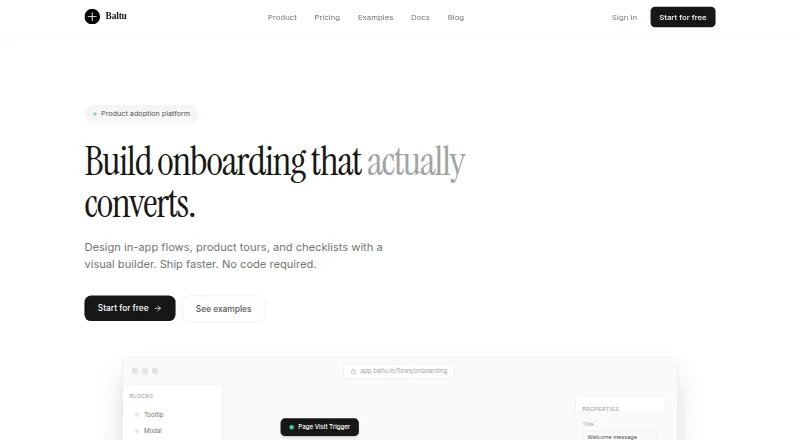
What Baltu is
Baltu is a web-based product adoption platform for creating in-app flows, product tours, and onboarding checklists. Its visual node-based builder supports branching and conditions, while 15 types of interface blocks include tooltips, modals, banners, surveys, resource centers, guide panels, and toasts. Teams can target users by properties, behavior, or dates, combining AND/OR rules and checking estimated audience size live. Per-flow analytics cover views, starts, completions, block performance, trends, and drop-offs. Baltu supports JavaScript and React SDKs with TypeScript, and says eight frameworks work out of the box. It provides separate development, staging, and production environments, versioned publishing, and rollback. Blocks render in the app’s DOM, inherit its fonts and colors, and can take custom CSS. The free plan supports up to 500 MAUs without a credit card. Growth is $49 a month and adds A/B testing, frequency caps, and multi-environment support.
Good
- Visual builder supports branching flows and conditions
- Target users by properties, behavior, or dates
- Analytics include funnels and drop-off analysis
- Separate dev, staging, and production environments
- Free plan covers up to 500 MAUs
Watch out
- Web platform only
- Free plan is limited to 500 MAUs
- A/B testing is listed with Growth
Who it suits
Baltu suits teams that want to guide users through product features with tours, flows, and checklists. Its audience targeting and completion analytics also suit teams monitoring onboarding journeys.
Verdict
Baltu combines in-app guidance tools with audience targeting and per-flow analytics. Its free plan covers up to 500 MAUs, while Growth costs $49 a month and adds testing and other features.
Plans and prices
From Baltu's own pricing page, checked 28 Sep 2026.
| Plan | Price | What it gives you |
|---|---|---|
| Free | Free | Up to 500 MAUs · no credit card required |
| Growth | $49 a month | Includes A/B testing, frequency caps, and multi-environment support · Monthly; no annual contracts, cancel anytime |
The facts
Each one read from Baltu's own pages, with the date it was checked.
What it does
- Analytics
- Per-flow analytics include view, start, and completion funnels, block performance, daily trends, and drop-off analysis.checked 28 Sep 2026
- Design tools
- Baltu lists six style presets, 14 prebuilt block configurations, a reusable component library, and a visual element picker.checked 28 Sep 2026
- Environments
- Baltu supports dev, staging, and production environments with separate API keys, versioned publishing, and rollback.checked 28 Sep 2026
- Flow builder
- Its visual builder uses nodes to create flows with branching logic and conditions.checked 28 Sep 2026
- Installation
- The site describes installation as two lines of code and says flows are delivered based on targeting rules.checked 28 Sep 2026
- Integrations
- Baltu supports Slack and generic webhooks for alerts about broken selectors, flow errors, and completion-rate drops.checked 28 Sep 2026
- Product
- Baltu is a product adoption platform for building in-app flows, product tours, and checklists.checked 28 Sep 2026
- Rendering
- Baltu says its blocks render in the app's DOM rather than an iframe, inherit app fonts and colors, and allow custom CSS overrides.checked 28 Sep 2026
- SDK
- The lightweight JavaScript and React SDK has TypeScript support, and the site says eight frameworks are supported out of the box.checked 28 Sep 2026
- Targeting
- Users can be targeted by properties, behavior, or dates, with AND/OR conditions and live audience estimates.checked 28 Sep 2026
- UI blocks
- Baltu lists 15 UI block types, including tooltips, modals, banners, surveys, resource centers, guide panels, and toasts.checked 28 Sep 2026
The full review of Baltu
Baltu is a web-based product-adoption platform for creating in-app flows, tours, and checklists. It fits product teams that need audience-specific guidance and clear evidence of where users disengage. Its focused adoption toolkit is a better match than a general analytics suite when in-product instruction is the priority.
Overview
Baltu combines flow authoring, user targeting, and analysis at the individual-flow level. Teams can build guided tours, onboarding checklists, and resource-center content, then decide who receives each experience using user properties, behavior, and dates. AND/OR conditions and live audience estimates make segmentation more practical than sending one sequence to every user.
The product is designed for guidance inside a web application. Its installation is described as two lines of code, after which targeting rules determine delivery. That narrow focus is useful for onboarding and feature adoption, but teams looking primarily for broad product-usage reporting should consider a more analytics-led product.
Key features
Flow building and interface design
The visual builder uses nodes, branching logic, and conditions, so a flow can respond to what a user does instead of forcing a single linear path. Baltu lists 15 block types, including tooltips, modals, banners, surveys, resource centers, guide panels, and toasts. This range supports short prompts, richer explanations, feedback collection, and an always-available help surface in the same system.
Six style presets, 14 prebuilt block configurations, reusable components, and a visual element picker provide a repeatable starting point for teams producing multiple flows. Baltu says blocks render in the application DOM rather than an iframe, inherit the app's fonts and colors, and accept custom CSS overrides. That approach can produce a more native-looking experience, while CSS overrides require teams to maintain their own presentation rules.
Targeting and measurement
Targeting can combine properties, behavior, or dates with AND/OR conditions, and live audience estimates show the likely reach before publication. Per-flow analytics include view, start, and completion funnels, block-level performance, daily trends, and drop-off analysis. These reports connect a specific onboarding step to its outcome, which is more actionable than a single completion number.
Reliability and integrations
Slack and generic webhooks can alert teams to broken selectors, flow errors, and drops in completion rate. The lightweight JavaScript and React SDK includes TypeScript support, and Baltu says eight frameworks are supported out of the box. Development, staging, and production environments use separate API keys, with versioned publishing and rollback. Those controls suit teams that need to separate releases from live guidance, rather than editing production content without a recovery path.
Pricing
The Free plan costs nothing and supports up to 500 MAUs. No credit card is required, making it appropriate for small products, prototypes, or teams validating an onboarding program. The 500-MAU ceiling is the important trade-off: products above that audience size will need a paid plan or another tool.
Growth costs $49 a month, billed Monthly, with no annual contracts and cancellation anytime. It adds A/B testing, frequency caps, and multi-environment support. Choose it when experiments, control over how often users see prompts, and separated deployment environments justify a recurring charge. Teams that only need basic flows and remain under 500 MAUs can stay on Free; teams needing those controls cannot get them from the cheaper tier.
Platforms
Baltu is a web platform. Its JavaScript and React SDK, TypeScript support, and stated support for eight frameworks are relevant to teams embedding guidance in web applications.
Who it's for
Baltu is best for product, growth, and customer-success teams responsible for web onboarding or feature adoption. It is particularly suitable when different segments need different paths and when completion funnels and block-level drop-offs must inform iteration. Small teams can start without payment, while growing products can use Growth's testing, frequency controls, and environment separation. It is less suitable for organizations seeking a broad analytics suite rather than an in-app guidance system.
Pros and cons
Pros
- Branching flow builder: Node-based conditions support journeys that react to user behavior instead of relying only on linear tours.
- Detailed flow reporting: Funnel stages, block performance, trends, and drop-offs show where a guide succeeds or loses users.
- Operational safeguards: Separate environments, versioned publishing, rollback, and failure alerts reduce the risk of unnoticed guidance breakage.
- Native presentation options: DOM rendering, inherited app styling, and CSS overrides can keep prompts visually consistent with the product.
Cons
- Small free-plan audience: The 500-MAU limit can force a growing product onto paid pricing quickly.
- Web-only platform: Teams needing native Android or iOS delivery will need another solution.
- Focused scope: Baltu centers on adoption flows and their performance rather than serving as a broad product-analytics platform.
Alternatives
Pendo Analytics is the stronger choice when you need product analytics and in-app guides across Android, iOS, and web; its free plan covers 500 monthly active users and includes unlimited web and mobile app keys.
Stonly suits teams seeking a guide-focused product with a free tier limited to 400 guide views per month, five published guides, one language, 100 steps per guide, and one team member.
Wakeline is worth choosing when a larger free audience matters: its Free plan allows 1,000 monthly active users, three flows, and one teammate, while Pro is $41 a month billed annually.
Driver.js is a free option for developers who want unlimited projects and personal or commercial use without attribution requirements.
Flook is aimed at widget deployment, with a free free plan that includes paid-plan features but watermarks widgets.
Dock is a broader workspace and content platform, with its Free plan covering 10 workspaces and specified CMS, slide, playbook, course, and order-form limits.
StepBeam is an alternative for teams wanting up to 1,000 MAU, three seats, one application, basic analytics, and community support on its free plan.
Synerdeck is oriented toward client portals and templates rather than in-app product adoption.
For a wider category comparison, see Customer Onboarding Software.
Verdict
Choose Baltu if your priority is targeted web onboarding with branching flows and actionable per-flow completion data. Its strongest case is the combination of audience rules, native-looking blocks, and release controls in one focused tool. Look elsewhere if you need mobile apps, a broader analytics suite, or a free plan that supports more than 500 MAUs.
Alternatives to Baltu
- 1

StepBeam
Free planWebAPI7.5From $124 a month - 2

Wakeline
Free planAndroidiOSWebExtension7.5From $41 a month - 3
Flook
Free planWebExtension7.3From $39 a month - 4

Chameleon
WebAPIExtension7.2From $279 a month - 5
GatherMonk
WebExtension7.2From $29 a month - 6

Inline Manual
WebAPIExtensionSelf-hosted7.2From $3 a month