
AppsFlyer Data Clean Room
AppsFlyer Data Clean Room lets organizations match first-party user-level data with AppsFlyer attribution data, then share aggregated reports without exposin…
What AppsFlyer Data Clean Room is
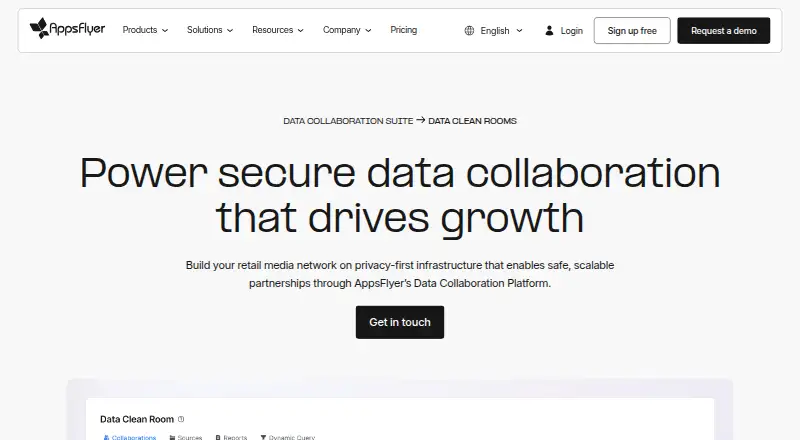
AppsFlyer Data Clean Room lets organizations match first-party user-level data with AppsFlyer attribution data, then share aggregated reports without exposing raw data to collaborators. It is part of AppsFlyer’s Data Collaboration Platform, which is positioned for retail media networks and privacy-safe partnerships. Data owners control roles, access levels, and query rights. To create reports, users select sources, join identifiers, metrics, grouping dimensions, and a cloud destination for processed results. Dynamic Query supports real-time custom SQL across attribution data and custom sources, with previews and downloadable results. It does not return Meta attribution data; AppsFlyer directs users to DCR reports for that data. Supported cloud services include BigQuery and Snowflake warehouses, and Amazon S3 and Google Cloud Storage buckets. Sources need a shared unique app-user identifier, while warehouse tables need date and version columns. Listed privacy technologies include encryption, anonymization, federated processing, and differential privacy. AppsFlyer was founded in 2011. The product is available on Android, iOS, web, and API, and has a free plan. Data Collaboration Platform pricing depends on processed data volume and simultaneous collaboration entities. AppsFlyer lists annual third-party security audits and certifications including ISO 27001 and SOC 2.
Good
- Shares aggregated reports rather than raw data.
- Data owners can set roles, access levels, and query rights.
- Supports custom SQL queries with previews and downloadable results.
- Connects with BigQuery, Snowflake, Amazon S3, and Google Cloud Storage.
- Lists encryption, anonymization, federated processing, and differential privacy.
Watch out
- Dynamic Query does not return Meta attribution data.
- Sources need a shared unique app-user identifier to match.
- Warehouse tables require date and version columns.
- Platform pricing scales with data volume and simultaneous collaboration entities.
Who it suits
It suits retail media networks and organizations seeking privacy-oriented collaboration using attribution and first-party data. Teams that need controlled data access, aggregated reporting, or SQL analysis may find its reporting options relevant.
Verdict
Choose AppsFlyer Data Clean Room if your organization needs aggregated collaboration around first-party and attribution data with defined access controls. Look elsewhere if Meta attribution must be returned directly through Dynamic Query or your sources cannot meet its matching requirements.
Plans and prices
From AppsFlyer Data Clean Room's own pricing page, checked 15 Oct 2026.
| Plan | Price | What it gives you |
|---|---|---|
| Zero | Free | Owned-media activities · 12,000 welcome conversions in first year · core analytics · 30-day select add-ons · not suitable for paid activities · Free forever |
| Growth | $0.07 a month | Basic mobile attribution · 12,000 welcome conversions in first year · 30-day select add-ons · Pay-as-you-go; $0.07 per conversion after welcome package |
| Data Clean Room | Priced on request | Premium feature · Pricing not listed publicly · Contact AppsFlyer for details |
| Enterprise | Priced on request | Cross-channel attribution · signal-loss mitigation · ROAS optimization · user-acquisition scaling · AI insights · fraud prevention · Custom pricing |
The facts
Each one read from AppsFlyer Data Clean Room's own pages, with the date it was checked.
What it does
- Ad hoc queries
- Dynamic Query supports real-time custom SQL queries on attribution data and custom sources, with preview and downloadable results.checked 30 Sep 2026
- Aggregated outputs
- Reports are delivered in aggregated form so collaborators do not receive raw user data.checked 15 Oct 2026
- API and SDKs
- AppsFlyer publishes API references and SDK installation guides for Android, iOS and Unity.checked 15 Oct 2026
- Audience
- AppsFlyer describes the Data Clean Room within its Data Collaboration Platform for retail media networks and privacy-safe partnerships.checked 30 Sep 2026
- Automated uploads
- Source pipelines use date, version and data folders, with an _SUCCESS marker file to trigger report processing; APIs can automate folder creation and uploads.checked 15 Oct 2026
- Braze integration
- The Braze integration uses a Snowflake data share and requires matching AppsFlyer CUID values to Braze external_user_id values.checked 15 Oct 2026
- Cloud data sources
- The clean room supports BigQuery and Snowflake data warehouses plus Amazon S3 and Google Cloud Storage buckets.checked 15 Oct 2026
- Cloud integrations
- Supported DCR cloud services are BigQuery and Snowflake data warehouses and Amazon S3 and Google Cloud Storage buckets.checked 30 Sep 2026
- Data processing policy
- AppsFlyer states that it does not sell end-user personal data and shares it only for customer-directed integrations, service operations, legal obligations, safety or corporate transactions.checked 15 Oct 2026
- Documentation depth
- The Data Clean Room knowledge base includes overview, cloud setup, connections, sources, reports, attribution reports, in-app-event reports and dynamic-query articles.checked 15 Oct 2026
- Flexible activation
- The broader Data Collaboration Platform supports audience building, campaign activation and measurement across channels.checked 15 Oct 2026
- Funding news
- Crunchbase News reported on June 22, 2026 that AppsFlyer raised more than $1 billion in Series E funding at a reported $2.7 billion post-money valuation.checked 15 Oct 2026
- Identifier requirement
- Each source must share an identifier field that uniquely identifies an app user with another source before datasets can be matched.checked 15 Oct 2026
- Input requirements
- Sources must share at least one unique app-user identifier to be matched, and warehouse tables require date and version columns.checked 30 Sep 2026
- Integration requirements
- The Braze integration requires a Braze subscription with Snowflake Secure Data Sharing and both the Braze and AppsFlyer SDKs integrated into the app.checked 30 Sep 2026
- Licence
- The terms grant limited, non-transferable access and prohibit reverse engineering, copying or creating derivative works, indicating a proprietary service rather than open-source software.checked 15 Oct 2026
- Limit: pricing and data accuracy
- G2 reviewers repeatedly complain that pricing is expensive or unclear and report data inaccuracies or inflated analytics.checked 15 Oct 2026
- Limit: Trustpilot complaints
- Trustpilot reviewers post complaints about unexplained charges, inability to remove payment cards, service suspension and poor support; some reviews describe scams using the AppsFlyer name.checked 15 Oct 2026
The company
- Company founded
- AppsFlyer was founded in 2011.checked 15 Oct 2026
- Company founders
- Crunchbase lists Oren Kaniel and Reshef Mann as co-founders.checked 15 Oct 2026
- Company headquarters and size
- LinkedIn lists San Francisco, California headquarters and a company size of 1,001–5,000 employees.checked 15 Oct 2026
- Company legal name
- Crunchbase lists the legal name as AppsFlyer Ltd.checked 15 Oct 2026
- Founded
- 2011checked 28 Sep 2026
Money
- Limit: reporting and cost
- TrustRadius reviewers cite limited custom reports, short raw-data lookback windows, confusing exports, UI issues and pricing that can exclude smaller teams.checked 15 Oct 2026
The full review of AppsFlyer Data Clean Room
AppsFlyer Data Clean Room matches first-party user data with AppsFlyer attribution data and returns privacy-preserving, aggregated reporting. It suits retail media networks and other partners already operating in the AppsFlyer ecosystem. Choose it when governed collaboration matters more than unrestricted raw-data access; otherwise, its matching prerequisites and volume-based pricing may be a poor fit.
Overview
Data owners define roles, access levels, and query rights, while collaborators receive aggregated results instead of user-level records. That separation supports joint measurement without exposing underlying identities. The service runs in the cloud and requires every source to provide at least one shared unique app-user identifier. Warehouse tables also need date and version columns, so unprepared datasets may require additional engineering before they can participate.
AppsFlyer positions the product within its Data Collaboration Platform for retail media networks and privacy-safe partnerships. Encryption, anonymization, federated processing, and differential privacy add layers of protection. AppsFlyer also says its security program receives annual third-party audits and cites ISO 27001, ISO 27017, ISO 27018, ISO 27032, ISO 27701, and SOC 2 certifications.
Key features
Report configuration lets teams select sources, join identifiers, metrics, grouping dimensions, and a destination for processed output. This is useful for repeatable measurement programs with clearly defined schemas, while the identifier and table rules make data readiness a practical gate.
Dynamic Query provides real-time custom SQL over attribution data and custom sources, including a preview and downloadable results. It is a strong option for exploratory analysis and bespoke questions, but it does not return Meta attribution data. Meta-related queries must instead be built as DCR reports, an important limitation for teams whose measurement depends on that channel.
Processed reports can be sent to BigQuery or Snowflake data warehouses, or to Amazon S3 and Google Cloud Storage buckets. These destinations fit organizations with established cloud data workflows rather than teams seeking a standalone desktop or on-premises tool.
An open-beta enrichment program lists Braze, Start.io, Techsalerator, and Evorra. The Braze connection has concrete prerequisites: a Braze subscription with Snowflake Secure Data Sharing, plus both Braze and AppsFlyer SDKs integrated into the app. AppsFlyer supports audit logs, offline data attribution, privacy-safe matching, SQL analysis, aggregated output, and cloud deployment.
Pricing
AppsFlyer uses a freemium model and offers a free plan, but the Data Clean Room plan is a premium feature with custom pricing: contact AppsFlyer for details. Pricing for the broader Data Collaboration Platform scales with processed data volume and the number of simultaneous collaboration entities. That structure can suit organizations whose activity varies, but budgeting requires estimating both data throughput and partner concurrency rather than counting seats alone.
The free-plan label makes initial evaluation possible, yet no quota, seat allowance, trial duration, or renewal terms are provided. Larger collaborations should expect a sales-led discussion and should clarify how volume and simultaneous entities affect the bill before committing.
Platforms
AppsFlyer Data Clean Room is delivered as a cloud service with Android, iOS, web, and API support. Its warehouse and object-storage destinations make it practical for teams integrating outputs into existing data platforms, while the API option supports programmatic workflows.
Who it's for
Retail media networks, app marketers, and privacy-conscious partners already using AppsFlyer are the natural audience. It is particularly suitable when several organizations need shared attribution or first-party analysis but must keep raw records concealed and access tightly governed.
Look elsewhere if your sources cannot expose a common app-user identifier, your warehouse tables lack required date and version fields, or your analysts need Meta attribution returned directly through Dynamic Query. Organizations without BigQuery, Snowflake, Amazon S3, or Google Cloud Storage workflows may also face unnecessary integration effort.
Pros and cons
- Pros: Role, access, and query-right controls limit who can request or receive results.
- Pros: Aggregated output and privacy technologies support collaboration without sharing raw user data.
- Pros: SQL, configurable reports, previews, downloads, and multiple cloud destinations cover both ad hoc and operational analysis.
- Pros: Audit logs, offline attribution, and a broad certification portfolio strengthen governance requirements.
- Cons: A shared unique identifier is mandatory, and warehouse tables need date and version columns.
- Cons: Dynamic Query excludes Meta attribution, forcing those analyses into DCR reports.
- Cons: Usage-based custom pricing makes costs harder to predict as data volume or partner count grows.
Alternatives
For a directory of options, see Data Clean Room Software and Marketing Attribution Software.
- Placino is a freemium API and web option with a Free plan at no cost for 500K datapoints per month, one clean room, and up to three partners; choose it when those explicit starter limits fit.
- Amazon Marketing Cloud is a free API and web service available at no cost to eligible advertisers; pick it when eligibility and Amazon’s environment align.
- Snowflake CoCo is a paid product with a free trial and broader platform coverage; consider it when that commercial model and platform range suit your deployment.
- BigQuery Data Clean Rooms is free with contributor and subscriber roles; choose it when a BigQuery-centered clean-room workflow is preferred.
- Decentriq Data Clean Rooms is a paid service with demo-based pricing.
- Permutive is a paid Android, iOS, and web platform without a free trial.
- InfoSum Data Clean Room is a paid API and web service.
- Vendia Distributed Data Clean Rooms offers custom pricing for API and web deployments.
Verdict
AppsFlyer Data Clean Room is a strong choice for AppsFlyer-based retail media and partnership teams that need aggregated, access-controlled collaboration across first-party and attribution data. Its configurable reports, SQL tools, cloud destinations, and privacy governance are compelling, but strict matching requirements, Meta’s Dynamic Query exception, and custom volume-based pricing are clear reasons to choose another platform when those constraints do not fit.
Getting started
- Visit the AppsFlyer Data Clean Room product page.
- Use the free plan to get started.
- Prepare sources with at least one shared unique app-user identifier.
- Include date and version columns in warehouse tables.
- Choose sources, join identifiers, metrics, grouping dimensions, and a cloud destination for reports.
- Connect a supported cloud service such as BigQuery, Snowflake, Amazon S3, or Google Cloud Storage.
Limits worth knowing
Dynamic Query excludes Meta attribution data, which AppsFlyer says should be queried through DCR reports. Matching requires a shared unique app-user identifier, and warehouse tables require date and version columns.
Questions
Is there a free plan?
Yes. AppsFlyer lists a free plan for Data Clean Room.
How is pricing determined?
Data Collaboration Platform pricing scales with processed data volume and the number of simultaneous collaboration entities. The Data Clean Room plan price is not publicly listed.
Which platforms are supported?
The listed platforms are Android, iOS, web, and API.
Can users run SQL queries?
Yes. Dynamic Query supports real-time custom SQL on attribution data and custom sources, with preview and downloadable results. It does not return Meta attribution data.
Which cloud services can receive reports?
Supported services are BigQuery and Snowflake warehouses, plus Amazon S3 and Google Cloud Storage buckets.
Which privacy and security measures are listed?
The product lists encryption, anonymization, federated processing, and differential privacy. AppsFlyer also says its security program has annual third-party audits and lists ISO certifications and SOC 2.
Alternatives to AppsFlyer Data Clean Room
- 1
Amazon Marketing Cloud
Free planWebAPI7.0Free plan - 2

Permutive
AndroidiOSWeb6.6 - 36.3From $79 a month
- 4
 6.1
- 5

Placino
Free planWebAPI6.1Free plan - 6
Salesforce Data 360
WebAPI6.0From $240 a year