
Decentriq Data Clean Rooms
Decentriq Data Clean Rooms lets organizations collaborate on data analysis without handing one another the underlying records.
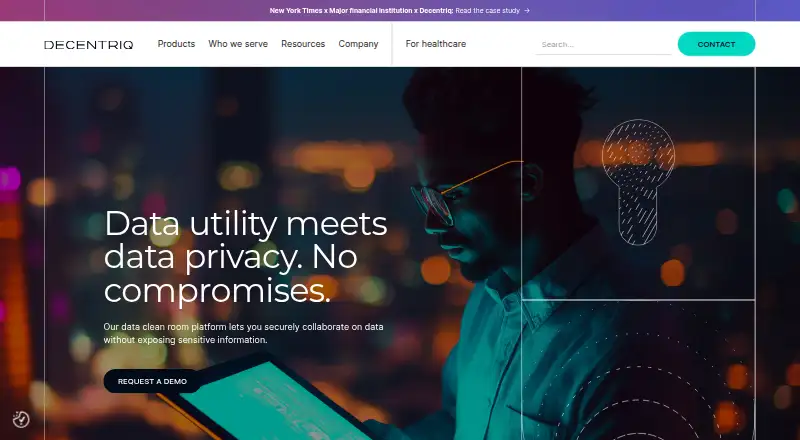
What Decentriq Data Clean Rooms is
Decentriq Data Clean Rooms lets organizations collaborate on data analysis without handing one another the underlying records. Participants can receive approved, aggregated results, while encryption and confidential computing keep raw data private to its owner. Business users can create insights and custom audiences through no-code workflows; more specialized collaborations can use Python, SQL, and R. In the no-code version, only approved aggregated insights and audience identifiers can leave the clean room. Advanced Analytics requires data-owner approval before outside parties can access results, and both versions provide a tamper-proof audit log. The platform offers API and SDK access, with built-in connectors for importing data from Amazon S3 and Snowflake and exporting to Amazon S3 and Meta Ads Manager. Decentriq identifies advertisers, publishers, data partners, retailers, agencies, and healthcare organizations as users. It is available through web and API, with cloud deployment and pricing on request.
Good
- No-code workflows support insights and custom audiences.
- Advanced Analytics supports Python, SQL, and R.
- Data owners approve advanced computations before access.
- Connectors include Amazon S3 and Snowflake.
- Both versions provide tamper-proof audit logs.
Watch out
- Paid service with pricing available on request.
- Data onboarding requires support from a customer's data team.
- No-code outputs are limited to approved insights and audience identifiers.
Who it suits
It suits organizations that need privacy-controlled collaboration on data, including advertisers, publishers, retailers, agencies, data partners, and healthcare organizations. Business users can work without code, while advanced collaborations can involve analysts and data scientists.
Verdict
Decentriq combines privacy controls with no-code and advanced analysis options for multi-party data work. Prospective customers need to contact the company or schedule a demo for pricing and product details.
Plans and prices
From Decentriq Data Clean Rooms's own pricing page, checked 3 Oct 2026.
| Plan | Price | What it gives you |
|---|---|---|
| Data Clean Rooms | Priced on request | Pricing not listed; request a demo |
The facts
Each one read from Decentriq Data Clean Rooms's own pages, with the date it was checked.
What it does
- Advanced analytics
- Custom collaborations support Python, SQL, and R for advanced analytics use cases.checked 3 Oct 2026
- API and SDK
- The product page describes API/SDK access for integration and automation with a customer's tech stack.checked 3 Oct 2026
- Business users
- Business users can gain insights and build custom audiences without writing code.checked 3 Oct 2026
- Getting started
- A customer's data team needs to support data onboarding; analysts can use the no-code clean room independently, while sophisticated Advanced Analytics collaborations involve data scientists.checked 3 Oct 2026
- Governance
- In Advanced Analytics clean rooms, data owners must approve computations before external parties can access results, and both versions provide a tamper-proof audit log.checked 3 Oct 2026
- Integrations
- Its publisher page identifies Amazon S3, Azure, Google Cloud, Snowflake, and Salesforce among data onboarding connectors, and Meta Ads Manager as an audience export connector.checked 3 Oct 2026
- Intended users
- The company describes the platform for advertisers, publishers, data partners, retailers, agencies, and healthcare organizations.checked 3 Oct 2026
- No-code workflows
- Business users can gain insights and build custom audiences without writing code.checked 3 Oct 2026
- Output controls
- The no-code version allows only approved aggregated insights and audience identifiers to leave the clean room.checked 3 Oct 2026
- Output limits
- The no-code version allows only approved aggregated insights and audience identifiers to leave the clean room.checked 3 Oct 2026
- Partner network
- The partner network includes data partners, demand partners, intermediaries, and publishers, with examples including The New York Times, The Wall Street Journal, Vodafone, and YouGov.checked 3 Oct 2026
- Privacy technology
- The platform uses advanced encryption and confidential computing to keep raw data private and inaccessible to anyone other than its owner.checked 3 Oct 2026
- Purpose
- The platform lets multiple parties combine and analyze data under privacy controls without exposing raw data; participants receive approved, aggregated results.checked 3 Oct 2026
- Sales and support
- Decentriq invites customers to contact the company or schedule a demo to learn more about the product.checked 3 Oct 2026
- Scale
- The product page says the platform can process datasets of hundreds of GBs.checked 3 Oct 2026
- Security
- Decentriq says it supports SSO and SOC 2 certification and can process datasets of hundreds of gigabytes.checked 3 Oct 2026
- Security certification
- The product page states that Decentriq has SOC2 certification and supports single sign-on for user authentication.checked 3 Oct 2026
- Target users
- The product page identifies advertisers, publishers, data partners, retailers, agencies, and healthcare organizations as audiences for its data clean rooms.checked 3 Oct 2026
- Use cases
- Publisher features include audience insights, remarketing, exclusion targeting, AI lookalike audiences, conversion lift, and incremental reach measurement.checked 3 Oct 2026
Where it runs
- Approvals and audit
- In Advanced Analytics, data owners must approve computations before external parties can access results; both versions offer a transparent, tamper-proof audit log.checked 3 Oct 2026
The company
- Founded
- 2019checked 28 Sep 2026
- Headquarters
- Zürich, Switzerlandchecked 28 Sep 2026
The full review of Decentriq Data Clean Rooms
Decentriq Data Clean Rooms is a cloud service for organizations that need to match and analyze partner data without exchanging raw records. It suits publishers, advertisers, retailers, agencies, healthcare organizations and other teams with strict data-governance needs. Its combination of no-code audience work and code-based analysis is compelling, although custom pricing means a buying decision starts with a sales conversation.
Overview
Decentriq lets several parties collaborate inside a controlled environment while each data owner keeps its source data private. Participants receive approved, aggregated results rather than unrestricted extracts. Advanced encryption and confidential computing are intended to prevent anyone other than the owner from accessing raw data, making the service appropriate where ordinary file sharing would create unacceptable exposure.
The platform is cloud deployed and accessible through web and API interfaces. A customer’s data team must handle onboarding, after which analysts can use the no-code environment independently. More sophisticated collaborations require data scientists, so the product is better suited to organizations with technical and governance resources than to casual, one-off data projects.
Key features
Controlled collaboration
No-code workflows let business users generate insights and build custom audiences without writing code. The output boundary is deliberately narrow: only approved aggregated insights and audience identifiers can leave the clean room. That is a strong safeguard for marketing activation, but it will not satisfy teams that need unrestricted row-level exploration or raw-data exports.
Advanced analytics and governance
Advanced Analytics collaborations support Python, SQL and R, giving data scientists substantially more flexibility than the no-code path. Data owners must approve computations before outside parties can access results, and both versions include a transparent, tamper-proof audit log. These controls add accountability to multi-party work, though approval procedures can introduce friction when analyses need frequent iteration.
Integration and scale
API and SDK access support integration and automation with an existing technology stack. Built-in connectors import from Amazon S3 and Snowflake and export to Amazon S3 and Meta Ads Manager, reducing custom pipeline work for teams using those systems. Decentriq says it can process datasets of hundreds of gigabytes, which places it in the range of substantial enterprise collaborations rather than small personal datasets.
Security and use cases
SOC 2 certification and single sign-on support enterprise authentication and oversight. Publisher-oriented applications include audience insights, remarketing, exclusion targeting, AI lookalike audiences, conversion-lift analysis and incremental-reach measurement. Its partner network spans data partners, demand partners, intermediaries and publishers, with examples such as The New York Times, The Wall Street Journal, Vodafone and YouGov.
Pricing
The Data Clean Rooms plan uses custom pricing; Decentriq directs prospective customers to request a demo. No public seat allowance, usage quota, trial period or renewal term is provided, so buyers should ask sales to scope onboarding, data volumes, partner participation and support as part of the quote. This model can make sense for organizations planning recurring, multi-party programs, but it offers little budget clarity for smaller teams comparing products.
Platforms
Decentriq Data Clean Rooms runs in the cloud and is offered through web and API access. SDK support is intended for integration and automation rather than as a separate end-user platform.
Who it's for
Advertisers and publishers can use the service for privacy-safe audience analysis and activation. Retailers, agencies and data partners gain a governed way to combine signals without handing over source records, while healthcare organizations can use the same controls where confidentiality is central. Choose it when multiple organizations need auditable matching or analysis and can provide data-engineering and, for Advanced Analytics, data-science support. It is a poor fit for an individual analyst seeking a self-serve, low-cost tool or for projects that require raw-data access outside the clean room.
Pros and cons
Pros
- Strong privacy boundary: encryption, confidential computing and owner-controlled raw data reduce exposure during collaboration.
- Two analysis modes: no-code audience work serves business users, while Python, SQL and R support specialist investigations.
- Auditable governance: computation approvals and tamper-proof logs make partner activity traceable.
- Enterprise integration: API/SDK access plus S3, Snowflake and Meta Ads Manager connectors support operational workflows.
- Large-data capability: stated support for datasets of hundreds of gigabytes fits substantial programs.
Cons
- Custom pricing only: prospects cannot estimate cost from published rates or quotas.
- Onboarding effort: a customer data team is needed to bring data into the service.
- Technical staffing for depth: Advanced Analytics collaborations involve data scientists and owner approvals.
- Restricted no-code outputs: only approved aggregates and audience identifiers can leave, limiting exploratory use.
Alternatives
For a broader shortlist, see Data Clean Room Software.
- Placino is worth choosing when a freemium entry point matters: its Free plan costs nothing, allows 500K datapoints per month, one clean room and up to three partners, with community support; Pilot is a billed proof-of-concept engagement with 5M datapoints per month.
- Amazon Marketing Cloud is the alternative for eligible advertisers wanting a no-cost service available through web and API access.
- AppsFlyer Data Clean Room suits teams already operating across Android, iOS, web and API channels; its premium Data Clean Room pricing is handled by contacting AppsFlyer, and a free plan is available.
- Snowflake CoCo is a paid option with a free trial and broad support across API, Linux, macOS, web and Windows.
- BigQuery Data Clean Rooms is a free alternative with separate contributor and subscriber roles and web/API access.
- Permutive is a paid publisher-focused option for Android, iOS and web.
- InfoSum Data Clean Room is another paid service with API and web access.
- Vendia Distributed Data Clean Rooms is a paid API/web option using custom pricing.
Verdict
Choose Decentriq when several organizations need privacy-safe, auditable data collaboration and you value both no-code workflows and serious Python, SQL and R analysis. Look elsewhere if published pricing, a self-serve free tier or unrestricted data exploration is more important than its governance and privacy controls.
Alternatives to Decentriq Data Clean Rooms
- 1

AppsFlyer Data Clean Room
Free planAndroidiOSWebAPI7.9$0.07 usage-based - 2
Amazon Marketing Cloud
Free planWebAPI7.0Free plan - 3

Permutive
AndroidiOSWeb6.6 - 46.3From $79 a month
- 5
 6.1
- 6

Placino
Free planWebAPI6.1Free plan