
BigQuery Data Clean Rooms
BigQuery Data Clean Rooms let multiple parties share, join, and analyze data without transferring or exposing the underlying data.
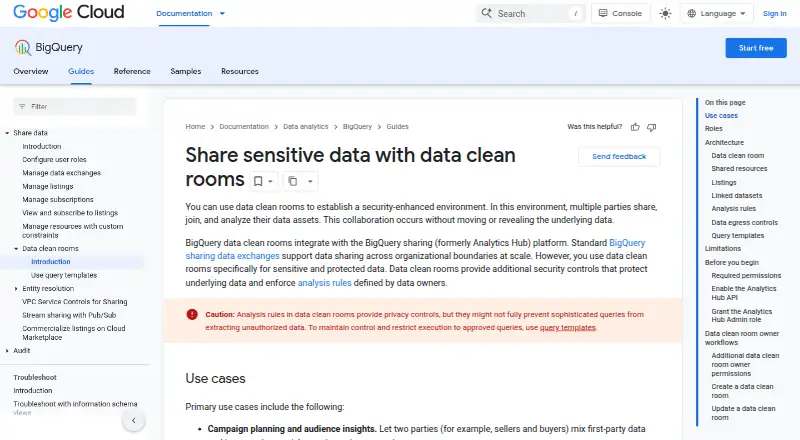
What BigQuery Data Clean Rooms is
BigQuery Data Clean Rooms let multiple parties share, join, and analyze data without transferring or exposing the underlying data. The cloud service connects to BigQuery sharing, and shared resources must be BigQuery tables, views, or table-valued functions. Owners manage rooms, contributors publish data, and subscribers query it. Contributors can set analysis rules, including aggregation thresholds, to limit the ways subscribers analyze shared data. Query templates let owners and publishers offer predefined queries without exposing underlying tables or views. The service blocks subscribers from copying or exporting raw data, and contributors can configure controls for query results. Google cautions that analysis rules may not stop sophisticated queries from extracting unauthorized data, and recommends templates when approved-query control is needed. A room can contain up to 100 shared resources; availability is limited to BigQuery sharing regions, without multi-region listings. Rooms can be managed in the Google Cloud console or created through the API. Contributors pay for data storage, while subscribers pay for compute when they run queries. Setup requires enabling the Analytics Hub API and assigning required IAM roles.
Good
- Raw data copying and exporting are blocked for subscribers
- Contributors can set aggregation analysis rules
- Query templates provide predefined query options
- Supports console management and API creation
- Storage and query compute costs are separated
Watch out
- A room holds at most 100 shared resources
- Availability is limited to BigQuery sharing regions
- Analysis rules may not stop sophisticated extraction queries
- Setup requires API enablement and IAM role assignment
Who it suits
It suits organizations that need to share and analyze data across parties while keeping underlying data in place. Contributors can govern query access, while subscribers can run queries against shared resources.
Verdict
BigQuery Data Clean Rooms provide role-based sharing and configurable analysis controls for collaborative data work. The resource cap, regional availability, setup requirements, and stated limits of analysis rules should factor into a deployment decision.
Plans and prices
From BigQuery Data Clean Rooms's own pricing page, checked 20 Sep 2026.
| Plan | Price | What it gives you |
|---|---|---|
| Data contributor | Priced on request | Publishes data to a clean room |
| Data clean room subscriber | Priced on request | Subscribes to and queries clean-room data |
The facts
Each one read from BigQuery Data Clean Rooms's own pages, with the date it was checked.
What it does
- Access setup
- Using data clean rooms requires enabling the Analytics Hub API and assigning the required IAM roles, including Analytics Hub Admin for owners.checked 2 Oct 2026
- Analysis controls
- Contributors can configure analysis rules, including aggregation thresholds, to restrict how subscribers query shared data.checked 2 Oct 2026
- BigQuery sharing
- Data clean rooms integrate with the BigQuery sharing platform, formerly called Analytics Hub.checked 3 Oct 2026
- Egress controls
- Data egress controls automatically prevent subscribers from copying or exporting raw data, and contributors can add controls for query results.checked 3 Oct 2026
- Interfaces
- The documentation describes managing clean rooms in the Google Cloud console and creating them through the API.checked 2 Oct 2026
- Limitations
- Analysis rules can be set only on views, and Google cautions that rules might not prevent sophisticated queries from extracting unauthorized data.checked 3 Oct 2026
- Pricing
- Data contributors are charged only for data storage, and subscribers are charged only for compute when they run queries.checked 3 Oct 2026
- Pricing basis
- Contributors are charged for data storage, while subscribers are charged for compute when they run queries.checked 2 Oct 2026
- Privacy controls
- Contributors can configure analysis rules, including an aggregation threshold rule that allows subscribers to analyze data only through aggregation queries.checked 3 Oct 2026
- Privacy limitation
- Google cautions that analysis rules might not prevent sophisticated queries from extracting unauthorized data and recommends query templates for approved-query control.checked 2 Oct 2026
- Purpose
- BigQuery data clean rooms let multiple parties share, join, and analyze data without moving or revealing the underlying data.checked 3 Oct 2026
- Query templates
- Owners and publishers can share predefined queries through query templates without sharing the underlying tables or views.checked 3 Oct 2026
- Regional availability
- Data clean rooms are available only in BigQuery sharing regions, and listings for multiple regions are unsupported.checked 3 Oct 2026
- Resource limit
- A data clean room can contain at most 100 shared resources; Google directs users to contact [email protected] to request an increase.checked 3 Oct 2026
- Roles
- The product defines owner, contributor, and subscriber roles for managing rooms, publishing data, and querying shared data.checked 3 Oct 2026
- Shared resources
- A shared resource must be a BigQuery table, view, or table-valued function routine.checked 3 Oct 2026
- Use cases
- Google lists campaign planning, measurement and attribution, activation, retail, financial services, healthcare, and supply chain use cases.checked 3 Oct 2026
The company
- Founded
- 1998checked 28 Sep 2026
- Headquarters
- Mountain View, California, United Stateschecked 28 Sep 2026
The full review of BigQuery Data Clean Rooms
BigQuery Data Clean Rooms let organizations share and analyze data collaboratively without moving or revealing the underlying data. They suit teams already working in BigQuery that need controlled partner access; the role-based model and query safeguards are useful, but regional and resource limits deserve attention.
Overview
Built on the BigQuery sharing platform, formerly Analytics Hub, the service gives owners, contributors, and subscribers distinct roles for managing rooms, publishing data, and querying shared data. A shared resource must be a BigQuery table, view, or table-valued function, making this a focused option for organizations whose collaboration already centers on BigQuery rather than a general-purpose data exchange.
Google identifies campaign planning, measurement and attribution, and activation as primary uses, as well as applications in retail, financial services, healthcare, and supply chains. Data stays in place while parties join and analyze it, which can support collaboration without handing partners copies of underlying records.
Key features
Rules and query templates
Contributors can set analysis rules, including aggregation thresholds that limit subscribers to aggregate queries. Query templates let owners and publishers provide predefined queries without exposing the underlying tables or views. These controls are useful for shaping access, but they are not a guarantee against disclosure: Google cautions that sophisticated queries may still extract unauthorized data. Rules can be set only on views, and Google recommends templates when approved-query control matters.
Data and output controls
Subscribers are automatically prevented from copying or exporting raw data, and contributors can configure controls for query results. This combination addresses both raw-data egress and the handling of query outputs, though it does not remove the need to design rules and approved queries carefully.
Capacity and regional scope
Each room supports at most 100 shared resources; Google says to contact its feedback address to request an increase. Rooms are available only in BigQuery sharing regions, and listings across multiple regions are not supported. Those constraints may complicate larger or geographically distributed collaborations.
Pricing
The service is free to use, with costs divided by role rather than a single room subscription: contributors pay for data storage, while subscribers pay for compute when they run queries. The Data contributor role publishes data to a room; the Data clean room subscriber role subscribes to and queries it. Neither role has a separate published price, so the relevant expense is the storage or query compute each party incurs.
There is a free plan, but free access does not mean storage and query work are cost-free. Teams should account for their own data storage and subscriber compute rather than treating the service as an all-included collaboration budget.
Platforms
BigQuery Data Clean Rooms are a cloud service with web and API access. The Google Cloud console supports room management, while the API can create rooms. Setup requires enabling the Analytics Hub API and assigning required IAM roles; owners need the Analytics Hub Admin role. That administrative setup makes it a stronger fit for teams already equipped to manage Google Cloud access than for groups seeking a standalone, low-setup tool.
Who it's for
Choose it when multiple parties need to collaborate on BigQuery data while keeping source data in place, and when role separation, aggregation rules, query templates, and output controls match the governance model. It is less suitable when a project needs cross-region listings, more than 100 resources in one room, or assurance that analysis rules alone prevent every sophisticated extraction attempt.
Pros and cons
- Pros: Contributors retain data in BigQuery while subscribers can join and analyze it without raw-data copying or export.
- Pros: Role separation, aggregation thresholds, query templates, and configurable result controls give teams several ways to shape collaboration.
- Pros: Storage and compute charges fall to the parties that contribute data and run queries, respectively, rather than a stated clean-room subscription fee.
- Cons: Analysis rules apply only to views and may not stop sophisticated queries from extracting unauthorized data.
- Cons: The 100-resource ceiling and single-region listing constraint restrict room scale and geographic reach.
- Cons: API activation and IAM role assignment add cloud administration work before collaboration can begin.
Alternatives
For a wider comparison, see Data Clean Room Software.
- Placino is a freemium alternative with a free tier capped at 500K datapoints per month, one clean room, and up to three partners, with community support; consider it when those explicit starter caps fit.
- LiveRamp Clean Room is a paid option with no free plan or trial; its Standard plan starts at $20,000 a year for fewer than 5 million customer records and 1–3 media destinations, suited to buyers seeking that stated packaged scope.
- Amazon Marketing Cloud is a free option for eligible advertisers, making it an alternative to consider when advertiser eligibility and its web-based access align.
- AWS Clean Rooms uses pay-as-you-go pricing, with charges depending on capabilities and AWS Region; consider it when that usage-based AWS model is a better fit.
- Decentriq Data Clean Rooms is a paid alternative with pricing available by demo request.
- InfoSum Data Clean Room is another paid alternative.
- AppsFlyer Data Clean Room has a free plan and a premium feature whose pricing is available by contacting AppsFlyer.
- Optable Collaborate is a paid alternative with pricing available by demo request.
Verdict
BigQuery Data Clean Rooms are a sound choice for organizations already using BigQuery that need partner analysis without moving source data, especially when role-based access and query templates can govern the work. Look elsewhere if the collaboration must span multiple regions, exceed 100 resources per room, or rely on analysis rules as a complete defense against data extraction.
Alternatives to BigQuery Data Clean Rooms
- 1

AWS Data Exchange
Free planWebAPI6.2Free plan - 2

Akoya
WebAPI5.8 - 3

Dawex Data Exchange Solution
APISelf-hosted5.6 - 4

Harbr
WebAPI5.5 - 5
 5.5
5.5 - 6
 5.5
5.5