XtreemFS
XtreemFS is a free, fault-tolerant distributed file system for general-purpose storage, available for Linux, macOS, Windows and self-hosted deployments.
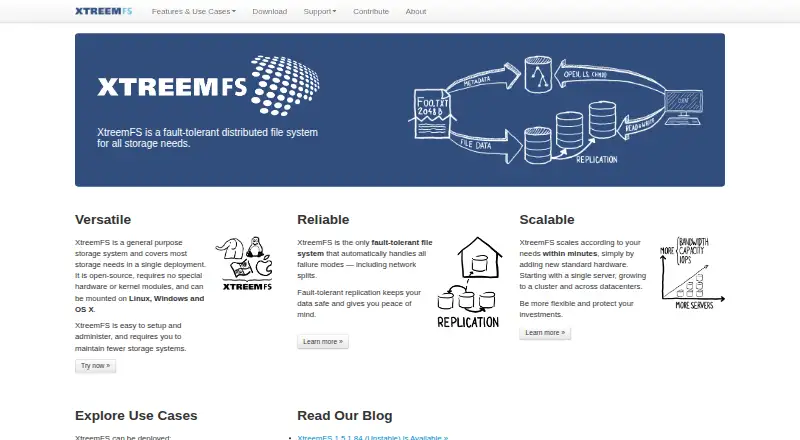
What XtreemFS is
XtreemFS is a free, fault-tolerant distributed file system for general-purpose storage, available for Linux, macOS, Windows and self-hosted deployments. It replicates files across storage servers and can switch to a backup replica if the primary fails. Full or partial read-only replicas for immutable files can also be used to create caches across datacenters. The project says installations can scale to thousands of storage and metadata servers by adding or removing storage servers. POSIX compatibility lets it serve as a drop-in NFS replacement, while built-in SSL and X.509 certificate support allow it to run over the internet without a VPN, according to the site. A Hadoop client is available for using XtreemFS as an HDFS replacement. Listed uses include filer replacement, HPC and Hadoop clusters, VM block storage and cross-branch data sharing. Linux distribution packages and precompiled Windows and Mac OS X clients are provided. The FAQ gives a single-volume capacity of up to tens of millions of files and reports no known limits for volumes or services.
Good
- Free, open-source BSD-licensed software.
- Automatic failover to backup file replicas.
- Supports read-only replicas and datacenter caches.
- POSIX compatibility enables NFS replacement.
- SSL and X.509 support are built in.
Watch out
- A single volume may contain up to tens of millions of files.
- Deployment packages are listed for Linux, Windows and Mac OS X.
Who it suits
XtreemFS suits teams needing replicated, self-hosted file storage for clusters, virtual machines or sharing data across branches. It may also fit deployments seeking POSIX compatibility or a Hadoop client.
Verdict
XtreemFS combines file replication and failover with POSIX compatibility and several deployment options. Its listed uses range from clustered workloads to cross-branch sharing, with a stated single-volume file limit.
Plans and prices
From XtreemFS's own pricing page, checked 30 Sep 2026.
| Plan | Price | What it gives you |
|---|---|---|
| XtreemFS | Free | Open-source BSD license · free of charge |
The facts
Each one read from XtreemFS's own pages, with the date it was checked.
What it does
- Compatibility
- XtreemFS offers POSIX compatibility and can be used as a drop-in replacement for NFS.checked 30 Sep 2026
- Deployment
- The project provides Linux distribution packages and precompiled client packages for Windows and Mac OS X.checked 30 Sep 2026
- Developer
- The site says XtreemFS is developed as an open-source project by Zuse Institute Berlin.checked 30 Sep 2026
- Hadoop
- A Hadoop client is available for using XtreemFS as an HDFS replacement.checked 30 Sep 2026
- Limit
- The FAQ says a single volume may contain up to tens of millions of files; it reports no known limits for the number of volumes and services.checked 30 Sep 2026
- Purpose
- XtreemFS is a fault-tolerant distributed file system for general-purpose storage.checked 30 Sep 2026
- Read-only replicas
- It supports full and partial read-only replicas for immutable files, which can be used to build a cache across datacenters.checked 30 Sep 2026
- Replication
- It replicates files across storage servers and can automatically fail over to a backup replica if the primary fails.checked 30 Sep 2026
- Scalability
- The site says an installation can scale to thousands of storage and metadata servers by adding or removing storage servers.checked 30 Sep 2026
- Security
- It has built-in SSL and X.509 certificate support, and the site says it can run over the internet without a VPN.checked 30 Sep 2026
- Support
- Users can ask questions on the public mailing list and report bugs through the GitHub bug tracker.checked 30 Sep 2026
- Use cases
- The site lists filer replacement, HPC and Hadoop clusters, VM block storage, and cross-branch data sharing as use cases.checked 30 Sep 2026
The full review of XtreemFS
XtreemFS is a self-hosted distributed filesystem for teams that need resilient shared files across servers or sites. It is best suited to infrastructure groups running Linux, HPC or Hadoop environments, and organizations replacing a filer or NFS. The main appeal is capable replication without a license fee; the trade-off is that your organization must operate the storage platform.
Overview
XtreemFS distributes files across storage servers and can move service to a backup replica when a primary fails. That design suits applications where an outage is more disruptive than the work of maintaining a distributed system. Replication is file-based rather than a simple whole-volume mirror, and POSIX compatibility keeps the access model familiar for software built around ordinary filesystem semantics.
The project comes from the open-source work of Zuse Institute Berlin. Its documented roles include filer replacement, HPC and Hadoop clusters, VM block storage, and sharing data between branches. A Hadoop client lets it serve as an HDFS replacement, while POSIX behavior supports use as a drop-in NFS substitute. Those options make it adaptable, but XtreemFS is infrastructure software rather than a hosted service: installation, monitoring, capacity planning, and recovery remain your responsibility.
Key features
Replication and failover
Continuous replication can copy files between storage servers, with automatic failover to a backup replica if the primary becomes unavailable. Replication operates at file scope and supports multiple sites, making it relevant to branch sharing and geographically separated infrastructure. This is a strong fit for continuity-sensitive workloads; it is less attractive if you want a provider to manage replicas and incident response.
Read-only distribution
Full or partial read-only replicas are available for immutable files. You can use them as caches across datacenters, reducing the need to serve every read from one location. The read-only model is deliberately suited to content that does not change, so it should not be treated as a general write-anywhere synchronization scheme.
Scale and compatibility
The project says an installation can grow to thousands of storage and metadata servers by adding or removing storage servers. That gives large infrastructure deployments room to expand without changing storage architecture, although operating a fleet at that scale demands substantial systems expertise. POSIX compatibility and NFS-replacement positioning help existing applications adopt it without a wholesale rewrite.
Security and clients
Built-in SSL and X.509 certificate support protects connections, and the project says deployments can run over the internet without a VPN. Linux distribution packages plus precompiled clients for Windows and Mac OS X simplify getting client access onto mixed-device estates. A Hadoop client extends the same storage layer to Hadoop workloads.
Capacity boundary
A single volume may contain up to tens of millions of files. The project reports no known limits for the number of volumes and services, so installations with many volumes can avoid a stated platform-wide count ceiling while still needing to plan around the per-volume file bound.
Pricing
XtreemFS costs free under its single XtreemFS plan. The plan is free of charge and distributed under the open-source BSD license. There are no paid tiers, seat charges, quotas, trial periods, or renewal terms to weigh. That makes it suitable for labs, universities, and production teams that can fund administration internally; the saving is on licensing, not on hardware, operations, or support staffing.
Platforms
Server deployment is self-hosted and supports Linux. Client packages are provided for Linux, Windows, and Mac OS X, and the platform is categorized for macOS and Windows use as well. This combination works for Linux-centered storage with heterogeneous user machines, while organizations seeking a fully managed cloud endpoint should look elsewhere.
Who it's for
Choose XtreemFS when you need shared POSIX storage with file replication, automated failover, or multi-site distribution and have administrators comfortable running distributed infrastructure. HPC and Hadoop operators can use its cluster-oriented access options, and companies replacing a filer or connecting branch offices can preserve familiar filesystem access. It is a poor fit for teams that want turnkey storage, vendor-managed upgrades, or a support contract built into the product.
Pros and cons
- Pro: Continuous file replication and automatic replica failover improve availability for critical shared data.
- Pro: POSIX compatibility and NFS-replacement support reduce application changes during migration.
- Pro: Read-only replicas can create datacenter caches for immutable content.
- Pro: SSL and X.509 support allow secured operation over the internet without a VPN.
- Pro: BSD-licensed open-source software has no license charge and supports Linux, Windows, and macOS clients.
- Con: Self-hosting leaves deployment, maintenance, and failure management to your organization.
- Con: A volume's tens-of-millions-of-files ceiling may require data partitioning for very large namespaces.
- Con: Read-only replicas are designed for immutable files, so they do not replace a general multi-writer synchronization layer.
Alternatives
For a NAS-focused photo library that requires a Synology NAS, choose Synology Photos instead. Obstor is another free, self-hosted open-source option with Linux, macOS, Windows, web, and API access. Pick SeaweedFS if you prefer a freemium project with a free community tier for any cluster size and public documentation, accepting that community support has no guaranteed response time.
LINBIT DRBD suits Linux or Windows environments seeking block-level replication, with a paid Starter plan alongside its open-source community version. Choose OpenEBS for open-source Kubernetes storage. Amazon S3 is the alternative when usage-based cloud storage and provider operation matter more than self-hosting. Longhorn targets distributed block storage for Kubernetes, while Resilio Active Everywhere is a paid, trial-available option priced by devices or endpoints rather than data volume or transfer.
Verdict
XtreemFS is a strong choice for organizations that want free, open-source shared storage with file-level replication, failover, POSIX access, and multi-site capability. Its decisive advantage is combining those controls without licensing fees. Look elsewhere if your priority is managed operations, turnkey cloud storage, or a storage model centered on Kubernetes block volumes rather than a self-hosted distributed filesystem.
Alternatives to XtreemFS
- 1
JuiceFS
Free planOpen sourceAPILinuxmacOSSelf-hosted7.9From $0.02 a month - 2
Google Cloud Managed Lustre
Free planWebAPILinuxSelf-hosted7.4From $0.06 a month - 3

LucidLink
AndroidiOSWebExtension7.1From $7 a month - 4

MooseFS
Free planWebAPILinuxmacOS7.1€9 one-time - 5
Tahoe-LAFS
Free planWebAPILinuxmacOS7.1Free plan - 6

SeaweedFS
Free planAPILinuxmacOSSelf-hosted7.0From $20 a year