SeaweedFS
SeaweedFS is a distributed storage system that serves S3 objects, Iceberg tables, and POSIX files from one cluster.
What SeaweedFS is
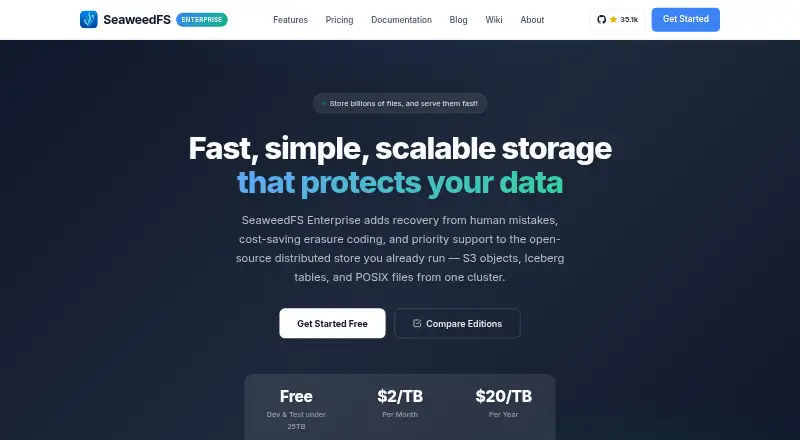
SeaweedFS is a distributed storage system that serves S3 objects, Iceberg tables, and POSIX files from one cluster. It supports S3, POSIX mounts, HDFS-compatible access, an Iceberg REST catalog, and WebDAV; its Iceberg catalog can be queried with Spark, Trino, Dremio, and DuckDB. The product describes scaling from gigabytes to petabytes and supporting billions of files. Development and testing under 25 TB are free, but production deployments need a paid license regardless of size. Enterprise features include deleted-file recovery within a configurable retention window, point-in-time restoration, repair of erasure-coding shards, and OIDC sign-in with role mapping. The free 25 TB trial limits deleted-file recovery retention to one hour. Enterprise support is optional and purchased separately from the capacity license. SeaweedFS is available for Linux, macOS, and Windows, and can be self-hosted with API access.
Good
- Serves S3 objects, Iceberg tables, and POSIX files
- Supports several storage access protocols
- Describes scaling to petabytes and billions of files
- Enterprise includes recovery and shard repair features
Watch out
- Production deployments require a paid license
- Trial deleted-file recovery retention is capped at one hour
- Enterprise support is purchased separately
- Capacity pricing includes replication or erasure-coding overhead
Who it suits
SeaweedFS may suit teams seeking shared object, table, and file storage across a cluster. Its free development and testing allowance is limited to under 25 TB; production use requires a paid license regardless of size.
Verdict
SeaweedFS combines several storage interfaces in one cluster, with enterprise recovery and data-protection features. Account for the production license requirement and separately priced support when assessing costs.
Plans and prices
From SeaweedFS's own pricing page, checked 2 Oct 2026.
| Plan | Price | What it gives you |
|---|---|---|
| Community support | Free | Any cluster size · GitHub issues and discussions · public documentation · no guaranteed response time |
| Development & testing | Free | Under 25 TB · development and testing only · no license required |
| Capacity license — Monthly | $2 a month | Used storage including replication/erasure-coding overhead · production use requires a paid license · Pay as you go |
| Capacity license — Yearly | $20 a year | Used storage including replication/erasure-coding overhead · production use requires a paid license · Simplified billing · Save ~17% |
| Essential support | $2,000 a year | Clusters up to 100 TB · private email support · 5-business-day response · 1 advisory hour/month · Annual fee |
| Small Production support | $5,000 a year | Clusters up to 250 TB · private email support · 3-business-day response · 2 advisory hours/month · annual configuration review · Annual fee |
| Growth support | $15,000 a year | Clusters up to 1 PB · private email support · 2–3-business-day response · 4 advisory hours/month · upgrade guidance · deployment assistance · Annual fee |
| Standard support | $40,000 a year | Multi-petabyte deployments · private Slack and email · 1-business-day response · 8 advisory hours/month · architecture and deployment assistance · Annual fee |
| Critical support | $85,000 a year | Revenue-bearing workloads · 1-hour P1 response · private Slack, email, and Zoom · direct engineering escalation · up to 12 advisory hours/month · Annual fee |
| Enterprise 5 PB+ | Priced on request | 5 PB+ · volume discounts · custom contracts and invoicing · Custom volume pricing |
The facts
Each one read from SeaweedFS's own pages, with the date it was checked.
What it does
- Data protection
- Enterprise automatically repairs missing or corrupted erasure-coding shards and periodically checks shards against checksums for silent corruption.checked 2 Oct 2026
- Deployment
- The deployment guide offers an official repository binary and the container image chrislusf/seaweedfs-enterprise.checked 2 Oct 2026
- Integrations
- The built-in Iceberg catalog supports querying with Spark, Trino, Dremio, and DuckDB.checked 2 Oct 2026
- License expiry
- If an Enterprise license expires, SeaweedFS says it falls back to the open-source implementation and data remains accessible, while self-healing features are disabled.checked 2 Oct 2026
- Point-in-time recovery
- Enterprise can rewind a folder, bucket, or object to a chosen moment, including restoring deletes and reverting overwrites, with a preview before changes are applied.checked 2 Oct 2026
- Production license limit
- Development and testing under 25 TB is free, while production deployments require a paid license regardless of size.checked 2 Oct 2026
- Protocols
- The cluster supports S3, POSIX mounts, HDFS-compatible access, an Iceberg REST catalog, and WebDAV.checked 2 Oct 2026
- Recovery
- Enterprise data recovery can restore deleted files from the Admin UI during a configurable retention window; the free 25 TB trial caps that window at one hour.checked 2 Oct 2026
- Scale
- The product page says it scales linearly from gigabytes to petabytes and supports billions of files.checked 2 Oct 2026
- Single sign-on
- Enterprise Admin UI supports OIDC sign-in and role mapping, with examples including Keycloak, Okta, Azure AD, and Microsoft ADFS.checked 2 Oct 2026
- Storage efficiency
- Enterprise customizable erasure coding can use a 20+4 ratio with 1.2× storage overhead, according to the maker’s feature page.checked 2 Oct 2026
- Support
- Enterprise support is optional and purchased separately from the capacity license; published support channels and response targets vary by plan.checked 2 Oct 2026
- What it does
- SeaweedFS is a distributed storage system serving S3 objects, Iceberg tables, and POSIX files from one cluster.checked 2 Oct 2026
The full review of SeaweedFS
SeaweedFS is a distributed storage system that serves S3 objects, Iceberg tables, and POSIX files from one cluster. It suits teams that need several storage interfaces alongside large-scale capacity. Its production license requirement and separately purchased support make cost planning as important as its technical breadth.
Overview
SeaweedFS brings object, file, and table access together, with S3, POSIX mounts, HDFS-compatible access, an Iceberg REST catalog, and WebDAV. The product is designed to scale from gigabytes to petabytes and support billions of files. That breadth can simplify a mixed-storage architecture, but it also means production use is not free, even for small deployments.
Key features
The built-in Iceberg catalog connects to Spark, Trino, Dremio, and DuckDB, making SeaweedFS a fit for teams that want storage and table-catalog access in the same cluster. S3 compatibility, object versioning, lifecycle rules, immutability, and cross-region replication cover common object-storage needs.
Enterprise adds meaningful recovery and resilience controls. Admins can recover deleted files within a configurable retention window; the free 25 TB trial limits that window to one hour. Point-in-time recovery can rewind a folder, bucket, or object, including deletes and overwrites, with a preview before changes are applied. Enterprise also repairs missing or corrupted erasure-coding shards and checks them periodically against checksums.
Customizable erasure coding can use a 20+4 ratio with 1.2× storage overhead, according to the maker. Enterprise Admin UI supports OIDC sign-in and role mapping, with examples including Keycloak, Okta, Azure AD, and Microsoft ADFS. The deployment guide offers an official repository binary and the chrislusf/seaweedfs-enterprise container image.
Pricing
SeaweedFS is freemium, but its free allowance is limited by purpose rather than cluster size: development and testing under 25 TB need no license, while every production deployment requires a paid capacity license. Capacity billing counts used storage including replication and erasure-coding overhead, so protection choices affect the bill.
- Community support: free, for any cluster size. It includes GitHub issues and discussions and public documentation, with no guaranteed response time.
- Development & testing: free, under 25 TB and for development and testing only. It is not a production option.
- Capacity license — Monthly: $2 a month, billed pay as you go. It licenses production use based on used storage, including protection overhead.
- Capacity license — Yearly: $20 a year, billed with simplified billing and saving about 17%. It has the same storage basis and production requirement as monthly billing.
- Enterprise 5 PB+: custom pricing for 5 PB or more, with volume discounts and custom contracts and invoicing.
Support is optional and sold separately from capacity. Essential support costs $2,000 a year for clusters up to 100 TB, with private email support, a 5-business-day response, and one advisory hour per month. Small Production support is $5,000 a year for up to 250 TB, with a 3-business-day response, two monthly advisory hours, and an annual configuration review. Growth support costs $15,000 a year for up to 1 PB; it includes a 2–3-business-day response, four monthly advisory hours, upgrade guidance, and deployment assistance.
For larger or more critical environments, Standard support costs $40,000 a year for multi-petabyte deployments, with private Slack and email, a 1-business-day response, eight advisory hours monthly, and architecture and deployment assistance. Critical support costs $85,000 a year for revenue-bearing workloads, with a 1-hour P1 response, private Slack, email, and Zoom, direct engineering escalation, and up to 12 advisory hours monthly. If an Enterprise license expires, data remains accessible through the open-source implementation, but self-healing features are disabled.
Platforms
SeaweedFS supports API access and Linux, macOS, Windows, and self-hosted deployments. That makes it suited to infrastructure teams managing their own storage cluster rather than users looking for a hosted, end-user application.
Who it's for
Choose SeaweedFS when one self-hosted cluster needs to serve object, file, and Iceberg workloads, especially where enterprise recovery, shard repair, and identity integration matter. It is a weaker fit for production teams seeking a no-license open-source deployment or bundled support; production licensing is required at any size, and support adds a substantial separate annual cost.
Pros and cons
- Pro: Multiple access protocols and an Iceberg catalog in one cluster can serve varied workloads without requiring separate storage systems for each interface.
- Pro: Enterprise recovery includes both deleted-file restoration and point-in-time rollback, with preview before changes are applied.
- Pro: Automated shard repair and checksum checks address missing, damaged, and silent corruption risks.
- Con: Production requires a paid capacity license regardless of deployment size, so the free development allowance does not translate into free production.
- Con: Support is a separate purchase, and the listed annual tiers range from 2000.00 USD to 85000.00 USD.
- Con: License expiry disables self-healing features, so organizations relying on them must account for renewal continuity.
Alternatives
For broader comparisons, see Distributed File System Software, Software-Defined Storage Software, and Storage Replication Software.
MooseFS is worth considering if its free Community plan, with a single active master and single-parity erasure coding, suits the deployment better. Hadoop Distributed File System is a free Apache-licensed, self-hosted cluster option. JuiceFS offers a free self-hosted Community Edition with community support through GitHub and Discord.
OpenAFS is a free open-source distributed filesystem. Quobyte has a free edition capped at 150 TB. Ceph is free open-source distributed storage, with a running cluster required for block storage. XtreemFS is a free BSD-licensed option. BeeGFS is another freemium option.
Verdict
SeaweedFS is a strong choice for infrastructure teams that want object, file, and Iceberg access in one scalable cluster, backed by enterprise recovery and data-protection features. Choose it when those capabilities justify production licensing and separate support costs; look elsewhere if free production use or lower-cost bundled support is a priority.
Getting started
- Visit https://seaweedfs.com/.
- Choose the free development and testing option if the deployment is under 25 TB and not for production.
- For production, select a monthly capacity license at $2 a month or a yearly license at $20 a year.
- Use the deployment guide to get the official repository binary or the chrislusf/seaweedfs-enterprise container image.
- Select optional support separately if required.
Limits worth knowing
Development and testing under 25 TB are free, but production use requires a paid capacity license. The free 25 TB trial caps deleted-file recovery retention at one hour. Capacity charges are based on used storage, including replication or erasure-coding overhead.
Questions
Is SeaweedFS free?
Community support and development and testing under 25 TB are free. Production deployments require a paid capacity license regardless of size.
What does a capacity license cost?
The monthly license is $2 a month, and the yearly license is $20 a year. Both are based on used storage including replication or erasure-coding overhead.
What protocols does it support?
It supports S3, POSIX mounts, HDFS-compatible access, an Iceberg REST catalog, and WebDAV.
Which query tools work with its Iceberg catalog?
The built-in Iceberg catalog supports Spark, Trino, Dremio, and DuckDB.
Is Enterprise support included with the capacity license?
No. Enterprise support is optional and purchased separately from the capacity license.
What happens if an Enterprise license expires?
SeaweedFS says it falls back to the open-source implementation and data remains accessible, while self-healing features are disabled.
Alternatives to SeaweedFS
- 1
JuiceFS
Free planOpen sourceAPILinuxmacOSSelf-hosted7.9From $0.02 a month - 2
MinIO AIStor
Free planWebAPILinuxmacOS7.3Free plan - 3
StarWind Virtual SAN
Free planWebAPILinuxSelf-hosted7.2Free plan - 4

MooseFS
Free planWebAPILinuxmacOS7.1€9 one-time - 5

Ceph
Free planAPILinuxSelf-hostedWindows6.6Free plan - 6

Cloudian HyperStore
WebAPILinuxSelf-hosted6.5