Hadoop Distributed File System
Hadoop Distributed File System (HDFS) is the primary distributed storage used by Hadoop applications.
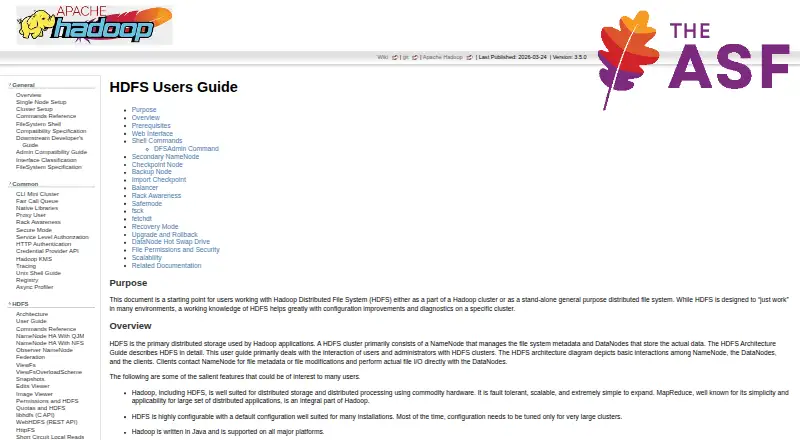
What Hadoop Distributed File System is
Hadoop Distributed File System (HDFS) is the primary distributed storage used by Hadoop applications. A cluster centers on a NameNode that manages filesystem metadata and DataNodes that store data. It is designed for fault tolerance on low-cost commodity hardware and for high-throughput streaming access and batch processing, rather than low-latency work. Its design targets files from gigabytes to terabytes, clusters of hundreds of nodes and tens of millions of files in one instance.
HDFS is written in Java and supported on major platforms, with self-hosted cluster deployment. Administration options include shell-like commands, NameNode and DataNode web servers, fsck diagnostics, safemode and a cluster balancer. Its permissions model shares much with POSIX and can optionally support POSIX ACLs. Hadoop offers simple operating-system identity and Kerberos authentication modes. Configured encryption protects data at rest and in transit through encryption zones and the Hadoop Key Management Server. WebHDFS provides REST access, and listed storage integrations include Amazon S3, Azure Blob Storage and Azure Data Lake Storage. HDFS is free and licensed under Apache License 2.0.
Good
- Designed for fault tolerance on commodity hardware.
- Supports high-throughput batch and streaming workloads.
- Offers REST, Java and C API access.
- Configured encryption covers data at rest and in transit.
Watch out
- Designed for throughput rather than low latency.
- Support is through project mailing lists maintained by volunteers.
- Requires self-hosted cluster deployment.
Who it suits
HDFS suits organizations building self-hosted Hadoop storage for high-throughput batch or streaming workloads. Its stated design fits large files and clusters, rather than low-latency access needs.
Verdict
HDFS provides distributed storage and administration features for Hadoop workloads at large file and cluster scales. Its throughput focus makes workload fit an important consideration, and support is provided through project mailing lists.
Plans and prices
From Hadoop Distributed File System's own pricing page, checked 30 Sep 2026.
| Plan | Price | What it gives you |
|---|---|---|
| Apache Hadoop (open source) | Free | Apache License 2.0 · self-hosted cluster deployment · no charge |
The facts
Each one read from Hadoop Distributed File System's own pages, with the date it was checked.
What it does
- Administration
- HDFS provides shell-like commands, built-in NameNode and DataNode web servers, fsck diagnostics, safemode, and a cluster balancer.checked 30 Sep 2026
- Architecture
- An HDFS cluster primarily consists of a NameNode managing filesystem metadata and DataNodes storing data.checked 30 Sep 2026
- Authentication
- Hadoop supports simple operating-system identity mode and Kerberos authentication mode.checked 30 Sep 2026
- Downloads and integrity
- Apache distributes source and binary tarballs and recommends verifying releases with GPG signatures or SHA-512 checksums.checked 30 Sep 2026
- Encryption
- Configured HDFS encryption provides transparent end-to-end encryption for data at rest and in transit using encryption zones and the Hadoop Key Management Server.checked 30 Sep 2026
- Fault tolerance
- HDFS is highly fault-tolerant and designed to run on low-cost commodity hardware.checked 30 Sep 2026
- License
- Apache Hadoop is licensed under the Apache License 2.0.checked 30 Sep 2026
- Permissions
- HDFS implements a permissions model sharing much of POSIX and optionally supports POSIX access control lists.checked 30 Sep 2026
- Purpose
- HDFS is the primary distributed storage used by Hadoop applications.checked 30 Sep 2026
- REST integration
- The WebHDFS HTTP REST API supports the complete FileSystem and FileContext interfaces for HDFS.checked 30 Sep 2026
- Scale
- HDFS is tuned for gigabyte-to-terabyte files, hundreds of nodes per cluster, and tens of millions of files in one instance.checked 30 Sep 2026
- Storage integrations
- The documentation lists Amazon S3, Azure Blob Storage, Azure Data Lake Storage, Tencent COS, and other Hadoop-compatible file systems.checked 30 Sep 2026
- Support
- Apache Hadoop support is provided through project mailing lists maintained by non-paid volunteers.checked 30 Sep 2026
- Workload fit
- HDFS is designed for streaming access and batch processing with high throughput rather than low latency.checked 30 Sep 2026
Where it runs
- Language and platforms
- Hadoop is written in Java and supported on all major platforms.checked 30 Sep 2026
The full review of Hadoop Distributed File System
Overview
Hadoop Distributed File System (HDFS) is a distributed filesystem that provides storage for Hadoop applications. It is best suited to teams operating self-hosted clusters for large-scale batch or streaming work. Choose it for resilient, high-throughput storage across many nodes; look elsewhere when low-latency access matters more than throughput.
Key features
HDFS separates filesystem metadata from stored data: a NameNode manages metadata while DataNodes hold the data. It is designed for gigabyte-to-terabyte files, clusters of hundreds of nodes, and tens of millions of files in an instance. That capacity makes it a strong fit for large processing jobs, not a default choice for workloads centered on small files or quick individual responses.
Fault tolerance and replication are designed to keep data available on low-cost commodity hardware. Administrators get shell-like commands, NameNode and DataNode web servers, fsck diagnostics, safemode, and a cluster balancer. Those controls offer useful operational visibility, but running a self-hosted distributed cluster remains part of the commitment.
HDFS permissions share much of the POSIX model, with optional POSIX access control lists. Hadoop supports operating-system identity and Kerberos authentication. Configured encryption zones provide transparent encryption for data at rest and in transit through the Hadoop Key Management Server. WebHDFS exposes the complete FileSystem and FileContext interfaces over HTTP; access is also available through Java and C APIs, a browser, an NFS gateway, and the FS shell.
Hadoop is written in Java and supported on major platforms. HDFS also documents integration with Amazon S3, Azure Blob Storage, Azure Data Lake Storage, Tencent COS, and other Hadoop-compatible filesystems. Apache distributes source and binary tarballs and recommends checking releases with GPG signatures or SHA-512 checksums.
Pricing
Apache Hadoop (open source) costs nothing, billed no charge. The Apache License 2.0 software supports self-hosted cluster deployment, so there is no paid tier to unlock the core filesystem. The trade-off is operational: you provide and administer the cluster yourself. Support comes through project mailing lists maintained by non-paid volunteers, rather than a guaranteed commercial response.
Platforms
HDFS is available for Linux, macOS, and Windows, as well as through APIs and self-hosted deployment. Its access options include Java API, C API, REST API, HTTP browser, NFS gateway, and FS shell. This breadth serves teams integrating Hadoop storage into varied environments, while keeping infrastructure under their control.
Who it's for
HDFS is for organizations building Hadoop workloads that need high-throughput storage across large files and clusters. Its fault tolerance, replication, and administration tools suit sustained batch processing and streaming access. It is a less natural fit for latency-sensitive applications or teams that do not want to manage distributed storage.
Pros and cons
- Pros: Built for large files and clusters, with fault tolerance and replication on commodity hardware.
- Pros: Offers practical administration tools, multiple access interfaces, POSIX-oriented permissions, Kerberos authentication, and configured encryption.
- Cons: Throughput is prioritized over low latency, limiting its fit for interactive workloads.
- Cons: Self-hosted deployment and volunteer-maintained mailing-list support leave cluster operation and timely assistance to the user.
Alternatives
For a broader comparison, see Distributed File System Software.
- SeaweedFS is worth considering if a freemium option with a free plan and trial is preferable; its community support has no guaranteed response time.
- MooseFS offers a free Community plan with a single active master and single-parity erasure coding for readers whose needs fit those limits.
- JuiceFS has a self-hosted Community Edition with community support via GitHub and Discord, an option for teams who prefer those support channels.
- OpenAFS is another free, open-source distributed filesystem for readers comparing free self-hosted options.
- OrangeFS offers downloadable open-source software; consider it when that model suits the deployment.
- Quobyte may suit readers who want a free edition capped at 150 TB of storage.
- Ceph is a free open-source distributed storage option, particularly relevant when a running Ceph cluster for block storage is already part of the setup.
- Google Cloud Managed Lustre is an alternative for readers seeking a paid managed service rather than self-hosted HDFS.
Verdict
Choose HDFS for Hadoop workloads that need fault-tolerant, high-throughput storage across large files and clusters. Its combination of scale, replication, and administration features is compelling without a license charge. Look elsewhere if low latency, managed operations, or guaranteed support is central to the decision.
Getting started
- Open the Apache Hadoop HDFS user guide
- Download an Apache source or binary tarball
- Verify the release with a GPG signature or SHA-512 checksum
- Deploy a self-hosted cluster with NameNode and DataNode services
- Configure authentication, permissions, replication, and encryption as needed
- Use the FS shell, Java, C, REST, HTTP, or NFS access options
Limits worth knowing
HDFS is tuned for high-throughput streaming and batch processing, not low-latency work. Its stated design scale targets large files, hundreds of nodes, and tens of millions of files in one instance.
Questions
What does HDFS cost?
The Apache Hadoop open-source plan is free, with no charge under the Apache License 2.0.
Where can HDFS run?
It is self-hosted and supported on Linux, macOS, Windows, and other major platforms.
Is HDFS open source?
Yes. Apache Hadoop is licensed under the Apache License 2.0.
Which authentication methods are supported?
Hadoop supports simple operating-system identity mode and Kerberos authentication mode.
Can HDFS encrypt stored and transferred data?
Configured encryption zones and the Hadoop Key Management Server provide transparent encryption at rest and in transit.
What storage systems integrate with HDFS?
The documentation lists Amazon S3, Azure Blob Storage, Azure Data Lake Storage, Tencent COS, and other Hadoop-compatible file systems.
Alternatives to Hadoop Distributed File System
- 1
JuiceFS
Free planOpen sourceAPILinuxmacOSSelf-hosted7.9From $0.02 a month - 2
Google Cloud Managed Lustre
Free planWebAPILinuxSelf-hosted7.4From $0.06 a month - 3

LucidLink
AndroidiOSWebExtension7.1From $7 a month - 4

MooseFS
Free planWebAPILinuxmacOS7.1€9 one-time - 5
Tahoe-LAFS
Free planWebAPILinuxmacOS7.1Free plan - 6

SeaweedFS
Free planAPILinuxmacOSSelf-hosted7.0From $20 a year