
MinIO AIStor
MinIO AIStor is an enterprise AI data store combining persistent memory, tables, objects, and files.
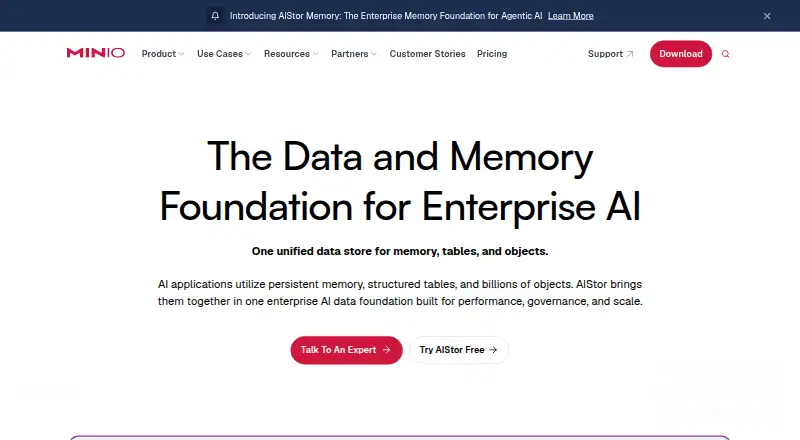
What MinIO AIStor is
MinIO AIStor is an enterprise AI data store combining persistent memory, tables, objects, and files. AIStor Memory stores agent context, workspaces, secrets, artifacts, and telemetry, while AIStor Tables provides native Apache Iceberg storage for analytics, feature stores, lakehouse architectures, and structured AI datasets. S3-compatible object storage covers models, checkpoints, training datasets, embeddings, documents, media, and logs. Access and integration options include S3, S3 Express, MCP, SFTP and Files, Iceberg Catalog, and OpenSharing. Management tools include encryption, key management, lifecycle controls, immutability, replication, audit trails, metrics, and error logs. Deployment options include Linux, Windows, macOS, Kubernetes Helm, OpenShift, and Podman. AIStor Free is free for single-node deployments with the full feature set, but is intended for self-supported use cases that need no data resiliency beyond one node; redistribution is prohibited. Enterprise and Enterprise Lite pricing is on request, and Lite is for capacity below 400 TiB.
Good
- Free tier includes the full feature set
- S3-compatible object storage
- Supports Apache Iceberg tables
- Lists multiple replication options
- Deployment options include Linux and Kubernetes Helm
Watch out
- Free tier is intended for single-node use
- Free tier does not provide resiliency beyond one node
- Redistribution of the free tier is prohibited
- Enterprise Lite is limited to below 400 TiB
Who it suits
AIStor suits teams building AI data stores that need object storage, agent memory, or Iceberg tables. The free tier fits single-node use cases that can be self-supported.
Verdict
AIStor combines several data storage types with management and replication capabilities. Check the single-node free-tier limitation and capacity terms for Enterprise Lite against deployment needs.
Plans and prices
From MinIO AIStor's own pricing page, checked 15 Oct 2026.
| Plan | Price | What it gives you |
|---|---|---|
| AIStor Free | Free | single-node deployment · full feature set · community Slack and documentation support · redistribution prohibited · free of charge |
| AIStor Enterprise | Priced on request | multi-node deployment · unlimited scale · premium support · Request enterprise Pricing |
| AIStor Enterprise Lite | Priced on request | multi-node deployment · below 400 TiB · direct-to-engineer support optional · Request enterprise Lite Pricing |
| Enterprise | Priced on request | multi-node horizontal scaling · unlimited scale · premium SUBNET support · 24/7/365 direct-to-engineer support under 4-hour SLA · 60-day free trial · subscription based on usable storage capacity |
| Enterprise Lite | Priced on request | multi-node horizontal scaling · below 400 TiB · Lite SUBNET diagnostics/security reporting · optional direct-to-engineer support under 5-day SLA · 60-day free trial · subscription based on usable storage capacity |
The facts
Each one read from MinIO AIStor's own pages, with the date it was checked.
What it does
- AI memory
- AIStor Memory stores agent context, workspaces, secrets, artifacts and telemetry beyond the lifetime of ephemeral runtimes.checked 15 Oct 2026
- AIStor Memory
- AIStor Memory stores agents’ context, workspaces, secrets, artifacts, and telemetry in AIStor.checked 30 Sep 2026
- Capacity limit
- Enterprise Lite is for capacity requirements below 400 TiB, and deployments exceeding 400 TiB are upgraded to Enterprise.checked 30 Sep 2026
- Certifications
- The pricing page lists SOC 2 and ISO 27001 as certified, SEC 17a-4(f) and FINRA 4511(c)-(d) as compliant, and FIPS 140-3 and a pentest report.checked 30 Sep 2026
- Compliance
- MinIO says AIStor includes WORM storage for SEC 17a-4(f), FINRA, and CFTC requirements, as well as controls supporting HIPAA, GDPR, CCPA, SOC 2, and ISO 27001.checked 30 Sep 2026
- Developer APIs and SDKs
- Documentation lists S3 API compatibility plus Go, Python, Java, .NET, JavaScript, Haskell, C++ and Rust SDKs.checked 15 Oct 2026
- Documentation depth
- The documentation includes installation, administration, SDK references, API compatibility, operations, metrics, troubleshooting, upgrades and disaster recovery topics.checked 15 Oct 2026
- Encryption
- AIStor supports TLS 1.2 or later and server-side encryption through SSE-KMS or SSE-S3 with customer-managed keys.checked 15 Oct 2026
- Extensibility
- Bucket event notifications can target AMQP, Elasticsearch, Kafka, MQTT, MySQL, NATS, NSQ, PostgreSQL, Redis and webhooks.checked 15 Oct 2026
- Hardware baseline
- Recommended production sizing is at least eight dedicated hosts, eight drives per server, 100GbE networking, 16 CPU or vCPU per host and 128GB available memory per host.checked 15 Oct 2026
- Iceberg tables
- AIStor Tables provides Apache Iceberg-native table storage for analytics, feature stores, lakehouses and structured AI datasets.checked 15 Oct 2026
- Identity and access
- The console supports built-in users, OIDC, Active Directory/LDAP single sign-on, groups, policies and child access keys.checked 15 Oct 2026
- Integrations and protocols
- The product page lists S3, S3 Express, MCP, SFTP and Files, Iceberg Catalog, and OpenSharing for access and integration.checked 30 Sep 2026
- Legal entity and funding
- Crunchbase identifies the legal name as MinIO Inc, lists three funding rounds including Series B, and names Intel Capital, General Catalyst, Nexus Venture Partners and Dell Technologies Capital among investors.checked 15 Oct 2026
- Licence
- AIStor is commercially licensed under MinIO's software licensing model; the former AGPLv3 MinIO community edition is frozen and no longer maintained.checked 15 Oct 2026
- Limit: Capterra compatibility and permissions
- Capterra reviewers report that the API is not fully compatible with S3 in some cases and cite shortcomings in per-user bucket or file permissions.checked 15 Oct 2026
- Management and security features
- Listed capabilities include an admin console, QoS, lifecycle management, encryption, key management, a data firewall, and immutability.checked 30 Sep 2026
The company
- Company founding
- MinIO says it was founded in 2014 by Garima Kapoor, Anand Babu Periasamy and Harshavardhana.checked 15 Oct 2026
- Company size and headquarters
- LinkedIn lists MinIO as a privately held software company headquartered in Redwood City, California, with 201–500 employees.checked 15 Oct 2026
- Founded
- 2014checked 28 Sep 2026
- Headquarters
- Redwood City, California, United Stateschecked 28 Sep 2026
Where it runs
- Deployment platforms
- Documentation covers Linux, Kubernetes, OpenShift, containers, macOS and Windows deployments.checked 15 Oct 2026
Money
- Free tier limitation
- AIStor Free is intended for single-node use cases that can be self-supported and do not require data resiliency beyond a single node.checked 30 Sep 2026
- Limit: G2 documentation and cost
- G2 reviewers mention limited public documentation, a small community, UI limitations in some environments and cost concerns for smaller companies.checked 15 Oct 2026
The full review of MinIO AIStor
MinIO AIStor is a self-hosted enterprise data platform for object storage, analytics tables, files and AI agent memory. It is best suited to infrastructure teams consolidating storage for AI and analytics workloads. Its breadth and deployment flexibility stand out, but multi-node resilience requires a paid enterprise plan with custom pricing.
Overview
AIStor brings several data types into one platform: objects for models and datasets, Apache Iceberg tables for structured analytics data, and persistent memory for agents. That combination may simplify infrastructure for teams whose AI workloads span training data, analytics and agent context. It is less compelling for people seeking a simple, inexpensive storage service: the free tier is single-node only, and larger resilient deployments require enterprise pricing.
MinIO reports maximum throughput of 23.5 TiB/s in WARP benchmarking and describes AIStor as scaling from edge deployments to exabyte-scale clusters. Those figures signal an ambition to serve demanding workloads, but the free tier's single-node boundary makes it unsuitable for users who need resilience across nodes without an enterprise plan.
Key features
Storage for objects, tables and agents
S3-compatible object storage covers models, checkpoints, training datasets, embeddings, documents, media and logs. Versioning, lifecycle rules and immutability give teams tools to manage object history, retention and protected records; cross-region replication can keep copies across locations. AIStor Tables provides native Apache Iceberg storage for analytics, feature stores, lakehouse architectures and structured AI datasets. AIStor Memory holds agent context, workspaces, secrets, artifacts and telemetry, extending the platform beyond bulk data storage.
Access and integration options include S3, S3 Express, MCP, SFTP and Files, Iceberg Catalog and OpenSharing. This range suits environments that need multiple access paths, though its value depends on which of these protocols a team actually uses.
Operations, resilience and compliance
The admin console, QoS, lifecycle management, encryption, key management, data firewall and immutability address day-to-day control and protection. Replication options cover active-active, synchronous, asynchronous, multisite, bucket, batch and edge use cases; audit trails, Prometheus metrics and error logs support operational oversight. This is a substantial toolkit for organizations managing distributed data, rather than a minimal storage layer.
MinIO says AIStor includes WORM storage for SEC 17a-4(f), FINRA and CFTC requirements, plus controls supporting HIPAA, GDPR, CCPA, SOC 2 and ISO 27001. The pricing page identifies SOC 2 and ISO 27001 as certified, SEC 17a-4(f) and FINRA 4511(c)-(d) as compliant, and FIPS 140-3 and a pentest report. Those distinctions matter: certification and compliance claims are specific, while the other controls are described as supporting requirements.
Pricing
AIStor uses a freemium model, with a 60-day trial and enterprise plans priced on request. The free plan is free, billed free of charge, and includes the full feature set for single-node deployment. It is intended for self-supported use cases that do not need data resiliency beyond one node; redistribution is prohibited. That makes it useful for evaluation or single-node use, but not a free route to resilient multi-node storage.
AIStor Enterprise has custom pricing and includes multi-node deployment, unlimited scale and premium support. SUBNET direct-to-engineer support is available 24/7/365 with a less-than-four-hour SLA and a Panic Button. It is the plan for deployments that need scale beyond Enterprise Lite and rapid escalation.
AIStor Enterprise Lite also has custom pricing. It supports multi-node deployments below 400 TiB, with optional direct-to-engineer support and a less-than-five-day SLA. Capacity above 400 TiB is upgraded to Enterprise, so teams near or beyond that threshold should weigh the capacity limit and support difference before choosing Lite.
Platforms
AIStor supports API, Linux, macOS, self-hosted, web and Windows environments. Server installation instructions also cover Kubernetes Helm, OpenShift and Podman, giving infrastructure teams several deployment routes across common operating systems and container platforms.
Who it's for
AIStor is a strong fit for organizations building AI or analytics infrastructure that want S3-compatible objects alongside Iceberg tables and agent memory, with replication and management controls under their deployment control. It is also relevant where compliance-oriented retention and distributed operations matter. It is a poor fit for users who need free multi-node resiliency, a fixed published enterprise price, or a simple file-storage product without the overhead of enterprise infrastructure.
Pros and cons
- Pro: Objects, Iceberg tables and agent memory share a platform, fitting workloads that span models, structured datasets and agent state.
- Pro: Broad replication choices, immutability and operational monitoring support distributed deployments and retention needs.
- Pro: Linux, Windows, macOS, Kubernetes Helm, OpenShift and Podman deployment paths suit varied self-hosted environments.
- Con: The free tier is single-node and self-supported, so it does not meet multi-node resiliency needs.
- Con: Enterprise and Enterprise Lite use custom pricing, complicating cost comparison before a purchase.
- Con: Enterprise Lite is capped below 400 TiB and offers a slower support SLA than Enterprise.
Alternatives
For general Storage Management Software or Software-Defined Storage Software, compare the category options before settling on an enterprise AI data platform.
- TrueNAS is a freemium option with a free Community Edition for any x86 hardware and community support; choose it if that free hardware flexibility matters more than AIStor's combined AI data features.
- Quobyte offers a free edition up to 150 TB; it is worth considering when that stated capacity fits the need.
- StarWind Virtual SAN has a free, self-supported plan with functionality limitations, though its Linux KVM version may have no limitations; consider it if that deployment route fits.
- Ceph is free, open-source distributed storage software; its block-storage use requires a running Ceph cluster.
- BeeGFS is another freemium storage option.
- openmediavault is free software under GNU GPL v3.
- Hitachi Universal Volume Manager requires a license on the local storage system.
Verdict
Choose MinIO AIStor if you are building self-hosted AI or analytics infrastructure and want object storage, Iceberg tables and agent memory with extensive replication and management controls in one platform. Its strongest case is breadth at enterprise scale; the main reason to look elsewhere is the single-node-only free tier and custom-priced multi-node plans, especially if your capacity exceeds Enterprise Lite's 400 TiB limit.
Getting started
- Visit the AIStor product page at min.io/product/aistor.
- Choose AIStor Free for a single-node deployment or request Enterprise or Enterprise Lite pricing for multi-node use.
- Follow MinIO's AIStor Server installation instructions for Linux, Windows, macOS, Kubernetes Helm, OpenShift, or Podman.
- Use the listed API, web, or self-hosted platform route for access.
Limits worth knowing
AIStor Free is intended for single-node use and does not provide data resiliency beyond one node; redistribution is prohibited. Enterprise Lite is for capacity requirements below 400 TiB, with deployments above that threshold upgraded to Enterprise.
Questions
Is there a free plan?
Yes. AIStor Free costs nothing and includes the full feature set for a single-node deployment.
What does the free plan limit?
It is intended for self-supported single-node use cases and does not provide resiliency beyond one node. Redistribution is prohibited.
How much do Enterprise plans cost?
Enterprise and Enterprise Lite pricing is available on request.
Which platforms does AIStor support?
Listed platforms include API, Linux, macOS, self-hosted, web, and Windows. Server installation instructions also cover Kubernetes Helm, OpenShift, and Podman.
What is the Enterprise Lite capacity limit?
Enterprise Lite is for capacity requirements below 400 TiB. Deployments exceeding 400 TiB are upgraded to Enterprise.
Alternatives to MinIO AIStor
- 1
JuiceFS
Free planOpen sourceAPILinuxmacOSSelf-hosted7.9From $0.02 a month - 2
StarWind Virtual SAN
Free planWebAPILinuxSelf-hosted7.2Free plan - 3

MooseFS
Free planWebAPILinuxmacOS7.1€9 one-time - 4

SeaweedFS
Free planAPILinuxmacOSSelf-hosted7.0From $20 a year - 5

Ceph
Free planAPILinuxSelf-hostedWindows6.6Free plan - 6

Cloudian HyperStore
WebAPILinuxSelf-hosted6.5