
OpenEBS
OpenEBS is open-source Kubernetes storage software for developers and platform SREs running stateful workloads.
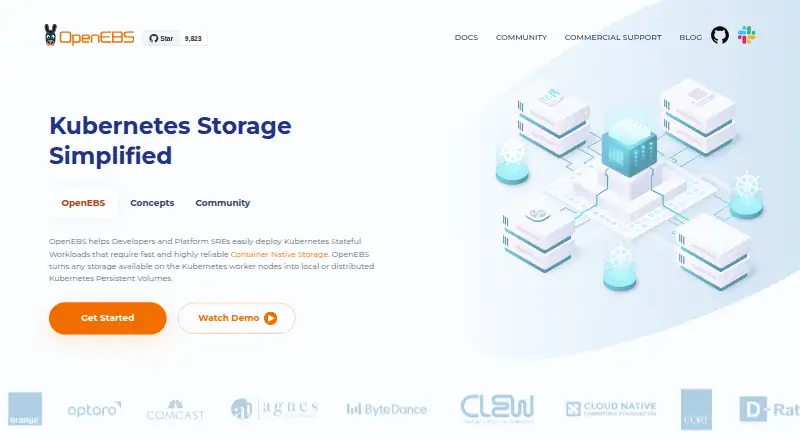
What OpenEBS is
OpenEBS is open-source Kubernetes storage software for developers and platform SREs running stateful workloads. It turns storage on Kubernetes worker nodes into local or distributed persistent volumes, with engines for Replicated PV Mayastor and local Hostpath, LVM, ZFS, and experimental Rawfile volumes. Mayastor can synchronously replicate volumes across Kubernetes zones; Kubernetes-native operations support copy-on-write snapshots and clones. Velero plugins provide backup and restore to AWS S3, GCP Object Storage, or MinIO. Volumes expose metrics including IOPS, throughput, latency, and traffic patterns for Prometheus and Grafana. OpenEBS operates in userspace rather than relying on Linux kernel-dependent software, and exposes declarative APIs through Kubernetes custom resources. It can be installed with Helm 3.2 or newer. Mayastor disk pools support data-at-rest encryption with user-defined AES-XTS keys, but are limited to one block device and encryption keys cannot be rotated. Stated use cases include self-managed databases, observability stacks, CI/CD, object storage, websites, and ML pipelines on Kubernetes.
Good
- Provides local and distributed Kubernetes persistent volumes.
- Mayastor synchronously replicates volumes across zones.
- Supports copy-on-write snapshots and clones.
- Backups can target S3, GCP Object Storage, or MinIO.
- Exposes volume metrics for Prometheus and Grafana.
Watch out
- Mayastor DiskPools are limited to one block device.
- Data-encryption keys cannot be rotated.
- OpenEBS kubectl plugin is available for Linux.
Who it suits
OpenEBS suits developers and platform SREs running stateful services on Kubernetes, including databases, observability stacks, CI/CD, object storage, websites, or ML pipelines. It is a free, open-source option for Kubernetes storage.
Verdict
OpenEBS offers several Kubernetes volume types alongside replication, snapshots, backups, and monitoring metrics. The Mayastor device and key-rotation limits are important considerations for deployments using its disk pools.
Plans and prices
From OpenEBS's own pricing page, checked 2 Oct 2026.
| Plan | Price | What it gives you |
|---|---|---|
| OpenEBS open source | Free | Open source · Kubernetes storage |
The facts
Each one read from OpenEBS's own pages, with the date it was checked.
What it does
- API
- OpenEBS exposes declarative APIs through Kubernetes custom resources.checked 1 Oct 2026
- Architecture
- OpenEBS operates exclusively in userspace, avoiding Linux kernel-dependent software.checked 1 Oct 2026
- Audience and use cases
- OpenEBS is used for self-managed databases, observability stacks, CI/CD, object storage and scalable websites or ML pipelines on Kubernetes.checked 2 Oct 2026
- Backup
- OpenEBS backup and restore works with Velero through OpenEBS Velero plugins and can target AWS S3, GCP Object Storage, or MinIO.checked 1 Oct 2026
- Backup integrations
- OpenEBS volume backup and restore works with Velero and object-storage targets including AWS S3, GCP Object Storage and MinIO.checked 2 Oct 2026
- Container-native storage
- OpenEBS is an open-source implementation of the Container Native Storage pattern and uses Kubernetes to orchestrate volume services.checked 2 Oct 2026
- Current limitation
- Replicated PV Mayastor DiskPools are limited to a single block device and data-encryption keys cannot be rotated.checked 2 Oct 2026
- Encryption
- OpenEBS supports data-at-rest encryption for Mayastor disk pools using user-defined AES-XTS keys.checked 2 Oct 2026
- Governance
- OpenEBS was originally built by MayaData, donated to the Cloud Native Computing Foundation, and is a CNCF sandbox project.checked 1 Oct 2026
- Installation
- OpenEBS can be installed with Helm, and the default chart installs Local PV Hostpath, Local PV LVM, Local PV ZFS and Replicated Storage.checked 2 Oct 2026
- Integrations
- OpenEBS documents integrations with Prometheus, Grafana, Alert Manager, ELK, Loki, Logstash, Velero, OpenShift, EKS, DigitalOcean, Rancher, MicroK8s, and KubeSphere.checked 1 Oct 2026
- Observability
- OpenEBS volumes expose IOPS, throughput, latency and data-pattern metrics for Prometheus and Grafana monitoring.checked 2 Oct 2026
- Open source
- The OpenEBS homepage describes the project as 100% open source.checked 1 Oct 2026
- Purpose
- OpenEBS provides local or distributed persistent volumes for Kubernetes stateful workloads.checked 2 Oct 2026
- Replication
- Replicated Storage can synchronously replicate volumes across Kubernetes zones for high availability.checked 2 Oct 2026
- Security
- Replicated PV Mayastor REST API TLS is available but security features are opt-in and plaintext communication remains the default.checked 2 Oct 2026
- Snapshots and clones
- Replicated Storage supports instantaneous copy-on-write snapshots and clones managed with standard kubectl commands.checked 2 Oct 2026
- Storage engines
- OpenEBS v4.6 includes Replicated PV Mayastor, Local PV Hostpath, Local PV LVM, Local PV ZFS, and experimental Local PV Rawfile.checked 1 Oct 2026
- Storage types
- OpenEBS turns storage on Kubernetes worker nodes into local or distributed Kubernetes persistent volumes.checked 1 Oct 2026
- Support
- Users can file GitHub issues or ask questions in the Kubernetes Slack #openebs channel.checked 2 Oct 2026
Where it runs
- Platform limitation
- The OpenEBS kubectl plugin is available for Linux.checked 1 Oct 2026
Alternatives to OpenEBS
- 1
JuiceFS
Free planOpen sourceAPILinuxmacOSSelf-hosted7.9From $0.02 a month - 2

MinIO AIStor
Free planWebAPILinuxmacOS7.3Free plan - 3
StarWind Virtual SAN
Free planWebAPILinuxSelf-hosted7.2Free plan - 4

MooseFS
Free planWebAPILinuxmacOS7.1€9 one-time - 5

SeaweedFS
Free planAPILinuxmacOSSelf-hosted7.0From $20 a year - 6

Ceph
Free planAPILinuxSelf-hostedWindows6.6Free plan