UnPay Loan Management System
- Android app
- Yes
- Free plan
- Yes
- Runs on
- Android, api, iOS, Web
Summary
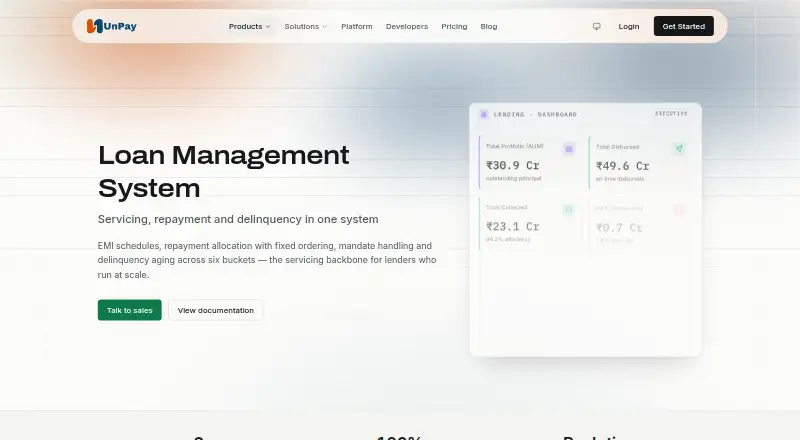
UnPay Loan Management System manages loan servicing from disbursement through repayment and closure. At disbursement, it creates flat or reducing-balance instalment schedules, then applies repayments to penalty, interest and principal in that order. Collection methods include NACH, eMandate, PDC, standing instructions and manual receipts. A scheduled sweep updates days past due and places loans into configured NPA threshold buckets. Listed resolution choices include moratorium, EMI reduction, tenure extension, one-time settlement, legal action and write-off. Its API can post repayments, retrieve schedules and balances, initiate restructures or closures, and send event webhooks. The product records an actor and timestamp for restructuring and closure events, and scopes loan data by organisation. UnPay lists NBFCs, microfinance, housing finance, vehicle and equipment finance, embedded lending and asset reconstruction among its intended uses. The free Build sandbox includes 15 products and 480 API endpoints. Scale and Enterprise pricing is not listed; product rate cards are shared during onboarding. UnPay states it is ISO 27001 and Cert-In certified.
Who it is for
It suits lenders and finance providers handling the listed loan types, from NBFCs and microfinance providers to embedded lenders. Its API and organisation-level data controls may also suit teams integrating servicing into their systems.
What is good
- Creates flat or reducing-balance instalment schedules.
- Supports several repayment collection methods.
- Provides API access and event webhooks.
- Free Build sandbox includes 15 products and 480 API endpoints.
- Supports multiple restructuring and closure options.
What to know first
- Scale and Enterprise prices are not listed.
- Free Build is a sandbox plan.
- Rate cards are shared during onboarding.
Everything Xiaomi review
UnPay Loan Management System: the full review
UnPay covers servicing workflows from schedule creation through repayment, delinquency handling and closure. The free sandbox offers a way to explore the platform, while production plan pricing requires further inquiry.
Overview
UnPay Loan Management System is a servicing platform for lenders managing loans from disbursement through payoff. It is best suited to finance providers that need repayment operations and delinquency workflows alongside API-based integration. Its broad servicing scope is a strength; production pricing is custom, so it is less suited to buyers who need a known cost before engaging.
Key features
At disbursement, UnPay can generate flat or reducing-balance instalment schedules. Repayments follow a fixed waterfall—penalty, then interest, then principal—which gives operations a consistent allocation rule, though it may not fit lenders that need a different sequence. Collection methods include NACH, eMandate, PDC, standing instructions and manual receipts. Payment scheduling, automatic matching and invoice reconciliation are also supported; payment processors include payment gateways, UPI and NPCI.
A scheduled sweep updates days past due and assigns loans to configured NPA-threshold buckets. For resolution, the system supports moratoriums, EMI reductions, tenure extensions, one-time settlements, legal action and write-offs. The API can post repayments, retrieve schedules and balances, initiate restructures or closures, and emit webhooks for due, overdue, bucket-change and closure events. Those hooks can help connected systems respond to servicing events without relying solely on manual checks.
Restructuring and closure records capture an actor and timestamp, while loan data is scoped by organisation. UnPay states that it is ISO 27001 and Cert-In certified; its security policy describes TLS encryption in transit, AES-256 at rest and hardware-backed key management. These controls may matter to lenders assessing governance and data protection, but they do not replace a buyer's own security review.
Pricing
Build: 0.00 USD per free. It provides all 15 products in a sandbox, 480 API endpoints and community support. This is a useful no-cost way to explore the platform, but it is sandbox access rather than production service.
Scale: custom pricing, billed per transaction with volume tiers. It includes production access, email and chat support, and a 99.9% SLA. This is the relevant option for lenders moving into live operations, though per-transaction costs require a volume-based quote.
Enterprise: custom pricing under custom annual agreements. It adds dedicated infrastructure, on-premises or VPC deployment options, a 99.99% uptime SLA and 24/7 named support. It is aimed at organisations that need deployment control or a higher service commitment, rather than teams that can work within Scale's terms.
UnPay offers a free plan and a free trial. Individual product rate cards are shared during onboarding, so buyers should confirm product-level charges and the applicable transaction economics before committing.
Platforms
UnPay supports Android, iOS, web and API access, with both deployment approaches available. A borrower portal is supported. The combination suits organisations serving borrowers through apps or web while connecting loan operations to other software.
Who it's for
The named audiences are NBFCs, microfinance providers, housing finance firms, vehicle and equipment finance businesses, embedded lenders and asset reconstruction firms. Its schedule generation, collection handling and delinquency resolution make it relevant to lenders managing ongoing servicing rather than only loan origination. Accounting integrations include Tally, SAP and NetSuite.
Pros and cons
- Pros: Covers repayment processing, delinquency classification and multiple resolution paths in one servicing workflow, which can reduce the need to split those operations across separate tools.
- Pros: API actions and event webhooks span repayments, balances, restructures, closures and servicing events, giving integrated teams useful ways to connect systems.
- Pros: Organisation-scoped data, actor-and-time records for restructuring and closure, and stated security controls address governance concerns relevant to lending operations.
- Cons: Scale and Enterprise have custom pricing, so production cost is harder to compare without a quote.
- Cons: Build is limited to a sandbox; it does not provide the production access or service commitments described for paid plans.
Alternatives
For reconciliation-focused work rather than end-to-end loan servicing, compare Payment Reconciliation Software and Loan Management Software. Fihary is another freemium option on Android, web and Windows, with a free tier capped at one Mobile Money operator, one user and 10 transactions per day. ReconcileIQ offers API and web access, including a free tier with 1,000 one-off credits and cash accounting for one IQ Books organisation. BankStatementMatcher is API- and web-based; its free tier caps daily statements, uploaded rows, receipt matches and Insights, while including CSV export.
Invoiced is a paid API and web alternative with custom pricing based on requirements and use. Ledge Cash Application is a paid web option with pricing available by contacting Ledge. OCTA AP Automation is a paid API and web option. Centime AP Automation is a paid web option with custom quotes based on monthly invoice and payment volume, with users included at no extra cost. EasyReco is a paid Android and web option with monthly plans.
Verdict
UnPay is a strong fit for lenders that need servicing, repayment allocation and delinquency resolution tied together, especially when API integration and organisation-level controls matter. The sandbox gives teams a way to explore its breadth, but production buyers should look elsewhere if transparent upfront pricing is essential.
UnPay Loan Management System plans and pricing
All plansCompared on loan management software
Facts
- Purpose
- The system handles loan servicing from disbursement through repayment and closure.unpay.co · 30 Sept 2026
- Schedules
- It generates flat or reducing-balance instalment schedules at disbursement.unpay.co · 30 Sept 2026
- Repayment allocation
- Repayments are applied in a fixed order: penalty, interest, then principal.unpay.co · 30 Sept 2026
- Repayment methods
- The page lists NACH, eMandate, PDC, standing instructions, and manual receipts as collection channels or methods.unpay.co · 30 Sept 2026
- Delinquency and classification
- A scheduled sweep advances days past due and re-buckets loans against configured NPA thresholds.unpay.co · 30 Sept 2026
- Restructuring
- Listed resolution options include moratorium, EMI reduction, tenure extension, one-time settlement, legal action, and write-off.unpay.co · 30 Sept 2026
- API
- The API can post repayments, fetch schedules and balances, raise restructures or closures, and send webhooks for due, overdue, bucket-change, and closure events.unpay.co · 30 Sept 2026
- Audit and tenant controls
- The product page says restructuring and closure events record an actor and timestamp, and loan data is scoped to an organisation.unpay.co · 30 Sept 2026
- Security certification
- UnPay states that it is ISO 27001 certified and Cert-In certified.unpay.co · 30 Sept 2026
- Security practices
- The security policy says data is encrypted in transit using TLS and at rest using AES-256, with hardware-backed key management.unpay.co · 30 Sept 2026
- Support and pricing
- The pricing page lists community support for the free sandbox, email and chat support on Scale, and 24/7 named support on Enterprise; it says individual product rate cards are shared during onboarding.unpay.co · 30 Sept 2026
- Intended users
- The product page names NBFCs, microfinance providers, housing finance, vehicle and equipment finance, embedded lenders, and asset reconstruction as intended users.unpay.co · 30 Sept 2026
Company
- Founded
- 2024unpay.co · 28 Sept 2026
- Headquarters
- Bidhannagar, Kolkata, West Bengal, Indiaunpay.co · 28 Sept 2026
Best UnPay Loan Management System alternatives
See all 20


Where it ranks on Everything Xiaomi
Is UnPay Loan Management System yours?
Claim it for free: prove the domain, then correct facts, plans and screenshots. An editor reviews every change.
Sources
- unpay.co/products/loan-management-system· checked 30 Sept 2026
- unpay.co/information-security· checked 30 Sept 2026
- unpay.co/pricing· checked 30 Sept 2026