
Ledge Cash Application
Ledge Cash Application matches payments from banks, payment processors, and remittance files to invoices and an ERP.
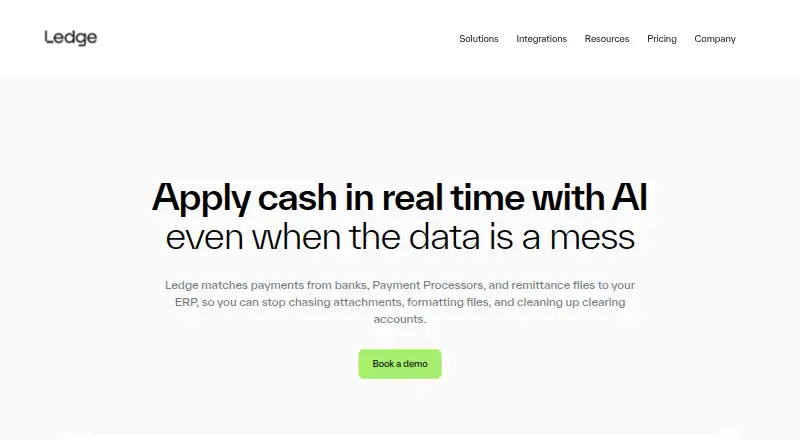
What Ledge Cash Application is
Ledge Cash Application matches payments from banks, payment processors, and remittance files to invoices and an ERP. Its AI and rules handle vague or partial references and one-to-many or many-to-one matches. It extracts remittance details from PDFs, emails, and shared inboxes, and suggests resolutions for short pays, overpays, and other exceptions. Matched payments can be posted to the general ledger with audit context, and the product retains an audit trail. Unmatched payments are flagged with transaction details and possible matches rather than forced or silently skipped. Ledge describes processing as continuous and daily, rather than a monthly batch job. Named processor integrations include Stripe, Adyen, PayPal, Braintree, ConexPay, EBANX, GoCardless, and Checkout; the company says it connects to more than 11,000 banks worldwide. Accounting integrations include NetSuite, QuickBooks, SAP S/4HANA, Sage Intacct, Xero, and Microsoft Dynamics 365. Pricing is on request. Ledge says its first automated cash application cycle runs within two weeks of setup.
Good
- Matches partial references and complex payment relationships.
- Extracts remittance data from PDFs and emails.
- Flags unmatched payments with possible matches.
- Maintains an audit trail for matches and records.
Watch out
- Pricing is available only on request.
- The first automated cycle may take up to two weeks of setup.
- Standard Support is offered on weekdays.
Who it suits
Ledge is aimed at mid-market and enterprise finance teams, including growing SaaS companies and multi-entity organizations. It may suit teams handling high daily transaction volumes and payment reconciliation.
Verdict
Ledge focuses on continuous cash application, exception handling, and audit context across payment and ERP sources. Finance teams should request pricing and confirm support coverage needs.
Plans and prices
From Ledge Cash Application's own pricing page, checked 21 Oct 2026.
| Plan | Price | What it gives you |
|---|---|---|
| Enterprise | Priced on request | Everything in Execute · proprietary-source integrations · API and webhooks output · cross-agent dependencies · cash-positions reporting · one annual platform fee |
| Execute | Priced on request | Everything in Track · direct data-source integrations · transaction monitors · AI-generated working papers and journal entries · continuous reconciliation · AI flux analysis · one annual platform fee |
| Track | Priced on request | 1 ERP integration · 1 bank integration · unlimited CSV uploads · close management · real-time dashboard · one annual platform fee |
The facts
Each one read from Ledge Cash Application's own pages, with the date it was checked.
What it does
- AI data use
- The vendor states customer data is not used to train its AI models.checked 21 Oct 2026
- AI matching
- AI and rules match payments to invoices, including vague or partial references and one-to-many or many-to-one relationships.checked 2 Oct 2026
- API authentication
- The API uses OAuth client credentials, with client IDs and secrets generated from the Developers page and bearer access tokens requested from Auth0.checked 21 Oct 2026
- Audit trail
- The product records an immutable, end-to-end transaction history linking changes and source data.checked 21 Oct 2026
- Availability commitment
- Ledge’s SLA sets a target availability of 99.9% monthly and describes service credits if availability falls below the target.checked 2 Oct 2026
- Compliance reports
- Ledge says SOC 1 and SOC 2 reports are available through its trust center or account team.checked 21 Oct 2026
- Context-aware matching
- Matching uses transaction and entity context and supports one-to-many and many-to-one relationships even when references are partial or absent.checked 21 Oct 2026
- Custom data sources
- Ledge supports CSV uploads through Excel, Google Sheets and SFTP, plus database connections such as Snowflake, Google Cloud and AWS.checked 21 Oct 2026
- Data-ingestion methods
- Documentation lists SFTP, Google Drive, OneDrive, REST APIs, JDBC, warehouses including Snowflake, Redshift and BigQuery, and manual uploads.checked 21 Oct 2026
- Documentation
- The help center documents checklist imports, preparer and reviewer approvals, NetSuite synchronization, Slack or Teams notifications, reconciliations and flux workflows.checked 21 Oct 2026
- Entity logic
- Cash application includes entity-aware processing across subsidiaries, no-code rules and foreign-exchange handling.checked 21 Oct 2026
- Exception handling
- Short pays, overpays and other unmatched items receive suggested resolutions and remain available for human review.checked 21 Oct 2026
- Funding
- New Enterprise Associates says it led Ledge’s $9 million seed round, and lists its first investment year as 2022.checked 21 Oct 2026
- Ingestion frequency
- Configured source ingestion can run as often as every 10 minutes.checked 21 Oct 2026
- Integrations
- Native connections include Stripe, Adyen, PayPal and more than 11,000 banks; the broader platform advertises 150-plus connectors.checked 21 Oct 2026
- Intended users
- Ledge says its platform is built for mid-market and enterprise finance teams, including growing SaaS companies and multi-entity organizations.checked 2 Oct 2026
- Ledger posting
- Matched payments can be posted directly to the general ledger with audit context.checked 21 Oct 2026
- Legal name
- The website terms identify the company as Ledge, Inc. and its affiliates.checked 21 Oct 2026
- Limit: learning curve
- A G2 reviewer describes a steep learning curve and opaque inner workings.checked 21 Oct 2026
- Limit: manual intervention
- G2 reviewers report that monthly general-ledger postings can still require frequent manual corrections and may not reflect bank cash activity accurately.checked 21 Oct 2026
- Limit: pricing
- A G2 reviewer says the operational benefits are good but the cost should be lower.checked 21 Oct 2026
- Limit: Xero reconciliation
- A G2 reviewer says direct reconciliation of bank balances in Xero was unavailable and expected on the roadmap.checked 21 Oct 2026
The company
- Company profile
- LinkedIn lists Ledge as privately held, headquartered in New York, with 11–50 employees and founded in 2022.checked 21 Oct 2026
- Headquarters
- New York, United States; Tel Aviv, Israelchecked 28 Sep 2026
The full review of Ledge Cash Application
Overview
Ledge Cash Application matches incoming payments and remittance details to invoices and an ERP, with a focus on ongoing processing and exception resolution. It is best suited to mid-market and enterprise finance teams handling high transaction volumes, especially growing SaaS companies and multi-entity organizations. Its continuous workflow and audit controls are compelling, but custom pricing and a narrow one-connection bank allowance may make it less suitable for smaller teams.
Key features
Matching and remittance
AI and rules match payments to invoices even when references are vague or partial, and can handle one-to-many and many-to-one relationships. That flexibility can reduce manual work when payment data does not align neatly with invoices. Ledge also extracts remittance details from PDFs, emails, and shared inboxes, bringing scattered payment context into the matching process.
Exceptions, posting, and audit
For short pays, overpays, and other exceptions, Ledge proposes resolutions and can reuse prior decisions when similar cases recur. Unmatched payments remain visible with transaction details and possible matches rather than being forced into a match or silently skipped. Matched payments can be posted to the general ledger with audit context, and an audit trail records matches and related records. This gives finance teams a clearer review path, though exceptions still require human judgment.
Continuous processing and integrations
Ledge describes cash application as daily, continuous processing rather than a monthly batch task. It names Stripe, Adyen, and PayPal among its native processor integrations and says it connects to more than 11,000 banks worldwide. Accounting integrations include NetSuite, QuickBooks, SAP S/4HANA, Sage Intacct, Xero, and Microsoft Dynamics 365. The product also supports multi-currency, invoice reconciliation, automatic matching, and API access.
For NetSuite users, Ledge is a certified SuiteApp. Its agents connect with read-only access by default and require human approval before posting, a useful control for teams that want automation without surrendering posting approval. Ledge says it is built for thousands of daily transactions and that the first automated cycle runs within two weeks of setup; those claims make it more relevant to organizations with meaningful volume and implementation needs than to occasional users.
Security and service
Ledge says its platform is SOC 1 and SOC 2 certified, with encryption, SSO, role-based permissions, and audit controls. Standard Support is available on weekdays; Premium Support adds extended weekday hours, weekend coverage, and a dedicated customer success manager. Its SLA targets 99.9% monthly availability and describes service credits if availability falls below that target. Teams with weekend operations should weigh the Premium Support requirement when evaluating the service.
Pricing
Ledge is paid software with custom pricing. All three plans require contacting Ledge for a price, so buyers should confirm costs and support coverage directly.
| Plan | Includes | Best fit |
|---|---|---|
| Track | One ERP and one bank integration, unlimited CSV uploads, close process management, and a real-time tracking dashboard. | Teams starting with a limited number of direct connections or relying on uploads. |
| Execute | Everything in Track, plus direct data-source integrations, ongoing transaction monitors, AI-generated working papers and journal entries, continuous account reconciliation, and AI-powered flux analysis. | Teams that need broader automation and recurring reconciliation workflows. |
| Enterprise | Everything in Execute, plus proprietary-source integrations, API and webhook output, cross-agent dependencies, and cash positions reporting. | Organizations with custom sources, downstream integrations, or more complex coordination needs. |
Track's one-bank-integration limit and CSV-based option are meaningful constraints for teams that need several live bank feeds. Execute adds direct integrations and continuous reconciliation, while Enterprise is the tier for proprietary sources and API or webhook output. No seat count, transaction quota, or trial term is stated for these plans, so buyers should establish those terms as part of a pricing discussion.
Platforms
Ledge is available on the web. Its bank-connection allowance is one connection, while its cash application page separately describes connectivity to more than 11,000 banks worldwide; teams should clarify how the connection allowance applies to their chosen plan and setup.
Who it's for
Ledge is a strong candidate for finance teams that process thousands of payments daily, need to reconcile remittance data from multiple formats, or want recurring cash application with a reviewable exception trail. Its support for multiple accounting systems and payment processors also suits organizations with varied financial infrastructure. Small businesses with low payment volume, or teams seeking a self-service free tier and transparent prices, should look elsewhere.
Pros and cons
- Pros: Flexible matching handles partial references and complex invoice-payment relationships, reducing the risk that imperfect remittance data blocks reconciliation.
- Pros: Exception suggestions, visible unmatched items, and retained audit context support controlled review instead of opaque auto-matching.
- Pros: Continuous processing and broad named accounting and processor integrations suit high-volume, multi-system finance operations.
- Cons: Custom pricing makes cost comparison difficult before a sales conversation.
- Cons: Track includes only one ERP and one bank integration, which may be restrictive for teams with several live sources.
- Cons: Premium Support is the option with weekend coverage, a relevant limitation for teams that need weekend assistance.
Alternatives
For a freemium option with a free tier and API and web access, consider ReconcileIQ; its free plan is limited to 1,000 one-off credits, one IQ Books organisation, and cash accounting only. Serrala Alevate AR Cash Application is another paid, web-based cash application option to compare. Teams evaluating paid web reconciliation software can also consider Trintech Accurate Reconciliation or Reconciler.
For bank reconciliation, Embat Bank Reconciliation offers modular plans with optional upgrades and a personalised proposal, while Aritma Reconciliation provides self-hosted and web options with a quote tailored to ERP, bank connections, transaction volume, and required products. BankStatementMatcher is a freemium API and web alternative with a no-signup free plan capped at one statement per day, 500 rows per upload, five receipt matches per day, and five Insights per day. Transformance ClearMatch is another paid option.
For category-level comparisons, browse Cash Application Software, Payment Reconciliation Software, Accounting Automation Software, Financial Close Software, and AI Accounting Software.
Verdict
Choose Ledge if your finance team needs continuous cash application at scale, with flexible matching, explicit exception review, and audit context across payment and ERP sources. Its strongest case is controlled automation for complex, high-volume operations. Look elsewhere if you need transparent pricing, a generous self-service tier, or more than one bank connection in the entry plan; request a quote and confirm integration and support coverage against your workflow.
Alternatives to Ledge Cash Application
- 1

HighRadius
AndroidiOSWebAPI7.1 - 2

OpenEnvoy
Free planWeb6.8Free plan - 3

SAP CPQ
Web6.4From $24 a month - 4

Invoiced
WebAPI6.1 - 5

Esker Cash Application
WebAPILinuxWindows6.0 - 6

Cloudsquid Cash Application Automation
WebAPISelf-hosted5.9