
OpenEnvoy
OpenEnvoy is a web-based accounts payable platform that uses AI-assisted workflows to capture, code, and match invoices in real time.
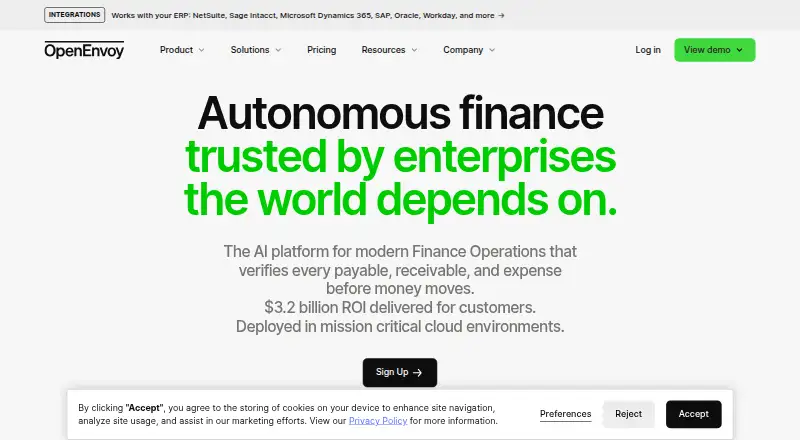
What OpenEnvoy is
OpenEnvoy is a web-based accounts payable platform that uses AI-assisted workflows to capture, code, and match invoices in real time. Its listed functions include approval workflows, purchase-order matching, payment execution, and support for multiple entities. It connects with ERP systems including NetSuite, Sage Intacct, Microsoft Dynamics 365, SAP, Oracle, and Workday, with named integrations also including Microsoft, QuickBooks, Xero, and Zoho. Every plan includes dual control, separating payment submission from approval. Essentials is free for small teams and includes 800 tokens; unused tokens roll over until used, and the plan is available instantly. Prices are not listed for Essentials, Scale, or Enterprise. Scale has a 50,000-token annual minimum, while Enterprise has a 500,000-token annual minimum. Support ranges from email and chat to priority support and a dedicated account manager. Scale typically goes live in under 90 days; Enterprise uses a custom rollout. The platform is deployed in mission-critical cloud environments.
Good
- Free Essentials plan includes 800 tokens.
- Unused tokens roll over until used.
- All plans include payment submission and approval controls.
- Supports multiple entities and purchase-order matching.
- Connects with named ERP and accounting systems.
Watch out
- Prices for Essentials, Scale, and Enterprise are not listed.
- Scale has a 50,000-token annual minimum.
- Enterprise has a 500,000-token annual minimum.
- Enterprise rollout timing is custom.
Who it suits
OpenEnvoy suits teams looking to automate invoice capture, coding, matching, approvals, and payment execution. Essentials is described as suitable for small teams; larger plans have annual token minimums.
Verdict
OpenEnvoy combines invoice processing with approval and payment controls, and offers a free Essentials tier. Before choosing a paid tier, teams should confirm pricing and consider the token minimums and rollout arrangements.
Plans and prices
From OpenEnvoy's own pricing page, checked 20 Sep 2026.
| Plan | Price | What it gives you |
|---|---|---|
| 800 Tokens Free | Free | 800 tokens |
| Essentials | Free | 800 tokens; best for small teams; annual minimum none · No annual minimum |
| Scale | — | 50,000 tokens annual minimum |
| Enterprise | — | 500,000 tokens annual minimum |
The facts
Each one read from OpenEnvoy's own pages, with the date it was checked.
What it does
- Accounting integrations
- 3checked 20 Sep 2026
- AP automation
- Captures, codes, and matches invoices in real time with AI-assisted workflows.checked 28 Sep 2026
- Cloud environment
- The platform is deployed in mission-critical cloud environments.checked 28 Sep 2026
- Implementation timing
- Essentials is instant, Scale typically goes live in under 90 days, and Enterprise uses a custom rollout.checked 28 Sep 2026
- Instant availability
- Essentials is available instantly; the page does not state a trial or refund policy.checked 28 Sep 2026
- Invoice capture
- aichecked 20 Sep 2026
- Listed integrations
- Named integrations include Microsoft, Oracle, QuickBooks, SAP, Xero, Zoho, Sage, and others.checked 28 Sep 2026
- Multi-entity support
- Yeschecked 20 Sep 2026
- Payment controls
- Every plan includes dual control separating payment submission and approval.checked 28 Sep 2026
- Payment execution
- Verified Payments supports vendor payments by virtual card, ACH, or wire in the U.S.checked 28 Sep 2026
- Payment provider
- Verified Payments cards are powered by Stripe and issued by Celtic Bank.checked 28 Sep 2026
- Performance metrics
- The page reports 99.69% capture accuracy, $3.2B overbillings caught, and $25B+ payment volume orchestrated.checked 28 Sep 2026
- PO matching
- Yeschecked 20 Sep 2026
- Pricing model
- Pay only for what you process using one token pool across products.checked 28 Sep 2026
- Supported ERPs
- Supports NetSuite, Sage Intacct, Microsoft Dynamics 365, SAP, Oracle, Workday, and more.checked 28 Sep 2026
- Support options
- Support ranges from email and chat to priority support and a dedicated account manager.checked 28 Sep 2026
- Token expiration
- Tokens do not expire and roll over until used.checked 28 Sep 2026
Where it runs
- Approval workflows
- Yeschecked 20 Sep 2026
The company
- Company recognition
- OpenEnvoy was named a 2023 Gartner Cool Vendor in Sourcing & Procurement.checked 28 Sep 2026
- Founded
- 2020checked 23 Sep 2026
- Team access
- Scale includes organization SSO and Enterprise includes Enterprise Directory Services.checked 28 Sep 2026
Money
- Free plan
- Yeschecked 20 Sep 2026
- Free tier
- Essentials is free with 800 tokens and is available for small teams.checked 28 Sep 2026
The full review of OpenEnvoy
OpenEnvoy is web-based accounts payable software for teams that want invoice processing, approvals and payment execution in one workflow. It is best suited to small teams starting with its free Essentials tier or larger organizations with substantial invoice volumes. Its combination of AI-assisted processing and payment controls is compelling, but paid plans carry sizeable annual token minimums.
Overview
OpenEnvoy brings invoice capture, coding and purchase-order matching together with approval workflows and payment execution. AI-assisted workflows process invoices in real time, while support for multiple entities makes the platform relevant to organizations managing payables across more than one business unit. Every plan separates payment submission from approval through dual control, a useful safeguard for teams that need distinct payment responsibilities.
The platform supports NetSuite, Sage Intacct, Microsoft Dynamics 365, SAP, Oracle and Workday, among other ERPs. Named integrations also include Microsoft, QuickBooks, Xero, Zoho and Sage. OpenEnvoy reports 99.69% capture accuracy, $3.2B in overbillings caught and $25B+ in orchestrated payment volume; those figures indicate the scale of its reported activity, but are not a promise of results for an individual customer.
OpenEnvoy was founded in 2020 and was named a 2023 Gartner Cool Vendor in Sourcing & Procurement. Its platform runs in mission-critical cloud environments. Verified Payments cards are powered by Stripe and issued by Celtic Bank.
Key features
- AI invoice processing: Captures, codes and matches invoices in real time. This can consolidate routine AP work, though teams should assess how well the workflow fits their own invoice and coding practices.
- Purchase-order matching and approvals: PO matching and approval workflows connect invoice review to authorization, making OpenEnvoy a stronger fit for controlled payables processes than a capture-only tool.
- Payment execution with dual control: OpenEnvoy can execute payments, and all plans separate submission from approval. That control is valuable for organizations that do not want one person to both initiate and authorize a payment.
- Multi-entity support: Organizations with multiple entities can use the platform across them rather than treating the product as a single-entity workflow.
- ERP and accounting connections: Support for major ERP systems and named integrations such as QuickBooks, Xero and Zoho gives teams several routes to connect existing finance systems.
- Organization access and support: Scale includes organization SSO; Enterprise adds Enterprise Directory Services. Support ranges from email and chat to priority help and a dedicated account manager, with access depending on plan.
Pricing
OpenEnvoy uses a freemium model. The free option is a practical entry point, while the paid plans' token minimums make them better suited to organizations able to commit to higher annual volumes.
| Plan | Price and allowance | Best fit and trade-off |
|---|---|---|
| 800 Tokens Free | free; 800 tokens | A no-cost way for a small team to begin. The allowance is limited, so larger invoice operations should look beyond the free tier. |
| Essentials | Custom pricing; 800 tokens; no annual minimum | Best for small teams that want the Essentials tier without an annual minimum. It is available instantly, but its price is not published. |
| Scale | Custom pricing; 50,000-token annual minimum | For organizations with enough volume to meet the minimum and a need for organization SSO. It typically goes live in under 90 days, so it is not an instant rollout. |
| Enterprise | Custom pricing; 500,000-token annual minimum | A fit for very high-volume organizations that need Enterprise Directory Services and can accommodate a custom rollout. |
Essentials tokens do not expire and roll over until used, which reduces the risk of losing unused allowance. The listed plans do not provide a published price for Essentials, Scale or Enterprise, so prospective buyers should confirm costs before committing. The free Essentials option is available instantly; no trial or refund policy is stated for it.
Platforms
OpenEnvoy is available on the web. It also supports a broad range of ERP and accounting connections, but web access is the platform format identified for the product.
Who it's for
OpenEnvoy is a strong candidate for finance teams that want invoice capture, PO matching, approvals and payment execution governed in one AP workflow. Essentials suits small teams that can work within 800 tokens and value having no annual minimum. Scale and Enterprise are aimed at larger operations: the 50,000- and 500,000-token annual minimums respectively make them harder to justify for low-volume teams, even before pricing is considered.
Teams that need a mobile app, or that cannot accommodate those paid-tier token commitments and rollout arrangements, should compare other options before choosing OpenEnvoy.
Pros and cons
- Pro: Invoice capture, coding, PO matching, approvals and payment execution are brought into one workflow, reducing the need to assemble those capabilities from separate tools.
- Pro: Dual control is included on every plan, so payment governance is not reserved for the highest tier.
- Pro: Essentials is free with 800 tokens, has no annual minimum, and unused tokens roll over until used.
- Con: Scale and Enterprise require annual minimums of 50,000 and 500,000 tokens, respectively, which may be excessive for smaller or less predictable workloads.
- Con: Paid-plan prices are custom, making budget comparison difficult without contacting OpenEnvoy.
- Con: Scale typically takes under 90 days to go live, while Enterprise uses a custom rollout; neither is as immediate as Essentials.
Alternatives
For adjacent categories, browse Accounts Payable Software, Cash Application Software and Freight Audit and Payment Software.
These alternatives focus on cash application or receivables rather than OpenEnvoy's AP workflow:
- CashOnTime is a paid web and API option.
- Invoiced is a paid web and API platform with custom pricing based on requirements and use; buyers can request a demo for a quote.
- Emagia Receivables Management is a paid web and self-hosted enterprise receivables product with pricing by inquiry.
- Hyperbots Cash Application Co-Pilot is a web-based, usage-priced option with a free trial, pay-as-you-go billing and unlimited users without per-seat licensing.
- Ledge Cash Application is a paid web-based option with Track and Execute plans.
- Cloudsquid Cash Application Automation is a paid option for web, API and self-hosted deployments; zero-retention mode is available and self-learning AI is Enterprise-only.
- GlobalPayEX Cash Application is a web-based paid option that typically combines a one-time setup fee with a monthly subscription tailored to the customer.
- Monk Cash Application is a paid web-based option with pricing that scales with business volume.
Verdict
Choose OpenEnvoy if your finance team wants an AP workflow spanning AI-assisted invoice handling, approvals, PO matching and controlled payment execution, and if Essentials' 800-token allowance or the larger plans' annual commitments suit your volume. Its most persuasive advantage is that dual control is standard across all plans. Look elsewhere if you need a published paid price, a low-volume paid tier, or a faster large-scale rollout.
Getting started
- Open the OpenEnvoy website.
- Choose the Essentials plan for the free 800-token option.
- Use the web platform; Essentials is available instantly.
Limits worth knowing
Essentials includes 800 tokens, which roll over until used. Scale has a 50,000-token annual minimum and Enterprise has a 500,000-token annual minimum.
Questions
Is OpenEnvoy free?
Yes. The 800 Tokens Free plan is listed as free (800 tokens). Essentials is also described as free for small teams and includes 800 tokens.
Do OpenEnvoy tokens expire?
No. Tokens do not expire and roll over until used.
What platforms does OpenEnvoy support?
OpenEnvoy is available on the web.
Which accounting and ERP systems does it support?
Supported ERPs include NetSuite, Sage Intacct, Microsoft Dynamics 365, SAP, Oracle, and Workday. Named integrations also include Microsoft, Oracle, QuickBooks, SAP, Xero, Zoho, and Sage.
What are the token minimums for Scale and Enterprise?
Scale has a 50,000-token annual minimum. Enterprise has a 500,000-token annual minimum.
What payment controls are included?
Every plan includes dual control, which separates payment submission from approval.
Alternatives to OpenEnvoy
- 1
Jorora Freight Audit
Free planWeb6.6$1.29 one-time - 2

Intelligent Audit
WebAPI6.3 - 3
Lojistic +PAY
Free planWebAPI6.2Free plan - 4
ShipEnd
WebAPI6.1From $25 a month - 5
Shipware Audit and Pay
Free planWeb5.9Free plan - 65.9