Universal SLR Assistant
Universal SLR Assistant supports systematic and scoping reviews with AI-assisted screening, extraction and reproducible outputs.
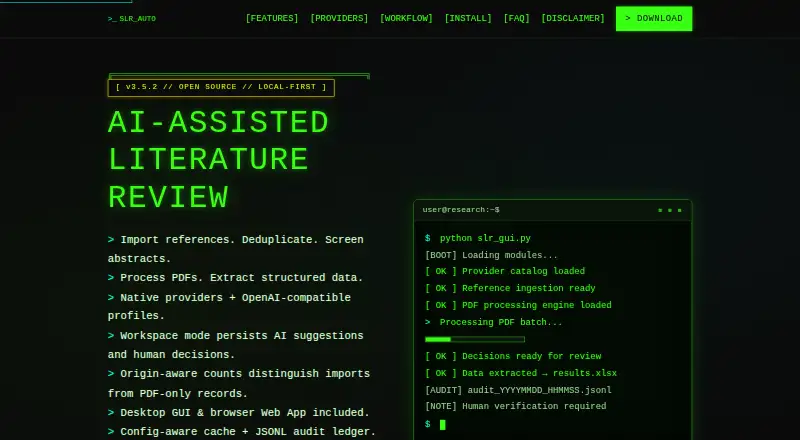
What Universal SLR Assistant is
Universal SLR Assistant supports systematic and scoping reviews with AI-assisted screening, extraction and reproducible outputs. It offers a desktop GUI and a browser-based Web App for local use. Researchers can import RIS, BibTeX, CSV and plain-text references, including exports from PubMed, Scopus and Web of Science. The workflow spans abstract screening, full-text PDF processing, structured extraction and export, while likely duplicates are flagged through DOI and fuzzy title matching. Workspace mode keeps references, PDF metadata, review items, decisions and audit events in a local SQLite workspace, separating AI suggestions from human decisions. Exports can include decision files and logs, full-text exclusion reasons, PRISMA-ready counts, a methods disclosure draft and a manifest. The project supports multiple cloud and local AI providers. Submitted paper text goes to cloud providers, while Ollama or another local endpoint can keep it on the user’s computer or local network. The software is free and open source, but cloud AI provider fees may apply. AI output is assistance only; people remain responsible for verifying and making final review and reporting decisions.
Good
- Imports common reference formats and research exports.
- Identifies likely duplicates with DOI and title matching.
- Workspace separates AI suggestions from human decisions.
- Exports PRISMA-ready counts and decision logs.
Watch out
- Human verification and final review decisions remain necessary.
- Cloud AI providers receive submitted paper text.
- Cloud AI provider API fees may apply.
- Local Web App is not intended as a public multi-user service.
Who it suits
It is intended for PhD students, researchers, professors, evidence synthesis teams and authors of systematic or scoping reviews. It may suit users who want a local workspace and structured review exports, provided they verify AI-assisted results.
Verdict
Universal SLR Assistant offers a structured workflow for systematic and scoping reviews, with local workspace storage and reproducible exports. Its AI results require human review, and users should choose providers with the paper-text transmission model in mind.
Plans and prices
From Universal SLR Assistant's own pricing page, checked 15 Oct 2026.
| Plan | Price | What it gives you |
|---|---|---|
| Free and open source | Free | MIT License · cloud AI provider API fees may apply |
The facts
Each one read from Universal SLR Assistant's own pages, with the date it was checked.
What it does
- Abstract screening
- AI evaluates titles and abstracts against user criteria and returns Include, Exclude or Maybe recommendations for human review.checked 15 Oct 2026
- AI providers
- Provider options include OpenAI, Anthropic Claude, Google Gemini, Ollama, OpenRouter, DeepSeek, Mistral, Kimi, xAI, LM Studio, vLLM, LocalAI, and custom OpenAI-compatible endpoints.checked 30 Sep 2026
- API and extensibility
- The Web App exposes workspace review and export HTTP endpoints, and contributors can add providers through the LLM interface or OpenAI-compatible profiles.checked 15 Oct 2026
- Audit ledger
- Each run can create a JSONL ledger containing provider, model, hashes, cache status, parsing status and retry metadata without storing API keys or full paper text.checked 15 Oct 2026
- Caching
- Configuration-aware JSON caching keys results by text, stage, provider, model, prompts and extraction settings.checked 15 Oct 2026
- Cloud data transmission
- When cloud providers are selected, submitted paper text is sent to the provider's API; router providers add another intermediary.checked 15 Oct 2026
- Data transmission
- Cloud providers receive submitted paper text, while Ollama or another local endpoint can keep paper text on the user's computer or local network.checked 30 Sep 2026
- Deduplication
- Duplicate detection combines DOI matching with fuzzy title matching and leaves final review to the researcher.checked 15 Oct 2026
- Developer post: automation
- A mirrored developer post lists automated deduplication and extraction as product capabilities.checked 15 Oct 2026
- Developer post: local integration
- A mirrored developer post highlights local Ollama integration and processing PDFs on the user's own machine.checked 15 Oct 2026
- Developer post: privacy
- A mirrored developer post claims local LLM use can keep data from leaving the user's hardware.checked 15 Oct 2026
- Developer post: providers
- A mirrored developer post describes support for more than nine AI providers, including OpenAI, Claude, Gemini and DeepSeek.checked 15 Oct 2026
- Developer profile
- A public profile identifies Mo Anisi as holding a BSc in Biology, an MSc in Cognitive Science and an MSc in Health and Social Welfare.checked 15 Oct 2026
- Documentation
- Documentation includes a 1,550-line complete user guide, in-app help, troubleshooting guidance, tests and GitHub issues.checked 15 Oct 2026
- Exports
- Workspace exports include decision CSV/XLSX files, AI and human decision logs, exclusion reasons, PRISMA-ready counts, a methods draft and a manifest.checked 15 Oct 2026
- Hardware guidance
- The user guide lists 4 GB RAM and 2 GB disk as minimums, with 8 GB RAM and 5 GB disk recommended; Ollama guidance lists at least 8 GB RAM and 10 GB disk.checked 15 Oct 2026
- Human decisions
- AI outputs remain suggestions, while final Include, Exclude or Maybe decisions require a human reviewer.checked 15 Oct 2026
- Installation
- Installation uses a Git clone, virtual environment and pip requirements, with batch launchers for Windows and Python commands for macOS or Linux.checked 15 Oct 2026
- Intended users
- It is intended for PhD students, researchers, professors, evidence synthesis teams, and systematic or scoping review authors.checked 30 Sep 2026
- Interfaces
- The project provides a desktop GUI and a browser-based local Web App.checked 30 Sep 2026
- Limitations
- AI output is assistance only; human verification and final inclusion, exclusion, extraction, and reporting decisions remain required.checked 30 Sep 2026
Money
- Developer post: cost
- A mirrored developer post says the tool has no monthly fees and is free under the MIT license.checked 15 Oct 2026
Where it runs
- Developer post: platforms
- A mirrored developer post names Windows, macOS and Linux as supported desktop platforms.checked 15 Oct 2026
- Limit: appraisal
- The product does not provide risk-of-bias or quality-appraisal tooling.checked 15 Oct 2026
The full review of Universal SLR Assistant
Universal SLR Assistant is a free, open-source tool for managing systematic and scoping reviews, from reference screening through extraction and export. It suits researchers who want a local workspace and a choice of cloud or local AI providers. Its strongest case is a traceable, end-to-end workflow; it is a poor fit for anyone expecting AI to make final review decisions or wanting a public, shared Web App.
Overview
The workflow runs from importing references to abstract screening, processing full-text PDFs, structured data extraction, and exporting results. It accepts RIS, BibTeX, CSV, and plain-text references, including exports from PubMed, Scopus, and Web of Science. DOI and fuzzy-title matching help surface likely duplicates, a useful safeguard before screening—but duplicate matches still need appropriate review.
Workspace mode keeps references, PDF metadata, review items, decisions, and audit events in a local SQLite workspace. Separating AI suggestions from human decisions supports accountable review rather than treating model output as a verdict. Exports include decision files, separate AI and human decision logs, full-text exclusion reasons, PRISMA-ready counts, a methods disclosure draft, and a manifest. That breadth makes the tool more compelling for reproducible work than for casual paper discovery.
Key features
AI assistance with a human checkpoint
Users can choose among providers including OpenAI, Anthropic Claude, Google Gemini, Ollama, OpenRouter, DeepSeek, Mistral, Kimi, xAI, LM Studio, vLLM, LocalAI, and custom OpenAI-compatible endpoints. The range gives teams flexibility to use cloud services or a local endpoint, but provider choice does not remove the need to verify summaries, screening suggestions, and extracted data. Final inclusion, exclusion, extraction, and reporting decisions remain human responsibilities.
Local workspace and privacy choices
The browser-based Web App binds to 127.0.0.1 and is intended for local use, not as a public multi-user service. Cloud providers receive submitted paper text; Ollama or another local endpoint can keep that text on the user's computer or local network. API keys are not written to the desktop or Web App settings files, and audit ledgers omit keys and full paper text. Readers handling sensitive material should choose a provider with the transmission model in mind.
Pricing
Free and open source — free under the MIT License. The plan includes screening, AI paper summaries, full-text analysis and storage, systematic review support, data extraction, reference deduplication, and exports in Excel (.xlsx), CSV, JSON, Markdown, and plain text. There is no paid tier described; cloud AI provider API fees may still apply, so free software does not necessarily mean free AI use.
Platforms
Universal SLR Assistant supports Linux, macOS, and Windows, with both a desktop GUI and a browser-based local Web App. The local-only Web App model is suited to an individual or locally managed workflow, not teams seeking a remotely hosted shared workspace.
Who it's for
PhD students, researchers, professors, evidence synthesis teams, and authors of systematic or scoping reviews are the natural audience. It is especially suitable for people who need an auditable sequence of human decisions and structured outputs, and who can manage their own provider choice and paper-text handling. Those seeking automated final judgments or public multi-user access should look elsewhere.
Pros and cons
- Pros: Broad reference imports and duplicate detection reduce friction when assembling a review library.
- Pros: Local SQLite storage, decision separation, audit events, and detailed exports support reproducibility.
- Pros: Cloud and local AI endpoint options let users choose a paper-text transmission approach.
- Cons: AI output requires human verification, so it cannot replace reviewer judgment or final reporting responsibility.
- Cons: Cloud providers receive submitted paper text, making provider choice a substantive privacy decision.
- Cons: The local Web App is not designed as a public multi-user service, limiting its fit for distributed collaboration.
- Cons: Cloud API fees may apply despite the software's free license.
Alternatives
For a wider comparison, see AI Literature Review Software and Systematic Review Software.
- ASReview is another free, open-source option with Linux, macOS, Windows, web, API, and self-hosted availability; running your own hardware or server may cost extra.
- Rayyan may suit mobile users who want Android or iOS access; its free plan caps use at 3 active reviews and 2 free reviewers, with limited mobile app access.
- Elicit is a web-based alternative for paper search and summaries, including search across more than 138 million papers and unlimited summaries on Basic, with limited Research Agent and Research Reports usage.
- Axelium offers a free plan with one lifetime review and one seat, which may suit a one-off individual project.
- EPPI-Reviewer is a web-based alternative with a free trial.
- INRA is a web-based option with a Teams & Institutions plan at $7.50 a year; the stated terms specify $7.50 per seat per month billed yearly and a three-seat minimum.
- Mapped Research may suit users who want a free web plan capped at 1,000 screening citations, 200 AI-assisted screenings, and 3 collaborators.
- Moara offers a free web plan for libraries of up to 50 papers, with Google Scholar and Semantic Scholar search and viewer or editor collaboration.
Verdict
Choose Universal SLR Assistant if you want a free, open-source review workflow that keeps its working data local and produces decision-focused exports. Its combination of traceability, broad import support, and provider flexibility is the main reason to choose it. Look elsewhere if your priority is a hosted team workspace, or if you need AI to stand in for human screening and verification.
Getting started
- Visit the project website.
- Choose the desktop GUI or browser-based local Web App for your platform.
- Import references from RIS, BibTeX, CSV, plain text, or supported database exports.
- Select an available AI provider, including a local option or custom OpenAI-compatible endpoint.
- Use the review workflow for screening, full-text PDF processing, and structured extraction.
- Export review decisions, logs, counts, and other available outputs.
Limits worth knowing
The software is free, but cloud AI provider API fees may apply. AI output is assistance only; human verification and final inclusion, exclusion, extraction, and reporting decisions remain required.
Questions
How much does Universal SLR Assistant cost?
The listed Free and open source plan costs nothing. Cloud AI provider API fees may apply.
Is there a free plan?
Yes. The project is free and open source under the MIT License.
Which platforms does it support?
Its listed platforms are Linux, macOS, web, and Windows. It provides a desktop GUI and a browser-based local Web App.
Can paper text stay local?
Ollama or another local endpoint can keep paper text on your computer or local network. Cloud providers receive submitted paper text.
What reference files can I import?
It imports RIS, BibTeX, CSV, and plain-text reference files, including exports from PubMed, Scopus, and Web of Science.
Does it make final review decisions?
No. AI output is assistance; human verification and final inclusion, exclusion, extraction, and reporting decisions remain required.
Alternatives to Universal SLR Assistant
- 1

ASReview
Free planOpen sourceWebAPILinuxmacOS7.7Free plan - 2
LASER AI
AndroidiOSWeb7.6From $3,000 a year - 3

Rayyan
Free planAndroidiOSWebAPI7.5From $4.99 a month - 4
RobotReviewer
Free planOpen sourceWebAPILinuxmacOS7.5Free plan - 5
Scholarcy
Free planWebAPIExtension7.5From $90 a year - 6
Sysrev
Free planWebAPISelf-hosted7.5From $50 a month