
Rayyan
Rayyan is a systematic review platform for teams conducting evidence reviews with transparent, auditable, and reproducible workflows.
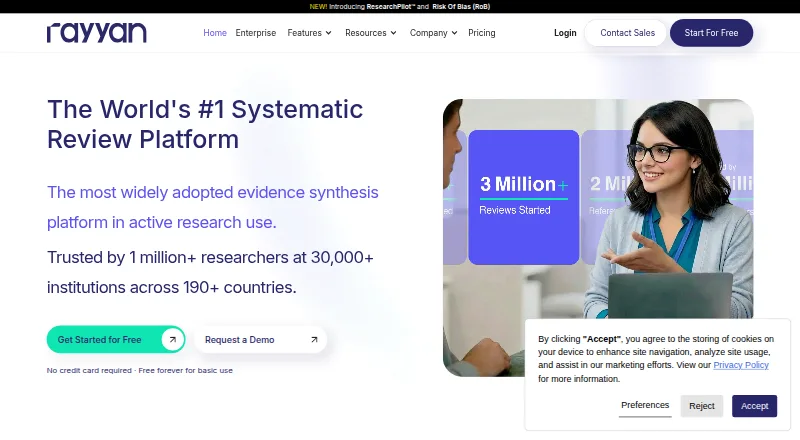
What Rayyan is
Rayyan is a systematic review platform for teams conducting evidence reviews with transparent, auditable, and reproducible workflows. It supports reference import, collaboration, deduplication, title and abstract screening, full-text screening, data extraction, risk-of-bias assessment, and reporting. ResearchPilot AI Reviewer screens articles against user-defined inclusion and exclusion criteria and supplies decisions with reasoning notes. Its AI Analyzer recommends include or exclude decisions with justification, while final decisions remain with researchers. ResearchPilot can also extract answers to custom questions from PDFs and metadata, highlight relevant text, and let users review extracted results. Rayyan accepts exported reference files from databases and reference managers, but has no direct database connection. Its API supports programmatic access to reviews, references, decisions, and metadata, plus workflow automation and external integrations. The mobile app is limited on Free and unlimited on Essential and higher. Rayyan is available on Android, iOS, and the web.
Good
- Supports screening through reporting in one workflow
- AI screening uses user-defined criteria
- Extracts custom answers from PDFs and metadata
- API supports workflow automation and integrations
- Free plan includes three active reviews
Watch out
- No direct database connection
- Free plan limits mobile app access
Who it suits
It suits research teams screening and analysing evidence across a systematic review workflow. The intended organisation users include pharma, medical-device, CRO, university, healthcare, government, and health technology assessment teams.
Verdict
Rayyan covers a broad review workflow and offers AI-supported screening and extraction while leaving final include-or-exclude decisions to researchers. Teams should account for its exported-file database workflow and the Free plan’s mobile limits.
Plans and prices
From Rayyan's own pricing page, checked 29 Sep 2026.
| Plan | Price | What it gives you |
|---|---|---|
| Free | Free | 3 active reviews · 2 free reviewers · 1 sample · limited mobile app access · Free forever |
| Essential | $4.99 a month | 5 free reviewers · PRISMA flow diagrams · auto-resolve duplicates · unlimited mobile app access · per seat, per month, billed annually |
| Advanced | $8.33 a month | 9 active reviews · 10 free reviewers · unlimited samples · AI PICO extraction · priority support · per seat, per month, billed annually |
| Business / Academic | $41.67 a month | 250 free reviewers · 50 org-wide reviews · team dashboard · workspace roles · priority support · per license, per month, billed annually; starting with 5 licenses |
| Enterprise | Priced on request | Unlimited reviews · unlimited viewers · SSO / SAML · API · management console · dedicated support · per license, billed annually |
The facts
Each one read from Rayyan's own pages, with the date it was checked.
What it does
- AI analysis
- ResearchPilot AI Analyzer recommends include or exclude decisions with justification notes based on the review criteria, while leaving final decisions to the researcher.checked 29 Sep 2026
- AI extraction
- ResearchPilot can extract answers to custom data-extraction questions from PDFs and metadata, highlight relevant text, and let users review extracted answers.checked 29 Sep 2026
- AI screening
- ResearchPilot AI Reviewer screens articles against user-defined inclusion and exclusion criteria and provides decisions with reasoning notes.checked 29 Sep 2026
- API
- API access includes programmatic access to reviews, references, decisions, and metadata, an official Python SDK, workflow automation, and external system integrations.checked 29 Sep 2026
- Audience
- Rayyan describes its intended organization users as pharma, medical-device, CRO, university, healthcare, government, and health technology assessment teams.checked 29 Sep 2026
- Integrations
- Rayyan accepts exported reference files from external databases and reference managers; it says there is no direct database connection.checked 29 Sep 2026
- Mobile
- Rayyan advertises a mobile app for working on the go or offline, with access limited on the Free plan and unlimited on Essential and higher.checked 29 Sep 2026
- Purpose
- Rayyan is a systematic review platform for teams conducting transparent, auditable, and reproducible evidence reviews.checked 29 Sep 2026
- Scale
- Rayyan says its Systematic Auto-Resolver can deduplicate up to 200,000 references using the user's protocol.checked 29 Sep 2026
- Security
- Rayyan's enterprise page states HIPAA and GDPR compliance, SOC 2 controls, encryption in transit and at rest, and support for SAML 2.0, OAuth, and MFA.checked 29 Sep 2026
- Support
- The pricing page lists Standard support for Free and Essential, priority support for Advanced and Business / Academic, and dedicated support for Enterprise.checked 29 Sep 2026
- Workflow
- Its review workflow covers reference import, collaboration, deduplication, title and abstract screening, full-text screening, data extraction, risk-of-bias assessment, and reporting.checked 29 Sep 2026
The company
- Company
- The site identifies the maker as Rayyan Systems, Inc. and lists its address as 1 Broadway, 14th Floor, Cambridge, Massachusetts 02142, USA.checked 29 Sep 2026
- Headquarters
- Cambridge, Massachusetts, USAchecked 23 Sep 2026
The full review of Rayyan
Rayyan is a systematic evidence-review platform for research teams, with a workflow that spans reference management, screening, extraction, and reporting. It is best suited to groups coordinating auditable reviews, especially when AI assistance is useful but researchers must retain decision authority. Its breadth comes with a file-based import step and meaningful differences between plans.
Overview
Rayyan combines reference import, collaboration, deduplication, title-and-abstract and full-text screening, data extraction, risk-of-bias assessment, and reporting. Keeping these stages in one workspace can simplify coordination across a review; teams that need only to organize citations may find the scope more than they need.
References arrive as exported files from databases or reference managers, not through a direct database connection. That means teams must account for export and import in their routine. Rayyan says its Systematic Auto-Resolver can deduplicate up to 200,000 references using the review protocol, a notable capacity for large collections.
Key features
ResearchPilot AI Reviewer screens against user-defined inclusion and exclusion criteria and supplies decisions with reasoning notes. AI Analyzer recommends include-or-exclude decisions with justifications based on the review criteria, while leaving the final call to the researcher. This makes the AI assistance useful as support for a human-led process, rather than a substitute for researcher judgment.
ResearchPilot can also extract answers to custom questions from PDFs and metadata, highlight relevant passages, and let users review the extracted answers. That can support structured extraction, though the review step remains important. For teams automating adjacent workflows, the API provides programmatic access to reviews, references, decisions, and metadata, plus an official Python SDK and options for automation and external integrations.
Rayyan accepts RIS, BibTeX, EndNote, and CSV exports. Its enterprise security offering states HIPAA and GDPR compliance, SOC 2 controls, encryption in transit and at rest, and SAML 2.0, OAuth, and MFA support. These are relevant provisions for organizations with formal security requirements.
Pricing
The Free plan costs nothing, remains free forever, and allows 3 active reviews, 2 free reviewers, and 1 sample. Mobile app access is limited. It is a practical way to begin a small review, but the caps and restricted mobile use may constrain ongoing team work.
Essential costs $4.99 a month per seat, billed annually. It includes 5 free reviewers, PRISMA flow diagrams, duplicate auto-resolution, and unlimited mobile app access, with Standard support. It suits teams needing those core workflow additions, but it does not include the Advanced plan's stated 9 active reviews, 10 free reviewers, unlimited samples, AI PICO extraction, or priority support.
Advanced costs $8.33 a month per seat, billed annually. It adds 9 active reviews, 10 free reviewers, unlimited samples, AI PICO extraction, and priority support. This is the stronger fit for researchers who need greater review capacity and those features; the annual per-seat billing is a consideration for teams scaling their seats.
Business / Academic costs $41.67 a month per license, billed annually, starting with 5 licenses. It includes 250 free reviewers, 50 organization-wide reviews, a team dashboard, workspace roles, and priority support. The minimum makes it more appropriate for institutions and larger coordinated groups than a small project.
Enterprise uses custom pricing, billed per license annually. It offers unlimited reviews and viewers, SSO / SAML, API access, a management console, and dedicated support. Organizations needing those controls and support can consider it; smaller teams may prefer the lower plans. The pricing page lists Standard support for Free and Essential, priority support for Advanced and Business / Academic, and dedicated support for Enterprise.
Platforms
Rayyan is available on web, Android, and iOS, with API access for integrations and automation. Its mobile app supports work on the go or offline, but Free users have limited access; unlimited mobile access begins with Essential.
Who it's for
Rayyan is aimed at evidence-review teams in pharma, medical devices, contract research organizations, universities, healthcare, government, and health technology assessment. Its shared workflow, protocol-based screening, and organization-level options make it a strong candidate for collaborative systematic reviews. A lone researcher or a group that needs direct database connectivity should weigh those workflow requirements before choosing it.
Pros and cons
- Pros: One workflow covers screening through extraction, risk-of-bias assessment, and reporting, reducing the need to divide review stages across tools.
- Pros: AI recommendations include reasoning or justification, and researchers retain final decision authority.
- Pros: Protocol-based deduplication supports collections of up to 200,000 references.
- Cons: Database references must be exported and imported because there is no direct database connection.
- Cons: Free access is capped at 3 active reviews, 2 free reviewers, and 1 sample, with limited mobile access.
- Cons: The Business / Academic plan starts at 5 licenses, which may be more commitment than a small team needs.
Alternatives
For a wider comparison, browse Literature Review Software, Systematic Review Software, and AI Literature Review Software.
Buhos is a free option for readers looking for software available on Linux, macOS, Windows, or self-hosted setups. ASReview is free and open source, with no licensing fees or subscriptions; running it on your own hardware or server may incur costs.
Elicit is a freemium web and API option, with unlimited search across more than 138 million papers, summaries, and chat with papers on its Basic plan, alongside limited Research Agent and Research Reports usage. CADIMA is a free web option with no topic restrictions and no stated reviewer limit.
Synthesis is a paid option with a free trial for readers who want to compare another tool. PICO Portal offers a freemium web plan with 1 project, unlimited citations, and unlimited collaborators, as well as a two-week ScholarIQ trial.
RevMan is a freemium alternative with a free trial and support for Linux, macOS, Windows, and web. INRA is another freemium web option; its Teams & Institutions plan is $7.50 per year, billed at $7.50/seat/month yearly, with a minimum of three seats, centralized user management and billing, and dedicated onboarding.
Verdict
Choose Rayyan if your team needs a shared, auditable systematic-review workflow with AI support that keeps final decisions with researchers. Its strongest case is the breadth from screening through extraction and reporting, backed by protocol-based deduplication. Look elsewhere if direct database connections are essential, or if the Free plan's review, reviewer, sample, or mobile limits would obstruct your work.
Getting started
- Open https://www.rayyan.ai/
- Choose web, Android, or iOS access, or use the API
- Import exported references from a database or reference manager
- Select the Free plan or a paid plan
- Set review criteria and begin screening references
Limits worth knowing
The Free plan allows 3 active reviews, 2 free reviewers, 1 sample, and limited mobile app access. Essential adds 5 free reviewers and unlimited mobile access; Advanced allows 9 active reviews, 10 free reviewers, and unlimited samples.
Questions
Is Rayyan free?
Yes. The Free plan is free and is billed free forever.
Which platforms does Rayyan support?
Rayyan supports web, Android, iOS, and API access.
Can Rayyan connect directly to research databases?
Rayyan accepts exported reference files from external databases and reference managers, but it does not offer a direct database connection.
What does the API provide?
The API provides programmatic access to reviews, references, decisions, and metadata, along with workflow automation, an official Python SDK, and external integrations.
Does Rayyan have AI-assisted screening and extraction?
ResearchPilot can screen against user criteria, recommend include or exclude decisions with notes, and extract answers from PDFs and metadata for review.
Alternatives to Rayyan
- 1

ASReview
Free planOpen sourceWebAPILinuxmacOS7.7Free plan - 2
LASER AI
AndroidiOSWeb7.6From $3,000 a year - 3
RobotReviewer
Free planOpen sourceWebAPILinuxmacOS7.5Free plan - 4
Scholarcy
Free planWebAPIExtension7.5From $90 a year - 5
Sysrev
Free planWebAPISelf-hosted7.5From $50 a month - 6
Universal SLR Assistant
Free planOpen sourceWebAPILinuxmacOS7.5Free plan