
ASReview
ASReview is a free, open-source tool that uses AI-aided active learning to prioritize records for systematic review screening while leaving decisions to a hu…
What ASReview is
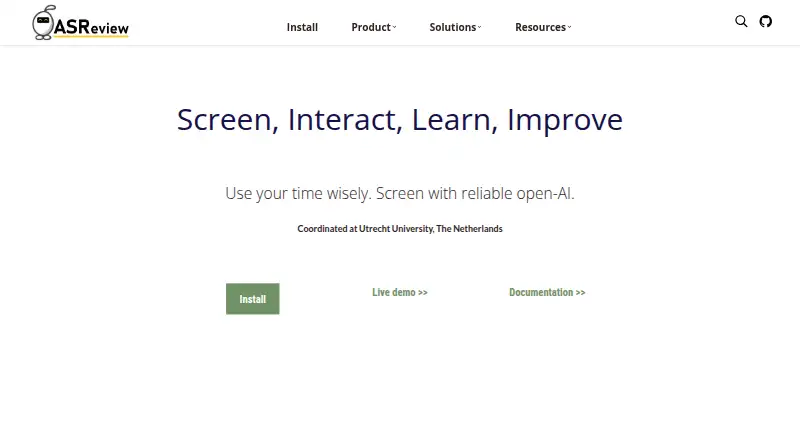
ASReview is a free, open-source tool that uses AI-aided active learning to prioritize records for systematic review screening while leaving decisions to a human screener. The site says this approach can reduce screening workload by up to 95%. Users can simulate AI-assisted review to compare models, and teams can screen in parallel through Crowdscreen, with administrators managing access through a private login system. The described model series include ELAS-Ultra, ELAS-Heavy, and language-agnostic ELAS-L; ELAS-Heavy and ELAS-L require the Dory package. ASReview works with reference managers including EndNote and PubMed, and supports CSV, RIS, and XLSX import and export. Documentation includes a Python API, as well as a REST API and command-line interface for automated workflows. In the default local setup, data stays on the user's computer. Server deployments keep data in the organization's environment and apply its policies. The project provides documentation, tutorials, videos, community discussion, workshops, and consultancy.
Good
- Human screeners remain part of screening decisions.
- Supports CSV, RIS, and XLSX import and export.
- Local setup keeps data on the user's computer.
- Crowdscreen enables parallel team screening.
Watch out
- ELAS-Heavy and ELAS-L require the Dory package.
- Running on personal hardware or a server may incur costs.
- No full-text management is listed.
Who it suits
ASReview is for screeners, information specialists, data scientists, developers, institutions, and students involved in systematic reviews. Its team screening and automation options may suit organizational workflows.
Verdict
ASReview combines human-led screening with AI-assisted prioritization and team workflows, without licensing fees or subscriptions. Consider its deployment costs and model package requirements when choosing a setup.
Plans and prices
From ASReview's own pricing page, checked 28 Sep 2026.
| Plan | Price | What it gives you |
|---|---|---|
| ASReview LAB | Free | Free and open source · no licensing fees or subscriptions · running your own hardware or server may incur costs |
| Free and open-source ASReview LAB | Free | core screening software · local, server or Docker deployment · no paid tier stated |
The facts
Each one read from ASReview's own pages, with the date it was checked.
What it does
- AI models
- Version 2 presets include ELAS-ultra, ELAS-heavy and ELAS-lang, with configurable classifiers, feature extractors and query strategies.checked 15 Oct 2026
- API
- ASReview documentation includes a Python API, and the institutional page also mentions a REST API and CLI for automated workflows.checked 28 Sep 2026
- API maturity
- The API documentation warns that the API is still under development and may change without warning.checked 15 Oct 2026
- Citation-manager integrations
- Documented citation-manager compatibility includes EndNote, Excel, Mendeley, RefWorks and Zotero through supported export formats.checked 15 Oct 2026
- Crowdscreen
- Crowdscreen lets AI agents propose records to a crowd of experts.checked 15 Oct 2026
- Custom models
- Model extensions can add classifiers, query strategies, balancing strategies and feature-extraction methods.checked 15 Oct 2026
- Dataset quality requirement
- Official documentation says models work best when duplicates are removed and titles and abstracts are complete for most records.checked 15 Oct 2026
- Documentation depth
- The documentation covers user, server and technical guides, including authentication, command-line use, APIs and extension development.checked 15 Oct 2026
- Documentation support
- The maker directs users to more than 500 pages of documentation and a GitHub community for help.checked 15 Oct 2026
- Double-screening limitation
- The independent review describes ASReview as a single-screener prioritization engine without multi-reviewer blind screening.checked 15 Oct 2026
- Extension system
- Python extensions can add model, subcommand and dataset functionality through setuptools entry points.checked 15 Oct 2026
- Formats
- The institutional workflow page describes CSV, RIS, and XLSX import and export.checked 28 Sep 2026
- Full-text limitation
- ASReview focuses on title-and-abstract screening and does not provide downstream full-text review or data-extraction workflows.checked 15 Oct 2026
- Human decisions
- Human reviewers label records while the model continuously updates the ranking.checked 15 Oct 2026
- Independent praise: auditability
- RSRCHDB describes the open code and peer-reviewed benchmarks as useful when screening decisions must survive audit.checked 15 Oct 2026
- Independent praise: privacy
- The Augmented Scholar highlights that local operation requires no account or upload and keeps unpublished review data on the user’s machine.checked 15 Oct 2026
- Independent praise: transparency
- The Augmented Scholar praises the open algorithms, versioned software, peer-reviewed method and ability to benchmark simulations locally.checked 15 Oct 2026
- Integrations
- The site describes compatibility with EndNote, PubMed, and other reference managers, and says RIS files can be imported and exported.checked 28 Sep 2026
- Intended users
- The site presents ASReview for screeners, information specialists, data scientists, developers, institutions, and students.checked 28 Sep 2026
- License
- The ASReview software repository is released under the Apache License 2.0.checked 15 Oct 2026
The company
- Company description
- LinkedIn describes ASReview as open-source software developed at Utrecht University for active-learning screening of scientific papers, policy reports and social-media data.checked 15 Oct 2026
- Company headquarters
- LinkedIn lists Utrecht, Netherlands as the headquarters and primary location.checked 15 Oct 2026
- Company size
- LinkedIn lists the organization size as 11–50 employees.checked 15 Oct 2026
- Headquarters
- Utrecht, Netherlandschecked 28 Sep 2026
The full review of ASReview
ASReview is a free, open-source screening tool for researchers who want AI to prioritize records while leaving decisions with a human screener. Its best fit is a flexible systematic-review workflow that can run locally or within an institution’s own environment; it is less suited to teams that need built-in full-text management or AI paper summaries.
Overview
ASReview applies active learning to screening: as a person labels records, the software helps prioritize what to assess next. The site says this can reduce screening workload by up to 95%, a potential benefit rather than a promised outcome. That makes it a useful way to focus human attention, not a replacement for screening judgment.
It supports systematic reviews, recommendations, and collaboration, and exchanges records in CSV, RIS, and XLSX. Compatibility with EndNote, PubMed, and other reference managers helps it fit into existing research workflows. Readers comparing tools can browse Literature Review Software, AI Literature Review Software, and Systematic Review Software.
Key features
Prioritization and model simulation
Researchers can simulate AI-aided reviewing to compare models and examine performance before using a workflow. ASReview describes the ELAS-Ultra, ELAS-Heavy, and language-agnostic ELAS-L model series; ELAS-Heavy and ELAS-L require the Dory package. That model choice offers flexibility, but the package requirement matters for teams planning to use those particular series.
Team screening and integrations
Crowdscreen supports parallel screening, with administrators controlling access through a private login system. A Python API, REST API, and CLI support automated workflows, while CSV, RIS, and XLSX import and export provide practical routes into and out of the tool. The combination suits research groups with technical support or established data workflows better than users seeking an all-in-one review workspace.
Privacy and support
In the default local setup, data stays on the user's computer. Server deployments keep data within the organization's environment and follow its policies, giving institutions a choice of deployment model. ASReview also describes itself as GDPR compliant, says it uses no tracking cookies, and provides security updates. Free documentation, tutorials, videos, and community discussion support are available; organizations can also arrange in-house workshops and custom consultancy.
Pricing
ASReview LAB: free. The free, open-source plan has no licensing fees or subscriptions, making it a strong fit for individual researchers, students, and teams avoiding recurring software charges. The trade-off is operational: running the software on your own hardware or server may incur costs. There is no free trial, but the plan itself is free. No paid tier is described, so organizations needing workshops or custom consultancy should account for those services separately.
The free plan includes screening workflows, systematic-review support and tools, collaboration, recommendations, and CSV, RIS, and XLSX export. It does not include AI paper summaries or full-text management. Those omissions are significant for anyone expecting one tool to handle the entire review process.
Platforms
ASReview supports API, Linux, macOS, self-hosted, web, and Windows deployments. Local and self-hosted options are particularly relevant to researchers who want data to remain on their own computer or within their institution's environment.
Who it's for
ASReview is aimed at screeners, information specialists, data scientists, developers, institutions, and students. It is strongest for people conducting systematic reviews who value human-led screening, configurable AI prioritization, and the ability to collaborate or automate workflows. Researchers who mainly need full-text organization or generated paper summaries should look elsewhere or plan a complementary tool.
Pros and cons
- Pros: Free and open source, with no licensing fees or subscriptions, lowers the software cost for individuals and institutions.
- Pros: Local and organization-controlled server deployment options let teams choose where their data resides.
- Pros: Simulation, multiple model series, APIs, and standard research-file formats support comparison and integration into established workflows.
- Cons: Hardware or server operation may still cost money, so free licensing does not mean a cost-free institutional deployment.
- Cons: The tool lacks full-text management and AI paper summaries, limiting its role as a complete review workspace.
- Cons: ELAS-Heavy and ELAS-L require the Dory package, adding a requirement for users choosing those model series.
Alternatives
Choose RevMan if its freemium plan and trial, alongside Linux, macOS, web, and Windows support, better fit your review setup. Rayyan is another freemium option, with Android, iOS, API, and web platforms; its Free plan caps use at three active reviews and two free reviewers, so it may suit a small mobile-oriented team better than an uncapped ASReview workflow.
Bibliometrix is a free, open-source R package with a Biblioshiny web interface, making it a natural alternative when that package-and-interface approach fits your work. Consider Elicit for its research agent, reports, paper search, summaries, and chat features, with a freemium model. EviSynth offers free academic access, unlimited collaborators, and no trials or subscriptions, and may appeal to academic teams looking for that arrangement.
Litmaps may suit researchers who want article mapping and collaboration options; its free plan is limited to 20 inputs, 100 articles, one Litmap, and no collaboration. ResearchRabbit offers a free web plan with unlimited searches across 310+ million articles, unlimited libraries and collections, sharing, and up to 50 seed articles, making it an option for broad discovery. Abstrackr is a free web alternative with no seat limits or usage caps.
Verdict
Choose ASReview if you need a no-license-cost, human-led systematic-review screening workflow with AI prioritization, simulation, and control over where data is stored. Its strongest reason to choose is the balance of flexible deployment and research-focused screening without subscriptions. Look elsewhere if full-text management or AI paper summaries are central to your process, or factor in the hardware and server costs of operating your own deployment.
Getting started
- Open https://asreview.nl/.
- Choose a platform: Linux, macOS, Windows, web, API, or self-hosted.
- Start with the free, open-source ASReview LAB; there are no licensing fees or subscriptions.
- Import records from CSV, RIS, or XLSX, or use a compatible reference manager.
- For team screening, use Crowdscreen and have administrators manage access through its private login system.
Questions
Does ASReview cost anything?
ASReview LAB is free and open source, with no licensing fees or subscriptions. Running your own hardware or server may incur costs.
Which platforms does ASReview support?
Listed platforms are Linux, macOS, Windows, web, API, and self-hosted.
Can teams use ASReview together?
Yes. Crowdscreen supports parallel screening, with administrators managing access through a private login system.
Which file formats can ASReview import and export?
It supports CSV, RIS, and XLSX. The site also describes compatibility with EndNote, PubMed, and other reference managers.
Where does ASReview keep data?
In the default local setup, data stays on the user's computer. Server deployments keep data within the organization's environment and apply its policies.
Does ASReview offer AI paper summaries or full-text management?
No. ASReview does not provide AI paper summaries or full-text management.
Alternatives to ASReview
- 1
LASER AI
AndroidiOSWeb7.6From $3,000 a year - 2

Rayyan
Free planAndroidiOSWebAPI7.5From $4.99 a month - 3
RobotReviewer
Free planOpen sourceWebAPILinuxmacOS7.5Free plan - 4
Scholarcy
Free planWebAPIExtension7.5From $90 a year - 5
Sysrev
Free planWebAPISelf-hosted7.5From $50 a month - 6
Universal SLR Assistant
Free planOpen sourceWebAPILinuxmacOS7.5Free plan