Buhos
Buhos is web-based software for managing systematic literature reviews, with tools for screening references, handling full text, collaboration, and analysis.
What Buhos is
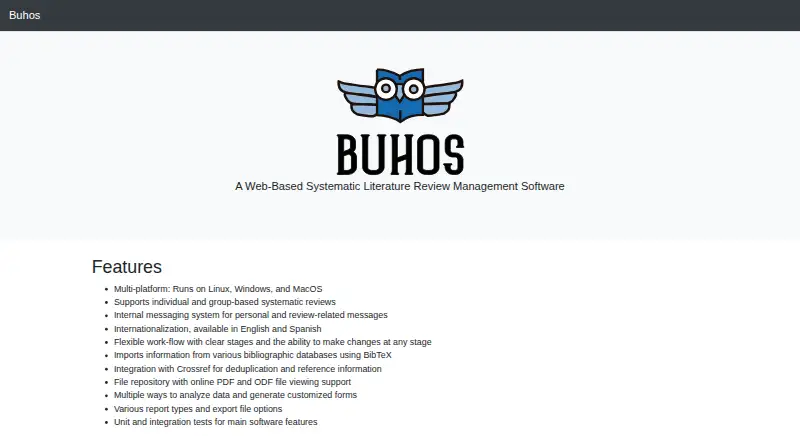
Buhos is web-based software for managing systematic literature reviews, with tools for screening references, handling full text, collaboration, and analysis. It supports individual and group reviews, with internal messaging for personal and review-related discussions. A workflow with defined stages can be changed at any point. Buhos imports bibliographic information from sources including WoS, Scopus, EBSCOhost, SciELO, PubMed, Lilacs, and ProQuest, using formats such as BibTeX, RIS, PubMed/NBIB, JSON, and CSV. Crossref supports deduplication and retrieval of reference information; Scopus and PubMed can retrieve missing abstracts and metadata when API credentials are available. A repository allows online viewing of PDF and ODF documents. The software also offers customized forms, data analysis, reports, and exports, and lists English and Spanish as available languages. It runs on Linux, Windows, and macOS. The project documentation says Buhos fully supports the conducting phase of a systematic review, partially supports report formatting, and does not support several planning and reporting activities.
Good
- Supports individual and group-based reviews.
- Imports references in several formats.
- Crossref integration supports deduplication.
- Repository supports online PDF and ODF viewing.
- Runs on Linux, Windows, and macOS.
Watch out
- Only English and Spanish are listed.
- Report formatting is only partially supported.
- Several planning and reporting activities are unsupported.
- Some metadata retrieval requires API credentials.
Who it suits
Buhos suits researchers conducting systematic reviews who need reference screening, full-text handling, and group collaboration. It may be less suitable for teams seeking support for all planning and reporting activities.
Verdict
Buhos offers a broad set of tools for the conducting phase of a systematic review, including collaboration and reference management. Its documented limits in planning and reporting matter for teams seeking end-to-end review support.
The facts
Each one read from Buhos's own pages, with the date it was checked.
What it does
- Analysis and reporting
- It offers data analysis options, customizable forms, multiple report types, and export options.checked 30 Sep 2026
- API
- The site links to API documentation at https://www.buhos.org/api.checked 29 Sep 2026
- Crossref
- Crossref integration supports deduplication and reference information lookup.checked 30 Sep 2026
- Demo
- The site offers a demo with the username and password both set to admin.checked 29 Sep 2026
- Deployment
- The project documentation describes individual installation and deployment on an independent HTTP server for multiple online users.checked 30 Sep 2026
- Documents
- A file repository supports online viewing of PDF and ODF files.checked 29 Sep 2026
- Files
- It provides a file repository with online PDF and ODF viewing.checked 30 Sep 2026
- Import formats
- The project documentation lists WoS, Scopus, EBSCOhost, SciELO, PubMed, Lilacs, and ProQuest, with imports via BibTeX, RIS, PubMed/NBIB, JSON, and CSV.checked 30 Sep 2026
- Imports
- It imports bibliographic database information using BibTeX.checked 30 Sep 2026
- Integrations
- The project documentation says Scopus and PubMed can retrieve missing abstracts and metadata when API credentials are available.checked 30 Sep 2026
- Languages
- The site says Buhos is available in English and Spanish.checked 30 Sep 2026
- Maintainer
- The site copyright line names Claudio Bustos Navarrete and shows 2016–2026.checked 29 Sep 2026
- Purpose
- Buhos is web-based software for managing systematic literature reviews.checked 30 Sep 2026
- Reference imports
- It imports bibliographic information using BibTeX.checked 29 Sep 2026
- Review collaboration
- It supports individual and group-based systematic reviews and includes an internal messaging system.checked 30 Sep 2026
- Review scope limit
- The project documentation says Buhos fully supports the conducting phase of a systematic review, partially supports report formatting, and does not support several planning and reporting activities.checked 30 Sep 2026
- Security and compliance
- The opened product and project pages do not state a security certification or compliance standard.checked 30 Sep 2026
- Supported systems
- The maker says Buhos runs on Linux, Windows, and macOS.checked 29 Sep 2026
- Workflow
- Its review workflow has defined stages, and changes can be made at any stage.checked 30 Sep 2026
The company
- Maker
- The site credits Claudio Bustos Navarrete; the project documentation names Claudio Bustos as the main developer.checked 30 Sep 2026
The full review of Buhos
Overview
Buhos is web-based software for organizing systematic literature reviews. It brings review workflow, reference handling, document access, analysis, and reporting into one environment, with support for both individual and group review work. Its scope is specific: project documentation says it fully supports the conducting phase, partially supports report formatting, and does not support several planning and reporting activities. Teams looking for support across the entire review lifecycle should weigh that boundary before choosing it.
The project is credited to Claudio Bustos Navarrete, whom its documentation also names as the main developer. Buhos lists English and Spanish as available languages. It has no stated security certification or compliance standard in the product and project pages described here.
Key features
Workflow and collaboration
Reviews move through defined stages, and the workflow allows changes at any stage. Buhos supports solo and group-based reviews, with internal messaging for personal and review-related communication. These capabilities make it possible to keep review work and related exchanges within the same system.
References and imports
Buhos imports bibliographic information using BibTeX. Its documentation lists supported source databases including Web of Science, Scopus, EBSCOhost, SciELO, PubMed, Lilacs, and ProQuest, with imports through BibTeX, RIS, PubMed/NBIB, JSON, and CSV. Crossref integration supports deduplication and reference-information retrieval. When API credentials are available, Scopus and PubMed can also retrieve missing abstracts and metadata.
Documents, analysis, and reporting
A file repository provides online viewing of PDF and ODF files, supporting full-text management within the review process. Buhos also offers data analysis, customized forms, reports, and export options. Those tools address work during and after review conduct, though the documented limits on planning and report formatting still matter when mapping the software to a team’s full process.
API and deployment
The project provides API documentation and links to a GitHub page for deployment. A demo is available using admin as both the username and password.
Pricing
Buhos is free, with a free plan listed. No paid price or billing term is provided in the available details.
Platforms
Buhos is web-based, and the maker says it runs on Linux, Windows, and macOS. The listed platforms also include API access and self-hosted deployment, which may suit teams that want to connect or deploy the software within their own setup.
Who it's for
Buhos is aimed at researchers and teams conducting systematic literature reviews who need staged screening, reference imports, full-text access, collaboration, analysis, and exports. It may be particularly relevant when a project needs to manage the conducting phase and can work with the stated limits around planning and report formatting.
Its listed language options are English and Spanish. Teams should also consider whether the available integrations match their reference sources and whether they can provide Scopus or PubMed API credentials if they need those services to fill in missing metadata.
Pros and cons
- Pros: Free plan; supports solo and group review work; defined but changeable workflow stages; Crossref deduplication and reference retrieval; PDF and ODF viewing; analysis, customized forms, reports, and exports.
- Cons: Documentation says several planning and reporting activities are unsupported, and report formatting is only partially supported; Scopus and PubMed enrichment requires API credentials; no security certification or compliance standard is stated in the reviewed pages.
Alternatives
Other options in this area include RevMan, ASReview, Rayyan, Bibliometrix, Elicit, EviSynth, EPPI-Reviewer, and Litmaps. Browse more options in Literature Review Software and Systematic Review Software.
Verdict
Buhos offers a free, web-based workspace for the core conduct of systematic reviews, combining flexible stages, collaboration, reference imports, document viewing, and analysis and reporting tools. Its documented coverage is not end-to-end: planning is not fully supported, and report formatting receives only partial support. It is best considered by reviewers who want these conducting-stage tools and have checked that the stated workflow limits, integrations, and deployment options fit their needs.
Alternatives to Buhos
- 1
RevMan
Free planWebLinuxmacOSWindows7.8From £80 a year - 2

ASReview
Free planOpen sourceWebAPILinuxmacOS7.7Free plan - 3
LASER AI
AndroidiOSWeb7.6From $3,000 a year - 4

Rayyan
Free planAndroidiOSWebAPI7.5From $4.99 a month - 5
Sysrev
Free planWebAPISelf-hosted7.5From $50 a month - 6
Universal SLR Assistant
Free planOpen sourceWebAPILinuxmacOS7.5Free plan