
Axelium
Axelium is an AI-assisted platform for systematic reviews and meta-analyses, covering evidence search through reporting and living reviews.
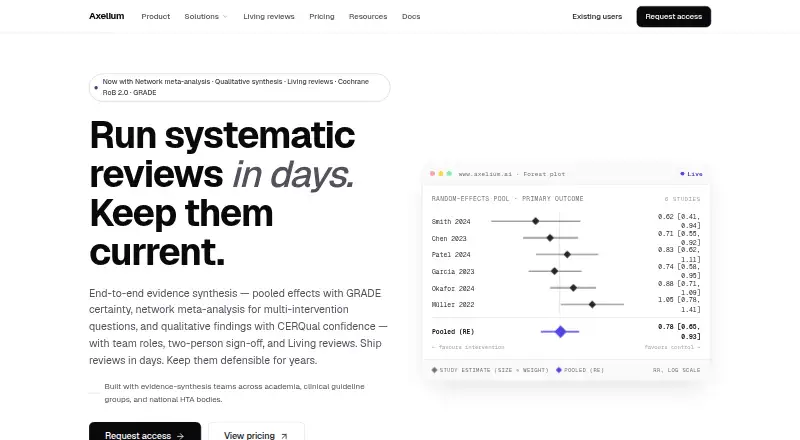
What Axelium is
Axelium is an AI-assisted platform for systematic reviews and meta-analyses, covering evidence search through reporting and living reviews. Its 11 stages include protocol, search, screening, full-text review, extraction, RoB 2.0, GRADE, statistics, network meta-analysis, reporting, and living reviews. The maker says AI extracts structured values while deterministic analysis code calculates statistics, with data points linked to source snippets in original PDFs. Listed methods include pairwise and network synthesis, Cochrane RoB 2.0, GRADE certainty ratings, CERQual, and PRISMA-style reporting. It can import references from tools and databases including EndNote, Zotero, PubMed, ClinicalTrials.gov, and Web of Science. Exports include DOCX, XLSX, RIS, BibTeX, and RevMan. Team controls include roles, comments, dual-person sign-off, conflict adjudication, and versioned audit snapshots. A free plan includes one lifetime review and one seat; Researcher costs $29 a month. Human checking is needed for screening suggestions, extracted values, risk-of-bias assessments, and draft reports. Recurring statistical refresh for living-review network meta-analysis is paused.
Good
- Provides an 11-stage review workflow.
- Links data points to source snippets in PDFs.
- Includes pairwise and network synthesis methods.
- Supports multiple reference imports and export formats.
- Team controls include sign-off and audit snapshots.
Watch out
- Free plan includes one lifetime review.
- Free plan includes one seat.
- Screening and extracted results need reviewer validation.
- Recurring statistical refresh for living-review NMA is paused.
Who it suits
Axelium describes use by individual researchers, pharma and HEOR teams, CROs and consultancies, HTA bodies, and clinical guideline committees. It may suit reviewers who need structured review stages and team sign-off controls.
Verdict
Axelium covers review workflows from protocol through reporting, with methods and collaboration controls for research teams. Plan for reviewer validation and note the paused recurring statistical refresh for living-review network meta-analysis.
Plans and prices
From Axelium's own pricing page, checked 29 Sep 2026.
| Plan | Price | What it gives you |
|---|---|---|
| Free | Free | 1 review (lifetime) · 1 seat · All core features · Community support · Free |
| Researcher | $29 a month | 3 reviews / month · 1 seat · All core features · Email support · Review packs from $49 · $29/ mo |
| Professional | $79 a month | 12 reviews / month · 1 seat · Priority email support · Discounted review packs ($39 / 3) · Living-review automation · Analysis Workbench for custom methods · $79/ mo |
| Team | $266 a month | 7 pooled reviews / seat / month · 3-seat minimum · Shared extraction and stats artifacts · Per-seat attribution dashboard · Priority support · $266/ mo |
| Enterprise | Priced on request | Custom volumes · BYOK · SSO · on-prem · custom volumes |
The facts
Each one read from Axelium's own pages, with the date it was checked.
What it does
- AI and statistics
- The maker says AI extracts structured values while deterministic analysis code calculates statistics, and data points link to source snippets in original PDFs.checked 29 Sep 2026
- Audience
- The site describes use for individual researchers, pharma and HEOR teams, CROs and consultancies, HTA bodies, and clinical guideline committees.checked 29 Sep 2026
- Exports and sign-in
- The product page lists RevMan 5 export and Google or Microsoft sign-in; pricing also lists Word, Excel, RIS, and BibTeX exports.checked 29 Sep 2026
- Human review limits
- Axelium says screening suggestions can be wrong, extracted values and risk-of-bias assessments need reviewer validation, and generated reports are drafts requiring checking.checked 29 Sep 2026
- Integrations
- It lists reference imports from EndNote, Zotero, Mendeley, Embase, and Web of Science; database sources include PubMed, ClinicalTrials.gov, EuropePMC, OpenAlex, CENTRAL, MAUDE, and ERIC.checked 29 Sep 2026
- Living review limit
- The maker says recurring living-review NMA statistical refresh is paused, while scheduled cycles can still import, screen, and extract new evidence for network reviews.checked 29 Sep 2026
- Methods
- The platform lists pairwise and network synthesis, Cochrane RoB 2.0, GRADE certainty ratings, CERQual, and PRISMA-style reporting.checked 29 Sep 2026
- Product
- Axelium is an AI-assisted platform for systematic reviews and meta-analyses, covering evidence search through reporting and living reviews.checked 29 Sep 2026
- Security and privacy
- The pricing page states GDPR-compliant, full audit trails on every review, and BYOK on Enterprise.checked 29 Sep 2026
- Support
- The contact page provides [email protected] for existing users and says the team replies within 1–2 business days.checked 29 Sep 2026
- Workflow
- Its listed 11-stage workflow includes protocol, search, screening, full-text, extraction, RoB 2.0, GRADE, statistics, network meta-analysis, reporting, and living reviews.checked 29 Sep 2026
Where it runs
- Browser companion
- The browser companion captures articles, PDFs, supplements, and citation metadata from pages users can legally access into an Axelium review.checked 29 Sep 2026
The company
- Team controls
- Team features include admin, lead reviewer, reviewer, and viewer roles, comments and mentions, dual-person sign-off, conflict adjudication, and versioned audit snapshots.checked 29 Sep 2026
The full review of Axelium
Overview
Axelium is an AI-assisted platform for systematic reviews and meta-analyses, built to take research teams from evidence search through synthesis and reporting. It suits researchers and evidence teams that need structured methods and collaboration controls in one workflow. Its breadth is a strength, but reviewers must validate AI outputs, and recurring statistical refresh for living-review network meta-analysis is paused.
Key features
The 11-stage workflow spans protocol design, searching, screening, full-text review, extraction, risk-of-bias assessment, certainty ratings, statistics, network meta-analysis, reporting and living reviews. That range can keep a review’s stages together rather than splitting work across separate tools; teams should still account for the human checks required at key stages.
Axelium says AI extracts structured values while deterministic analysis code calculates statistics, with extracted data points linked to source snippets in original PDFs. Those links help reviewers trace values back to evidence, but the maker warns that extracted values and risk-of-bias assessments need validation. Screening suggestions can also be wrong, and generated reports are drafts that require checking.
Methods include pairwise and network synthesis, Cochrane RoB 2.0, GRADE certainty ratings, CERQual and PRISMA-style reporting. Reference imports include EndNote, Zotero, Mendeley, Embase and Web of Science; searchable database sources include PubMed, ClinicalTrials.gov, EuropePMC, OpenAlex, CENTRAL, MAUDE and ERIC. Exports include Word/DOCX, Excel/XLSX, RIS, BibTeX and RevMan 5.
Team controls include admin, lead reviewer, reviewer and viewer roles, comments and mentions, dual-person sign-off, conflict adjudication and versioned audit snapshots. The browser companion captures articles, PDFs, supplements and citation metadata from pages users can legally access into a review. Pricing states GDPR compliance and full audit trails on every review; BYOK is an Enterprise feature.
For network reviews, scheduled living-review cycles can still import, screen and extract new evidence, but recurring statistical refresh is paused. Teams expecting the analysis itself to update on a recurring schedule should factor in that limit.
Pricing
Axelium has a free plan and paid plans from $29/mo. The free tier costs nothing and includes all core features, one lifetime review, one seat and community support. It is a narrow way for an individual to try the core workflow, not a recurring review allowance.
Researcher costs $29 a month ($29/ mo) for three reviews per month and one seat, with all core features and email support; review packs start at $49. It fits solo researchers with regular but limited review volume. Professional costs $79 a month ($79/ mo), raises the cap to 12 reviews per month while remaining one seat, and adds priority email support, discounted review packs ($39 / 3), living-review automation and an Analysis Workbench for custom methods. Choose it when those capabilities and higher volume justify the step up.
Team costs $266 a month ($266/ mo), with a three-seat minimum and seven pooled reviews per seat per month. Shared extraction and statistics artifacts, a per-seat attribution dashboard and priority support make it the plan aimed at collaborative groups; the minimum commitment makes it less suitable for a small team needing only occasional shared access. Enterprise uses custom volumes and custom pricing, with BYOK, SSO and on-prem deployment.
Platforms
Axelium is available on the web and as a browser extension. Google or Microsoft sign-in is supported. The extension’s capture workflow is useful for adding accessible articles and their citation metadata while browsing; it does not remove the need to check captured evidence and extracted content.
Who it's for
The product is positioned for individual researchers, pharma and HEOR teams, CROs and consultancies, HTA bodies, and clinical guideline committees. Solo researchers can start with Free or Researcher, while teams needing shared artifacts and role-based review controls should consider Team or Enterprise. Existing users can contact [email protected]; the team says it replies within 1–2 business days.
Pros and cons
- Pro: A broad review workflow combines search, screening, synthesis methods and reporting, which can suit projects that would otherwise span multiple tools.
- Pro: Source-linked extracted values and deterministic statistical calculations support traceability, while audit snapshots and sign-off controls help teams manage review decisions.
- Pro: Multiple reference imports, database sources and export formats support moving evidence into and out of the platform.
- Con: AI suggestions, extracted values, risk-of-bias assessments and draft reports all require human review, so automation is not a substitute for reviewer oversight.
- Con: Recurring statistical refresh for living-review network meta-analysis is paused, limiting the platform’s current appeal for teams expecting continuously refreshed network results.
- Con: The entry paid plans are single-seat, while Team requires three seats; collaboration at scale entails a sizable minimum plan.
Alternatives
For a different fit, consider AI Literature Review Software. Mapped Research is a web freemium option whose free plan allows up to 1,000 screening citations, 200 AI-assisted screenings, PRISMA auto-generation, open-access full-text retrieval and three collaborators; choose it if those screening and collaboration limits match the project better. Moara offers a free web plan for libraries of up to 50 papers per review, Google Scholar and Semantic Scholar search, Zotero and LibKey, and viewer or editor collaboration; it may suit smaller review libraries.
Rayyan has Android, iOS, API and web access, with a free tier capped at three active reviews and two free reviewers plus limited mobile app access; it is worth considering when mobile access matters. ASReview is free and open source across desktop, web and self-hosted platforms, with no licensing fees or subscriptions, though running it on your own hardware or server may cost money; choose it if open-source software is the priority.
INRA offers a Teams & Institutions plan at $7.50 a year (billed $7.50/seat/month, billed yearly), with a three-seat minimum, Professional features and centralized user management and billing; it may fit institutions prioritizing centralized administration. Evidentum is a free web alternative. EPPI-Reviewer is another option to consider. PICO Portal offers a plan with one project, unlimited citations and collaborators, and may suit a project needing those allowances.
Verdict
Axelium is a strong fit for research teams that want systematic-review methods, collaboration controls and reporting in a single workflow. Its traceability and breadth are the clearest reasons to choose it, but plan for reviewer validation throughout and look elsewhere if recurring statistical refresh for living network meta-analysis is essential.
Alternatives to Axelium
- 1

ASReview
Free planOpen sourceWebAPILinuxmacOS7.7Free plan - 2
LASER AI
AndroidiOSWeb7.6From $3,000 a year - 3

Rayyan
Free planAndroidiOSWebAPI7.5From $4.99 a month - 4
RobotReviewer
Free planOpen sourceWebAPILinuxmacOS7.5Free plan - 5
Scholarcy
Free planWebAPIExtension7.5From $90 a year - 6
Sysrev
Free planWebAPISelf-hosted7.5From $50 a month