
Mapped Research
Mapped Research is a web-based platform for organizing evidence synthesis, systematic reviews, and meta-analyses.
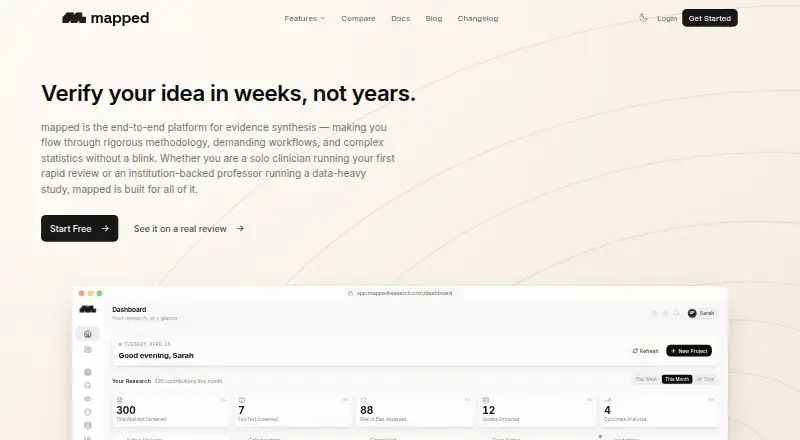
What Mapped Research is
Mapped Research is a web-based platform for organizing evidence synthesis, systematic reviews, and meta-analyses. It supports intervention, prognostic, diagnostic test accuracy, network meta-analysis, and scoping review workflows. The workflow applies PRISMA variants according to study type and incorporates Cochrane, GRADE, and CINeMA. For statistical analysis, it uses the R packages metafor, mada, and netmeta, and it can produce publication-ready plots. Collaboration features include five roles, stage-level permissions, dual-reviewer workflows, conflict resolution, and an audit trail. It connects with Google Sheets, Docs, Drive, and Slides, and reference managers through RIS and BibTeX. Plots export as PNG, SVG, PDF, or EPS at 600 DPI; manuscripts can be exported to Word, PDF, LaTeX, or Google Docs. A free plan is available, while paid project plans list launch prices of $79 and $139 per project. The platform is intended for medical researchers, from solo clinicians to institution-backed professors.
Good
- Supports several review and analysis types.
- Includes Cochrane, GRADE, and CINeMA workflows.
- Offers dual-reviewer workflows and conflict resolution.
- Exports plots in four formats at 600 DPI.
- Free plan allows up to three collaborators.
Watch out
- Free plan caps screening at 1,000 citations.
- Paid projects list $79 and $139 launch prices.
- API is only on the roadmap for Custom Enterprise.
Who it suits
Mapped Research suits medical researchers conducting systematic reviews or meta-analyses, whether working solo or with collaborators. Its role controls and dual-reviewer workflows may suit teams that need structured review processes.
Verdict
Mapped Research brings review workflows, statistical analysis, collaboration, and export tools into one web platform. Check the plan limits and project pricing against the scale of your review before choosing it.
Plans and prices
From Mapped Research's own pricing page, checked 3 Oct 2026.
| Plan | Price | What it gives you |
|---|---|---|
| Free | Free | Up to 1,000 screening citations · 200 AI-assisted screenings · PRISMA auto-generation · Open-access full-text retrieval · Up to 3 collaborators |
| Mapped Project | $79, paid once | 3,000 screening citations · 3,000 AI-assisted screenings · Data extraction and risk of bias for 10 studies each · Up to 10 collaborators · 1 reset per workflow step · $119$79/project (Launch Pricing) |
| Mapped Team | $139, paid once | 5,000 screening citations · 5,000 AI-assisted screenings · Data extraction and risk of bias for 50 studies each · Unlimited collaborators · 1 reset per workflow step · $199$139/project (Launch Pricing) |
| Custom Enterprise | Priced on request | SSO and central admin console · Volume pricing, purchase orders and invoicing · Dedicated onboarding and training · Unlimited projects and team members · Custom Enterprise plans |
The facts
Each one read from Mapped Research's own pages, with the date it was checked.
What it does
- AI oversight
- The privacy policy says AI provides suggestions and researchers make final decisions; research data is not used for model training without separate opt-in consent.checked 3 Oct 2026
- API
- The integrations page says an API is on the roadmap for Custom Enterprise plans, with a Q3 2026 target.checked 3 Oct 2026
- Collaboration
- Mapped lists five roles, stage-level permissions, dual-reviewer workflows, conflict resolution and an audit trail.checked 3 Oct 2026
- Data location and deletion
- The privacy policy says data is processed and stored in the United States and deleted-account data is permanently purged after a 30-day export grace period.checked 3 Oct 2026
- Exports
- Plots export at 600 DPI in PNG, SVG, PDF or EPS; manuscripts export to Word, PDF, LaTeX or Google Docs.checked 3 Oct 2026
- Integrations
- Its integrations page lists Google Sheets, Docs, Drive and Slides, plus Zotero, Mendeley, EndNote and RefWorks compatibility through RIS and BibTeX.checked 3 Oct 2026
- Intended users
- The maker describes Mapped as built for medical researchers, including solo clinicians and institution-backed professors conducting reviews.checked 3 Oct 2026
- Methodology
- The site says PRISMA variants are applied by study type and that Cochrane, GRADE and CINeMA are built into the workflow.checked 3 Oct 2026
- Purpose
- Mapped describes itself as an end-to-end evidence-synthesis platform for systematic reviews and meta-analyses.checked 3 Oct 2026
- Security
- The privacy policy states that data in transit uses TLS 1.3, data at rest uses AES-256 encryption, and the platform uses SOC 2 Type II compliant cloud infrastructure.checked 3 Oct 2026
- Statistics
- It uses the R packages metafor, mada and netmeta for statistical analysis and offers publication-ready plots.checked 3 Oct 2026
- Study types
- It supports intervention, prognostic, diagnostic test accuracy, network meta-analysis and scoping review workflows.checked 3 Oct 2026
- Support
- The getting-started documentation directs users to contact the company for direct support and offers feature guides and blog tutorials.checked 3 Oct 2026
The company
- Headquarters
- 30 N Gould St, STE R, Sheridan, WY 82801, USAchecked 28 Sep 2026
The full review of Mapped Research
Overview
Mapped Research is a web platform for systematic reviews and meta-analyses, aimed particularly at medical researchers managing evidence synthesis. Its strongest case is for teams that want screening, statistical analysis and publication exports together; its capped free tier and project-based paid plans are less appealing for open-ended use on a tight budget.
Key features
Workflows cover intervention, prognostic, diagnostic test accuracy, network meta-analysis and scoping reviews. PRISMA variants are applied by study type, with Cochrane, GRADE and CINeMA integrated into the workflow. That methodological range gives reviewers more than a screening workspace, especially when they need structured guidance through different review designs.
Statistical analysis uses the R packages metafor, mada and netmeta, and the platform produces publication-ready plots. Plots export at 600 DPI in PNG, SVG, PDF or EPS; manuscripts can go to Word, PDF, LaTeX or Google Docs. This is a practical route from analysis toward publication, but less compelling for researchers already committed to separate analysis and writing tools.
Collaboration brings five roles, stage-level permissions, dual-reviewer workflows, conflict resolution and an audit trail. Google Sheets, Docs, Drive and Slides are supported, as are Zotero, Mendeley, EndNote and RefWorks through RIS and BibTeX. The combination suits teams that need review decisions and handoffs managed together. AI provides suggestions, while researchers retain final decisions; research data is not used to train models without separate opt-in consent.
Mapped states that data is protected in transit with TLS 1.3 and at rest with AES-256, on SOC 2 Type II compliant cloud infrastructure. Data is processed and stored in the United States. After account deletion, data is permanently purged following a 30-day export grace period. Support is available by contacting the company, with feature guides and blog tutorials for self-service help. An API is on the roadmap for Custom Enterprise plans, with a Q3 2026 target, so teams needing API access now should not treat it as a current capability.
Pricing
The Free plan costs nothing and allows up to 1,000 screening citations, 200 AI-assisted screenings and three collaborators. It includes PRISMA auto-generation and open-access full-text retrieval, making it a useful starting point for smaller reviews, but the screening and AI quotas constrain larger projects.
Mapped Project is $79, paid once, billed $119$79/project (Launch Pricing). It raises the limits to 3,000 screening citations and 3,000 AI-assisted screenings, adds data extraction and risk of bias for 10 studies each, permits up to 10 collaborators and includes one reset per workflow step. It fits a defined, modest project, though study-level caps and a single reset leave less room for changes or growth.
Mapped Team is $139, paid once, billed $199$139/project (Launch Pricing). It allows 5,000 citations and AI-assisted screenings, extraction and risk-of-bias work for 50 studies each, unlimited collaborators and one reset per workflow step. Larger teams benefit from the collaborator allowance, but the project quotas still make it a bounded purchase rather than an unlimited subscription.
Custom Enterprise has custom pricing and adds SSO, a central admin console, volume pricing, purchase orders and invoicing, dedicated onboarding and training, plus unlimited projects and team members. It is the fit for institutions standardizing work across teams; solo reviewers are unlikely to need its administrative scope.
Platforms
Mapped Research runs on the web. That keeps it accessible through a browser, but it does not provide a listed native desktop or mobile platform.
Who it's for
Medical researchers, from solo clinicians to institution-backed professors, are the intended audience. Free is the sensible entry point for a small review; Project suits a modest one with several collaborators; Team is better for larger groups and higher study caps. Institutions needing centralized administration can consider Enterprise. Researchers who need larger quotas without per-project purchases, or a native mobile app, should look elsewhere.
Pros and cons
- Pros: Multiple review designs and established methodological frameworks are integrated into the workflow, reducing the need to stitch together separate review-management stages.
- Pros: Dual-reviewer processes, conflict resolution, stage permissions and an audit trail address the coordination demands of collaborative evidence synthesis.
- Pros: High-resolution plot exports and manuscript formats support publication workflows beyond screening and analysis.
- Cons: Free access is capped at 1,000 citations and 200 AI-assisted screenings, limiting its usefulness for substantial reviews without a paid project.
- Cons: Paid Project and Team tiers cap study counts and workflow resets, so evolving reviews may outgrow their allowances.
- Cons: Data is stored and processed in the United States, which may not suit every institution's data requirements.
Alternatives
For a broader comparison of tools in this category, see AI Literature Review Software.
- Axelium is worth considering for a browser-and-extension workflow; its free plan is limited to one lifetime review and one seat.
- Moara may suit readers focused on a paper library, search and reference tools, with a free tier capped at 50 papers per review library.
- Rayyan is an alternative for teams that want Android or iOS access as well as web; its free plan allows three active reviews and two free reviewers.
- ASReview is the alternative for readers who prioritize free, open-source software and can run it on their own hardware or server.
- INRA may fit teams seeking annual per-seat pricing; its Teams & Institutions plan is $90.00 per seat per year with a three-seat minimum.
- Evidentum is another free web-based option.
- EPPI-Reviewer is developed and maintained by the EPPI Centre, which the maker describes as part of UCL’s Social Science Research Unit and UCL Social Research Institute.
- PICO Portal offers a free plan with one project, unlimited citations and unlimited collaborators.
Verdict
Mapped Research is a strong fit for medical researchers who want review methods, screening, analysis, collaboration and publication exports in one web workspace. Its breadth is the main reason to choose it; the project quotas and United States data location are the main reasons to look elsewhere. Start with Free for a small review, and move to Project or Team only when their study and screening caps match the work ahead.
Alternatives to Mapped Research
- 1

ASReview
Free planOpen sourceWebAPILinuxmacOS7.7Free plan - 2
LASER AI
AndroidiOSWeb7.6From $3,000 a year - 3

Rayyan
Free planAndroidiOSWebAPI7.5From $4.99 a month - 4
RobotReviewer
Free planOpen sourceWebAPILinuxmacOS7.5Free plan - 5
Scholarcy
Free planWebAPIExtension7.5From $90 a year - 6
Sysrev
Free planWebAPISelf-hosted7.5From $50 a month