scanmem
scanmem is a free, open-source debugging utility for finding and changing variable values in an executing process.
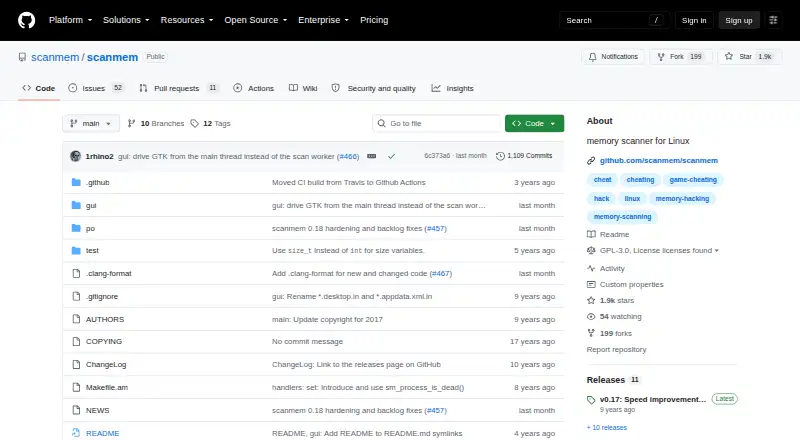
What scanmem is
scanmem is a free, open-source debugging utility for finding and changing variable values in an executing process. It searches a process by PID and uses values observed over successive scans to narrow down candidate memory addresses. The command-line tool can look for exact values, compare whether values changed or stayed the same, find increases or decreases, take snapshots, and search strings when configured for string scans. It can monitor matches as their values change and set values for selected or all known matches. GameConqueror provides a graphical interface with a process finder, flexible search syntax, a memory browser and editor, and controls for choosing search regions and locking addresses. The project separates this interface and command-line frontend from libscanmem, which performs the scanning. Linux interactive use requires libreadline and a mounted /proc filesystem; the GUI has its own dependencies. The project also documents an Android build using a standalone Android NDK toolchain. The default scan type is int, though the option command can change it.
Good
- Supports exact, comparative, snapshot, and string scans.
- Can monitor matches and change their values.
- GameConqueror offers a graphical memory browser and editor.
- Free and open source under listed licenses.
Watch out
- Linux interactive commands require libreadline and mounted /proc.
- GameConqueror has several additional dependencies.
- Default scan data type is int.
Who it suits
It suits Linux users who need to inspect process memory from the command line or through GameConqueror. The project also documents an Android build path for users working with the Android NDK.
Verdict
scanmem offers command-line process memory scanning, with GameConqueror as a graphical option. Its Linux requirements and integer default are worth considering before choosing it.
Plans and prices
From scanmem's own pricing page, checked 4 Oct 2026.
| Plan | Price | What it gives you |
|---|---|---|
| scanmem | Free | GPLv3; libscanmem is LGPLv3 |
The facts
Each one read from scanmem's own pages, with the date it was checked.
Where it runs
- Android build
- The project documents building Android interactive capabilities with a standalone Android NDK toolchain.checked 4 Oct 2026
- Linux requirements
- The README says scanmem requires libreadline for interactive commands and a mounted /proc filesystem.checked 4 Oct 2026
- Platform support
- The repository describes scanmem as a Linux memory scanner and documents an Android build using the Android NDK standalone toolchain.checked 4 Oct 2026
What it does
- CLI and library
- The project separates the scanmem command line frontend from libscanmem, the library that performs the memory scanning.checked 4 Oct 2026
- Documentation
- The project points users to man pages, command-line help, the interactive scanmem prompt, and GameConqueror’s interactive help.checked 4 Oct 2026
- GUI
- GameConqueror is a graphical front end for scanmem with flexible search syntax, variable locking, a process finder, and a memory browser/editor.checked 4 Oct 2026
- GUI features
- GameConqueror provides flexible search syntax, variable locking, a process finder, and a memory browser/editor.checked 4 Oct 2026
- GUI requirements
- GameConqueror lists libscanmem, Python 2 or 3, PyGObject, GTK+ 3, and policykit as requirements.checked 4 Oct 2026
- How scanning works
- It searches a process using its PID and values observed at different times, narrowing candidate addresses across scans.checked 4 Oct 2026
- Installation
- The README documents building from source with autotools and offers build instructions with or without the GUI.checked 4 Oct 2026
- Integrations
- The release notes announce a scanmem Slack chat for project collaboration.checked 4 Oct 2026
- Intended users
- The project describes scanmem as a debugging utility and GameConqueror as a graphical game-cheating tool for Linux.checked 4 Oct 2026
- Interface
- The GUI supports searching for values, choosing search regions and types, and editing or locking selected addresses.checked 4 Oct 2026
- License
- The project lists GPLv3 for scanmem and LGPLv3 for libscanmem; the GameConqueror README lists GPLv3.checked 4 Oct 2026
- Monitoring and editing
- Commands can monitor a match as its value changes and set values for selected matches or all known matches.checked 4 Oct 2026
- Notable limitation
- The default scan data type is int, and the manual says it can be changed with the option command.checked 4 Oct 2026
- Purpose
- scanmem is an interactive debugging utility for isolating and modifying a variable’s address in an executing process.checked 4 Oct 2026
- Requirements
- scanmem requires libreadline for interactive commands and a mounted /proc filesystem.checked 4 Oct 2026
- Scanning
- The v0.17 release lists snapshot and update support for string and bytearray scans.checked 4 Oct 2026
- Scripting
- The v0.17 release adds command-line options to run commands before interactive mode and to exit on initial command errors.checked 4 Oct 2026
- Search types
- The command-line tool supports exact-value scans, changed or unchanged comparisons, increased or decreased comparisons, snapshots, and string searches when the scan type is set to string.checked 4 Oct 2026
- Security
- GitHub reports that the project has no security policy file and no published security advisories.checked 4 Oct 2026
- Support
- The README points users to man pages, the command-line help, and GameConqueror's interactive help for documentation.checked 4 Oct 2026
The full review of scanmem
Overview
scanmem is a free, open-source utility for finding and changing values in a running process. It suits Linux users who are comfortable working with process IDs and memory scans, including people debugging software or investigating game values. Its command line offers several ways to narrow a search; GameConqueror adds a graphical route, but brings its own requirements.
Key features
Scanning starts with a process ID and values observed at different times. Repeated scans narrow the possible addresses, so scanmem can help when a value is not easy to identify from a single observation. The command-line tool supports exact-value searches, changed or unchanged comparisons, increased or decreased comparisons, snapshots, and string searches when the scan type is set to string. Version 0.17 adds snapshot and update support for string and bytearray scans.
Commands can monitor a match as its value changes, then set a value for one selected match or for all known matches. The default scan type is int; users working with another kind of value need to change it with the option command. That default is worth checking before interpreting results.
scanmem separates its command-line frontend from libscanmem, the library that performs the scans. The command line also supports scripting: version 0.17 added options to run commands before entering interactive mode and to exit if an initial command fails. This gives repeatable workflows more scope than a purely prompt-driven tool.
GameConqueror is the graphical front end, described as a game-cheating tool for Linux. It provides flexible search syntax, a process finder, a memory browser and editor, and variable locking; users can search values, select search regions and types, and edit or lock chosen addresses. It is a practical alternative to entering commands, though its separate dependencies make setup more involved than the scanmem command line alone.
Pricing
scanmem is free: its plan costs nothing, with no free trial. The project lists GPLv3 for scanmem, LGPLv3 for libscanmem, and GPLv3 for GameConqueror. There are no paid tiers to weigh against the free version.
Platforms
The project describes scanmem as a Linux memory scanner and documents an Android build using a standalone Android NDK toolchain. The README requires libreadline for interactive commands and a mounted /proc filesystem. Building from source uses autotools, with instructions for builds with or without the GUI.
GameConqueror requires libscanmem, Python 2 or 3, PyGObject, GTK+ 3, and policykit. Those dependencies are a meaningful setup consideration for anyone who wants the graphical interface rather than the command line.
Who it's for
scanmem fits Linux developers and technically minded users who need to track a process variable across successive observations, or who want to inspect and change game values. Its command line is the better fit for users comfortable with a prompt, while GameConqueror offers search and editing controls for those who prefer a GUI and can meet its dependencies.
It is not a strong fit for someone seeking a polished, general-purpose visual debugger or a tool with a simpler setup across desktop platforms. The project points users to man pages, command-line help, the interactive prompt, and GameConqueror's interactive help for guidance.
Pros and cons
- Pro: Multiple comparison modes, snapshots, and string searches help narrow candidates even when the target is known by how it changes.
- Pro: Monitoring, value editing, and GameConqueror's locking and memory browser cover both observing and changing selected values.
- Pro: The free, open-source project separates its scanning library from the command-line frontend, and supports scripted startup commands.
- Con: The default data type is int, so users scanning other kinds of values must change the option before searching.
- Con: Interactive command use requires libreadline and a mounted /proc filesystem; the GUI adds several dependencies of its own.
- Con: The project describes the scanner as Linux-focused; Android use is documented as a build using the NDK standalone toolchain, not as a ready-made cross-platform desktop workflow.
Alternatives
For a broader range of platforms, DOSBox Cheat Engine is a free, open-source option for Linux, macOS, web, and Windows, but requires DOSBox Staging 0.83 or later. ReClass.NET is another free, open-source choice for Linux and Windows. CoSMOS is free on Linux and Windows, with no registration, locked features, adware, or hidden software.
MemDBG is free and open source, with platform coverage spanning Android, iOS, Linux, macOS, and Windows. For a Linux-only alternative, PINCE is free, open source, and GPLv3+, and is described as a Linux reverse engineering tool. Mac users can consider Bit Slicer, free open-source software for macOS 10.8 or later. Squalr is a free, open-source option spanning Android, API, Linux, macOS, and Windows; Game Cheetah is free and covers Linux, macOS, and Windows.
Browse the Game Memory Editors category to compare more options.
Verdict
Choose scanmem if you want a free Linux scanner that can progressively narrow process values and monitor or edit matches, with GameConqueror available when a graphical interface matters. Look elsewhere if you need a straightforward cross-platform desktop tool or prefer not to manage the Linux and GUI dependencies.
Alternatives to scanmem
- 1
Bit Slicer
Free planOpen sourcemacOS7.0Free plan - 2
chromedp
Free planAPILinuxmacOSSelf-hosted6.7Free plan - 3
ArtMoney
Free planWindows6.5$24.90 one-time - 4
DOSBox Cheat Engine
Free planWebLinuxmacOSWindows6.4Free plan - 5
MemDBG
AndroidiOSLinuxmacOS6.4 - 6
ReClass.NET
Free planLinuxWindows6.4Free plan