MemDBG
MemDBG is a console payload and native frontend for inspecting memory, scanning, debugging, building trainers and research on PS4, PS5 and host machines.
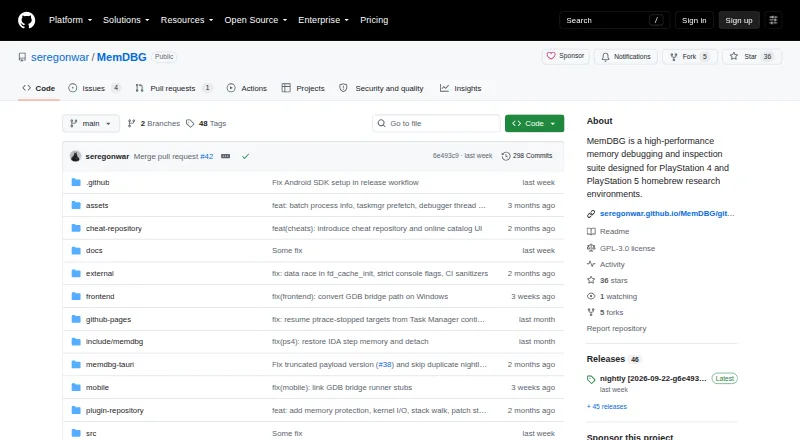
What MemDBG is
MemDBG is a console payload and native frontend for inspecting memory, scanning, debugging, building trainers and research on PS4, PS5 and host machines. Its scan workflows cover exact values, process-wide searches, AOB patterns, pointer chains, unknown values and heuristic Smart Auto-Search. Debugging tools include thread control, stepping, registers, breakpoints, watchpoints, stack walking and disassembly. Trainer workflows handle .cht files, batchcode imports, toggled or locked values, and patch-to-trainer export. The frontend supports desktop-side Lua and Python plugins from repository manifests, with a public plugin repository as its default source. It documents a GDB remote bridge for IDA Pro and an optional x64dbg plugin bridge. MemDBG is free, open source under GPL-3.0-or-later, and in active pre-release development. It is intended for offline homebrew development, reverse-engineering education, preservation and authorized security research. Host builds bind to loopback by default, and the project recommends an allowlisted frontend IP for LAN sessions. Some macOS debugger actions may require SIP or code-signing changes; the iOS/iPadOS release artifact is unsigned.
Good
- Supports multiple memory scanning workflows.
- Debugger includes breakpoints, watchpoints and disassembly.
- Supports desktop-side Lua and Python plugins.
- Free and licensed GPL-3.0-or-later.
Watch out
- The project is in active pre-release development.
- Some macOS debugger actions may require SIP or code-signing changes.
- The iOS/iPadOS release artifact is unsigned.
Who it suits
It is intended for people doing legitimate debugging, education, preservation, homebrew development or authorized security research on systems they own or may analyze. It is not intended for online cheating, piracy or unauthorized access.
Verdict
MemDBG brings memory scanning, debugging and trainer-building workflows together for console and host-machine research. Its pre-release status and platform caveats are worth noting before choosing it.
The facts
Each one read from MemDBG's own pages, with the date it was checked.
What it does
- Compatibility
- MemDBG uses its versioned MDBG protocol and can expose a separate ps5debug-compatible listener for older trainer and debugger clients.checked 30 Sep 2026
- Debugger
- Debugger features include process attach and detach, thread controls, stepping, registers, breakpoints, watchpoints, stack walking, and disassembly.checked 30 Sep 2026
- Integrations
- The project documents a host GDB remote proxy for IDA Pro and an x64dbg plugin bridge.checked 30 Sep 2026
- Intended audience
- The project describes its audience as people doing legitimate debugging, security research, education, preservation, and homebrew development on systems they own or are authorized to analyze.checked 29 Sep 2026
- Intended use
- The project is designed for offline homebrew development, reverse-engineering education, preservation, and authorized security research.checked 29 Sep 2026
- Intended users
- The project is designed for offline homebrew development, reverse-engineering education, preservation, and authorized security research.checked 30 Sep 2026
- License and status
- MemDBG is GPL-3.0-or-later and described as being in active pre-release development.checked 30 Sep 2026
- Memory scanning
- Scanning includes exact-value, process-wide, AOB, pointer-chain, unknown-value, and heuristic Smart Auto-Search workflows.checked 30 Sep 2026
- Plugins
- The frontend can run desktop-side Lua and Python plugins from repository manifests, with a bundled fallback plugin repository.checked 30 Sep 2026
- Protocol limits
- The documented maximum packet and MEMORY_READ sizes are 1 MiB, batch read/write requests allow 64 items, and scan values are limited to 16 bytes.checked 30 Sep 2026
- Purpose
- MemDBG is a console payload and native frontend for memory inspection, scanning, debugging, trainer building, and research on PS4, PS5, and host development machines.checked 30 Sep 2026
- Responsible use
- The maintainers say they do not support online cheating, piracy, unauthorized access, or disruptive behavior against online services or other players.checked 29 Sep 2026
- Security guidance
- Host builds bind to loopback by default, and the README recommends using an allowlisted frontend IP for LAN sessions.checked 30 Sep 2026
- Support
- The README directs users to open an issue with the payload/frontend version, platform, firmware, and logs when a firmware-specific problem occurs.checked 30 Sep 2026
- Trainer tools
- Trainer workflows support .cht save/load, batchcode import, ON/OFF values, lock intervals, and patch-to-trainer export.checked 30 Sep 2026
Where it runs
- Platform caveat
- Some macOS debugger actions may require SIP or code-signing changes, and the iOS/iPadOS release artifact is unsigned.checked 30 Sep 2026
- Platforms
- Release artifacts are listed for Windows, macOS, Linux, iOS/iPadOS, and Android; the payload targets PlayStation 4 and PlayStation 5.checked 30 Sep 2026
The full review of MemDBG
MemDBG is a free, open-source toolkit for inspecting memory, debugging and building trainers for PS4, PS5 and host machines. It best suits people working on systems they own or are authorized to analyze. Its breadth is compelling for that work, though active pre-release development and platform-specific setup caveats make it a less settled choice.
Overview
MemDBG joins a console payload and native frontend around a versioned MDBG protocol. It can also expose a separate listener for older trainer and debugger clients that use the ps5debug protocol, which may ease use with existing workflows.
The project is aimed at offline homebrew development, reverse-engineering education, preservation and authorized security research. Its maintainers reject online cheating, piracy, unauthorized access and disruptive behavior toward online services or other players. That clear boundary makes MemDBG a specialist tool, not a general-purpose game utility.
GPL-3.0-or-later licensing and a free price make it accessible to eligible users, but active pre-release development means it is not the safest pick for workflows that require a settled release.
Key features
Scanning and debugging
Scanning covers exact values, process-wide searches, AOB patterns, pointer chains, unknown values and heuristic Smart Auto-Search. That range supports both targeted searches and investigations where the value is not yet known. Debugger controls include thread management, stepping, registers, breakpoints, watchpoints, stack walking and disassembly, giving researchers several ways to inspect execution rather than relying on scans alone.
Trainer workflows and extensions
Users can save and load .cht files, import batchcode, manage ON/OFF values and lock intervals, and export patches to trainers. Desktop-side Lua and Python plugins can be loaded from repository manifests; the public MemDBG plugin repository is the default source. The combination makes MemDBG more useful for repeatable, extensible work than a scanner alone.
IDA Pro integration uses a documented GDB remote bridge, and an optional x64dbg plugin bridge is also supported. The documented maximum packet and MEMORY_READ sizes are 1 MiB, while batch reads and writes accept up to 64 items. Those are concrete protocol limits to account for when designing larger operations.
Pricing
MemDBG is free and open source under GPL-3.0-or-later. There is no paid tier or trial to weigh against a free-plan cap; no seat or quota terms are given. It suits users comfortable with an actively developed project, while those who need a supported commercial product should look elsewhere.
Platforms
MemDBG lists Android, iOS, Linux, macOS and Windows support. The iOS/iPadOS release artifact is unsigned, and some macOS debugger actions may require changes to System Integrity Protection or code signing. Those caveats can add setup friction, particularly on Apple devices, so platform support should not be mistaken for identical installation or debugger behavior across systems.
Host builds bind to loopback by default. For LAN sessions, the project recommends using an allowlisted frontend IP, a sensible precaution for users exposing a debugging workflow beyond the local machine.
Who it's for
Choose MemDBG if you need a broad scanning, debugging and trainer-building workflow for legitimate offline homebrew work, education, preservation or authorized research. It is a poor fit for online cheating, unauthorized access, piracy or casual use that does not need console and host-memory research tools. Users reporting problems are asked to include the payload and frontend versions, platform, firmware and logs when opening an issue.
Pros and cons
Pros
- Combines varied scan methods with substantial debugger controls, useful when an investigation moves from finding values to examining execution.
- Trainer export, batchcode, scripting plugins and debugger bridges support workflows beyond one-off memory searches.
- Free GPL-licensed software has no paid tier to unlock core workflows.
- A loopback default and LAN allowlisting guidance provide a security-conscious starting point for host builds.
Cons
- Active pre-release development makes long-term workflow stability less certain.
- The unsigned iOS/iPadOS artifact and possible macOS SIP or signing changes can complicate setup or debugger use.
- Protocol operations have defined packet, read-size and batch-item ceilings that may constrain larger requests.
Alternatives
For a free, open-source option limited to Linux and Windows, ReClass.NET is another choice. CoSMOS is free on Linux and Windows, requires no registration and advertises no locked features or adware. Linux users comparing other free, open-source tools can consider Cheat Engine Linux or PINCE; PINCE is described as a GPLv3+ Linux reverse-engineering tool.
Mac users looking for a free, open-source option for macOS 10.8 or later can consider Bit Slicer. Squalr is another free, open-source option spanning Android, API, Linux, macOS and Windows. Cheat Engine is a freemium alternative for Linux, macOS and Windows, while ProMod is a free option for macOS and iOS. Browse more options in Game Memory Editors.
Verdict
MemDBG is a strong fit for technically minded users who need scanning, debugging and trainer-building in one free toolkit for authorized console or host-machine work. Its broad workflow and plugin support are the main reasons to choose it; active pre-release development and Apple-platform setup caveats are the main reasons to look elsewhere when stability or straightforward setup matters more.
Alternatives to MemDBG
- 1
Bit Slicer
Free planOpen sourcemacOS7.0Free plan - 2
chromedp
Free planAPILinuxmacOSSelf-hosted6.7Free plan - 3
ArtMoney
Free planWindows6.5$24.90 one-time - 4
DOSBox Cheat Engine
Free planWebLinuxmacOSWindows6.4Free plan - 5
ReClass.NET
Free planLinuxWindows6.4Free plan - 6
scanmem
Free planAndroidLinux6.4Free plan