
Rubric
Rubric is a student engagement platform for universities, student unions, associations, and guilds.
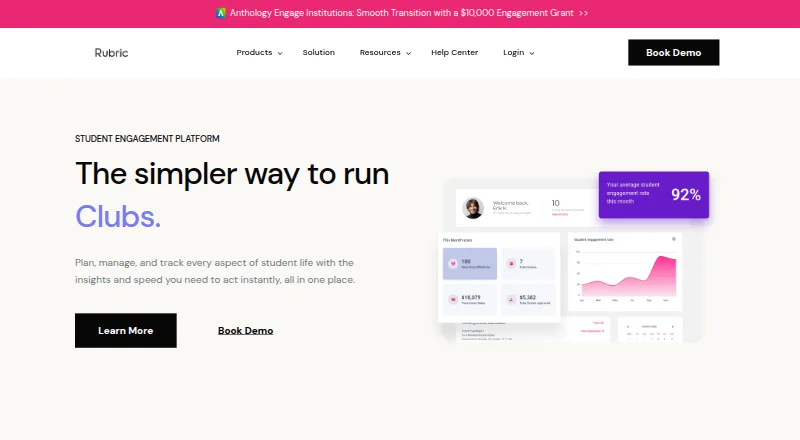
What Rubric is
Rubric is a student engagement platform for universities, student unions, associations, and guilds. Its 28 selectable modules cover clubs, student groups, events, memberships, student services, campus programs, and student insights. Club Management brings member types, hosted events, activity, forms, and attendance rates into a dashboard. Smart Digital Forms use drag-and-drop fields, club profile data, and approval flows. Event & Ticketing includes membership validation, recurring and collaborative events, a marketplace, tabling, and ticket scanning. Outreach Tools support SMS blasts and email campaigns with templates and live recipient lists. A Student CRM & Engagement Tracker connects activity touchpoints such as clubs, events, and trainings with engagement scoring and student profiles. Rubric connects to student information and learning management systems, single sign-on, and experience management systems. It has Android, iOS, and web platforms, and its campus app is listed for iPhone. A free plan is available; paid memberships, tickets, and merchandise may incur transaction and service fees. The operator is MySmock Pty Ltd trading as Rubric.
Good
- 28 modules can be selected for campus needs.
- Club dashboard shows activity, attendance, events, and members.
- Forms support live profile data and approval flows.
- Student engagement scoring and profile management are available.
- Android, iOS, and web platforms are listed.
Watch out
- Paid sales may incur tiered selling fees.
- Purchases may also have variable service fees.
- Onboarding can take 30–60 days.
Who it suits
Rubric suits campus organizations that need to coordinate student groups, events, memberships, and engagement. Its selectable modules and system integrations are relevant to universities, student unions, associations, and guilds.
Verdict
Rubric combines campus operations and student engagement tools with a free plan. Organizations should account for possible transaction and service fees on purchases and allow time for onboarding.
Plans and prices
From Rubric's own pricing page, checked 30 Sep 2026.
| Plan | Price | What it gives you |
|---|---|---|
| Champion | Free | 12 month transaction volume above $20,000 · Monthly subscription fee: Free · Paid memberships, tickets, and merchandise: 3% + 50¢ |
| Free | Free | 12 month transaction volume below $200 · Monthly subscription fee: Free · Paid memberships, tickets, and merchandise: Free |
| Standard | Free | 12 month transaction volume $200 – 20,000 · Monthly subscription fee: Free · Paid memberships, tickets, and merchandise: 4% + 70¢ |
The facts
Each one read from Rubric's own pages, with the date it was checked.
What it does
- Audience
- Rubric says it is used by student life teams to engage over 2.5 million students.checked 30 Sep 2026
- Club management
- The Club Management module displays club members, hosted events, activity levels, forms, attendance rates, and member types from a dashboard.checked 29 Sep 2026
- Communications
- Outreach Tools support SMS blasts and email campaigns with templates and real-time recipient lists.checked 29 Sep 2026
- Compliance
- Rubric's FAQ states that it is GDPR and ISO 27001 compliant, with SOC 2 Type II compliance in progress, and that data is hosted on encrypted servers with 99.9% uptime.checked 30 Sep 2026
- Data residency
- Rubric says it offers data residency options in Canada, the USA, Australia, and New Zealand.checked 30 Sep 2026
- Events and payments
- Event & Ticketing includes membership validation, recurring events, tabling, collaborative event management, a marketplace, and a ticket scanner.checked 29 Sep 2026
- Hosting and residency
- Rubric says its production systems and backups are hosted on Amazon EC2 and that data residency options are available in Canada, the USA, Australia, and New Zealand.checked 29 Sep 2026
- Integrations
- Rubric says integrations are tailored to each organization and may use APIs, webhooks, or file imports depending on contract scope and technical availability.checked 30 Sep 2026
- Integrations support
- The maker's admin portal lists Xero, QuickBooks, Microsoft Dynamics 365 Business Central, Stripe, Wallester, Weel, SAML 2.0, AAF OIDC, Google OAuth/OIDC, Microsoft Azure AD/Graph, and StudId integrations.checked 30 Sep 2026
- Limits and fees
- The US clubs pricing page says subscriptions are free, but paid sales may incur tiered selling fees, and purchases may also have service fees that vary by payment method, basket size, and card issuer.checked 30 Sep 2026
- Modules
- The platform offers 28 modules, including club management, digital forms, grants, event approvals, reporting, memberships, ticketing, and case management.checked 30 Sep 2026
- Onboarding
- The FAQ says most users are up and running within 30–60 days, depending on their package and integration or customization needs.checked 30 Sep 2026
- Pricing availability
- The official site invites prospective customers to book a demo or contact its team to get started; I found no public product pricing on the official pages opened.checked 29 Sep 2026
- Product
- Rubric describes itself as a student engagement platform for managing clubs, student groups, events, student services, memberships, campus programs, and student insights.checked 30 Sep 2026
- Security
- Rubric's security page states that it is GDPR compliant, PCI-DSS 3.2.1 Level 1 compliant, uses industry-standard encryption, and hosts production systems on Amazon EC2.checked 30 Sep 2026
- Student records
- Its Student CRM & Engagement Tracker connects touchpoints such as events, clubs, and trainings and supports engagement scoring and student profile management.checked 30 Sep 2026
- Support
- Rubric says it typically responds to support requests within 24 business hours and offers help through an in-app chatbot and email.checked 30 Sep 2026
- Support and uptime
- Rubric reports average uptime of 99.5% and says its support team responds to support requests in days.checked 29 Sep 2026
Where it runs
- Forms and approvals
- Smart Digital Forms support drag-and-drop fields, live data from club profiles, and approval flows.checked 29 Sep 2026
- Mobile app
- Rubric describes a campus engagement app that gives students access to events and activities; its App Store listing says it is available for iPhone.checked 29 Sep 2026
The company
- Founded
- 2017checked 28 Sep 2026
- Headquarters
- Burwood, New South Wales, Australiachecked 28 Sep 2026
- Maker
- The site identifies the operator as MySmock Pty Ltd trading as Rubric.checked 30 Sep 2026
The full review of Rubric
Overview
Rubric is a modular campus operations and engagement platform for universities, student unions, associations, and guilds. It suits institutions that want to connect club administration, events, student services, and engagement tracking in one system. Its breadth is appealing, but the transaction fees on paid sales and a potentially lengthy onboarding period matter when weighing it against simpler tools.
Rubric says customers can choose among 28 plug-and-play modules. Its Student CRM & Engagement Tracker links student profiles with touchpoints such as club activity, events, and trainings, then supports engagement scoring. That puts operational tasks and student participation in the same picture rather than limiting the platform to event management alone.
Founded in 2017, Rubric is operated by MySmock Pty Ltd trading as Rubric and is based in Burwood, New South Wales, Australia. For a broader category view, see Student Engagement Software.
Key features
Club management and forms
The Club Management dashboard brings together members, hosted events, activity levels, forms, attendance rates, and member types. For campus teams overseeing multiple clubs, this can make routine oversight more coherent. Smart Digital Forms add drag-and-drop fields, live data from club profiles, and approval flows, which should help connect submissions to the records and decisions they support.
Events, ticketing, and outreach
Event & Ticketing covers membership validation, recurring events, tabling, collaborative event management, a marketplace, and a ticket scanner. That is a substantial event toolkit for institutions handling both member-only and broader campus activity. Outreach Tools add templated email campaigns and SMS blasts with real-time recipient lists, supporting targeted communication without relying solely on event listings.
Student records and integrations
The Student CRM & Engagement Tracker connects events, clubs, and trainings with student profiles and engagement scoring. Rubric also says it connects with student information systems, learning management systems, single sign-on, and experience management systems. Its admin portal lists integrations including Xero, QuickBooks, Microsoft Dynamics 365 Business Central, Stripe, Wallester, Weel, SAML 2.0, AAF OIDC, Google OAuth/OIDC, Microsoft Azure AD/Graph, and StudId. The range is useful for institutions with established systems, though the actual fit will depend on their configuration.
Mobile access and security
Rubric describes a campus engagement app that gives students access to events and activities; its App Store listing says it is available for iPhone. The service also supports Android and web. Rubric says it uses SSL encryption, quality-assurance procedures, and industry-standard encryption and key-management practices. It states that it is GDPR compliant and PCI-DSS 3.2.1 Level 1 compliant as both a merchant and service provider. Production systems and backups run on Amazon EC2, with data residency options in Canada, the USA, Australia, and New Zealand.
Rubric reports average uptime of 99.5%. It says support is available by in-app chatbot and email and typically responds within 24 business hours. Most users are up and running within 30–60 days, depending on package and integration or customization needs, so institutions should plan for a rollout rather than expect an immediate switch.
Pricing
Rubric is freemium, and the US clubs plans show no monthly subscription charge. The plan names and thresholds are tied to 12-month transaction volume:
| Plan | 12-month transaction volume | Monthly subscription | Paid memberships, tickets, and merchandise |
|---|---|---|---|
| Free | Below $200 | Free | Free |
| Standard | $200–$20,000 | Free | 4% + 70¢ |
| Champion | Above $20,000 | Free | 3% + 50¢ |
The Free tier fits clubs with very low annual sales, while Standard and Champion keep the subscription free but charge transaction fees on paid sales. The lower rate on Champion makes it the better fit at higher volume; these fees can still affect net proceeds. Purchases may also carry service fees that vary by payment method, basket size, and card issuer. Institutions seeking product-wide pricing can book a demo or contact Rubric for custom pricing.
Platforms
Rubric supports Android, iOS, and web. Its student-facing campus engagement app offers access to events and activities, with iPhone availability stated in its App Store listing.
Who it's for
Rubric is best suited to universities, student unions, associations, and guilds that need a configurable mix of club administration, event sales, outreach, student records, and engagement analytics. Its modules and integrations are more compelling for organizations coordinating several campus workflows than for a small group that only needs a basic event page. The 30–60 day onboarding window is also a consideration for teams planning a launch.
Pros and cons
- Pros: 28 selectable modules let institutions shape the system around campus needs rather than adopt a single fixed workflow.
- Pros: Club records, event operations, forms, communications, and student engagement tracking sit within one platform.
- Pros: The published clubs tiers have no monthly subscription fee, including for higher transaction volumes.
- Pros: Data residency options span Canada, the USA, Australia, and New Zealand, and the stated compliance coverage includes GDPR and PCI-DSS 3.2.1 Level 1.
- Cons: Paid sales carry tiered transaction fees, and additional service fees may apply to purchases.
- Cons: Typical onboarding takes 30–60 days, which may not suit a team needing an immediate deployment.
- Cons: Reported average uptime is 99.5%, a figure institutions should weigh against their own availability requirements.
Alternatives
Choose GivePulse if a freemium service with a free plan and known entry-level limits—one admin, no subgroups, and five custom fields—better matches a smaller operation; its Give Joy plan is $20 a month when billed annually and allows two admins and one subgroup.
Modern Campus CMS is a paid alternative with Android, iOS, web, API, and self-hosted platforms. Consider Pathify if its paid Engagement Hub, priced by enrollment and optional add-ons, better fits an institution seeking that product model.
Suitable is another paid option for Android, iOS, and web. Civitas Advising may suit institutions looking for an annual, quote-based subscription scaled to institution size and integrated systems, typically on a multi-year term.
ConexED Retain and Early Alert are paid web-based alternatives. Consider Unibuddy if a paid platform with no free plan and enterprise chat options better suits the need to manage multiple ambassador programs and separate data by department.
Verdict
Rubric is a strong fit for campus organizations that want one configurable system for clubs, events, outreach, and student engagement records. Its broad module set, integrations, and free monthly subscription on the clubs tiers are persuasive; transaction and service fees, alongside a 30–60 day typical rollout, are the main reasons to look elsewhere. Choose it when coordinated campus operations matter more than a quick, fee-free setup.
Getting started
- Visit https://hellorubric.com/.
- Book a demo or contact Rubric's team to get started.
- Choose modules to fit your campus needs.
- Plan onboarding around your package and integration or customization needs.
- Use the campus engagement app on iPhone to give students access to events and activities.
Limits worth knowing
The Free plan has no monthly subscription fee, but paid memberships, tickets, or merchandise may incur tiered selling fees. Purchases may also have service fees that vary by payment method, basket size, and card issuer.
Questions
What does Rubric cost?
The listed club plans have a free subscription fee. Paid sales can incur fees: the Free tier lists no selling fee below $200 in 12-month transaction volume, Standard lists 4% + 70¢ for $200–20,000, and Champion lists 3% + 50¢ above $20,000. Purchases may also incur service fees.
What platforms does Rubric support?
Rubric is listed for Android, iOS, and web. Its campus engagement app is available for iPhone.
Who makes Rubric?
The site identifies its operator as MySmock Pty Ltd trading as Rubric.
What systems can Rubric connect with?
Rubric says it connects with student information systems, learning management systems, single sign-on, and experience management systems. Its admin portal also lists integrations including Xero, QuickBooks, Stripe, SAML 2.0, Google OAuth/OIDC, Microsoft Azure AD/Graph, and StudId.
How long does onboarding take?
Rubric says most users are up and running within 30–60 days, depending on their package and integration or customization needs.
How can an organization get started?
Rubric invites prospective customers to book a demo or contact its team.
Alternatives to Rubric
- 1
GivePulse
Free planAndroidiOSWebAPI8.1From $1.75 a year - 2
Nearpeer
AndroidiOSWeb7.1From $15,000 a year - 3
Zynvo
Free planAndroidiOSWeb7.1Free plan - 4

EAB Navigate360
AndroidiOSWebAPI6.8 - 5

Civitas Advising
AndroidiOSWebAPI6.7 - 6
InScribe
AndroidiOSWebAPI6.4