Nearpeer
Nearpeer is a student engagement and recruitment platform for higher education, connecting prospective and current students with peers and campus resources.
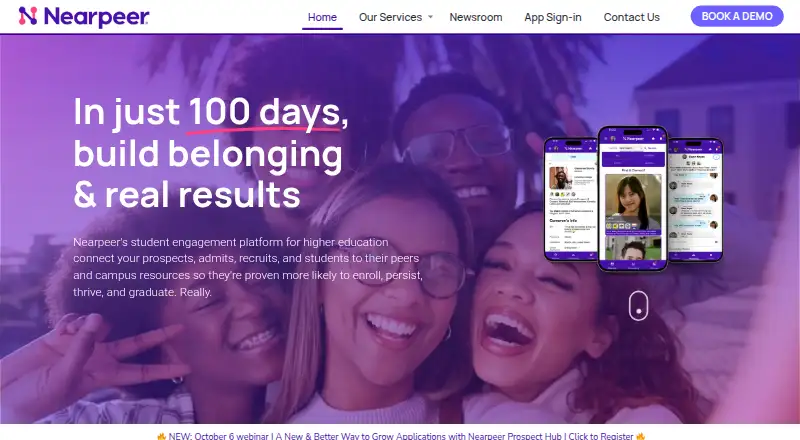
What Nearpeer is
Nearpeer is a student engagement and recruitment platform for higher education, connecting prospective and current students with peers and campus resources. It supports stages from prospective and admitted students through committed, new, and current students, and is aimed at first-year, transfer, international, adult, online, early-college, and non-degree learners. Nearpeer says its matching uses more than 3,600 criteria, including interests, identities, majors, goals, and hometowns. Students can connect with peers, study buddies, campus clubs, and others in their majors, including during orientation and the transition to college. Campus communities can be tailored to institutional priorities, and partners receive student insights. Nearpeer describes the product as a standalone tool that can complement student information systems, residence-life platforms, marketing tools, student-success platforms, and other student resources. Access is available on web, Android, and iOS. The company says it is SOC 2 Type 2 compliant and that Nearpeer for College conforms with WCAG 2.1 Level AA. Institutions are directed to book a demo; pricing is on request.
Good
- Matches students using more than 3,600 criteria
- Supports multiple learner groups and student stages
- Available on web, Android, and iOS
- States WCAG 2.1 Level AA conformance
Watch out
- Pricing is available on request
- Institutions are directed to book a demo
Who it suits
Nearpeer suits higher-education institutions seeking to connect students across the admissions and college transition journey. Its audiences include learners from first-year and transfer students to online, adult, and non-degree students.
Verdict
Nearpeer focuses on peer connection and campus engagement across a wide range of student types and lifecycle stages. Institutions should expect to request pricing and assess how its standalone platform fits their existing student tools.
Plans and prices
From Nearpeer's own pricing page, checked 7 Oct 2026.
| Plan | Price | What it gives you |
|---|---|---|
| Belonging Before Arriving Community of Practice | $15,000 a year | Exact cost depends on the size of the eligible student population; includes SWISS survey and assessment, Nearpeer platform and program services, and community-of-practice facilitation · per year per institution |
The facts
Each one read from Nearpeer's own pages, with the date it was checked.
What it does
- Accessibility
- Nearpeer for College states that it conforms with WCAG 2.1 Level AA and that accessibility was assessed through self-evaluation and external evaluation.checked 4 Oct 2026
- Audiences
- Nearpeer says it serves first-year, transfer, international, adult, online, early-college, and non-degree learners.checked 4 Oct 2026
- Community customization
- Nearpeer says each campus community can be customized to its strategic needs and that partners receive insights about students.checked 4 Oct 2026
- Enrollment use
- Colleges can use Nearpeer to engage prospective and admitted students, improve yield, and reduce summer melt.checked 7 Oct 2026
- Integrations
- A Nearpeer case study says the platform complemented the University of Oklahoma's existing StarRez housing management software for roommate matching.checked 7 Oct 2026
- Lifelong learning
- Nearpeer supports lifelong learning institutes with member profiles, group chats, member search, and matching based on shared interests and life transitions.checked 7 Oct 2026
- Parent engagement
- Nearpeer for Parents & Families lets parents connect before enrollment, find other families, and receive campus posts and notifications.checked 7 Oct 2026
- Peer matching
- Nearpeer says its peer-matching uses more than 3,600 criteria, including interests, goals, identities, career aspirations, clubs, majors, and hometowns.checked 7 Oct 2026
- Pricing availability
- The public site directs institutions to book a demo and does not state a product price on the pages reviewed.checked 4 Oct 2026
- Private communities
- The platform provides private, invitation-only spaces customized for each campus community.checked 7 Oct 2026
- Product
- Nearpeer is a student engagement and recruitment platform for higher education that connects prospective and current students to peers and campus resources.checked 4 Oct 2026
- Prospect Hub
- Nearpeer Prospect Hub offers institution-branded prospect engagement, a personalized resource center, prospect insights, and tools for managing recruitment communications.checked 7 Oct 2026
- Purpose
- Nearpeer is a higher education student engagement platform that connects prospective, admitted, and current students with peers and campus resources.checked 7 Oct 2026
- Security
- Nearpeer states that it became SOC 2 Type 2 compliant in 2026 and that institutions can request its SOC 2 Type 2 report, HECVAT, or VPAT through its Trust Center.checked 7 Oct 2026
- Student lifecycle
- The platform is presented for prospects, admitted and committed students, new students, and current students.checked 4 Oct 2026
- Student success
- Nearpeer supports first-year, transfer, international, adult, online, early-college, and non-degree students with peer connections around orientation, clubs, study buddies, and majors.checked 7 Oct 2026
- Support
- Nearpeer's contact page offers app support through a ticket submission option, as well as demo scheduling and general inquiries.checked 7 Oct 2026
The company
- Company
- Nearpeer's terms identify Nearpeer, Inc. as a Delaware corporation.checked 7 Oct 2026
- Founded
- 2017checked 28 Sep 2026
- Headquarters
- Nearpeer lists its address as 63 Federal St, Portland, Maine 04101, USA.checked 7 Oct 2026
Where it runs
- Mobile apps
- Nearpeer says the app is available through the Apple App Store and Google Play Store.checked 7 Oct 2026
The full review of Nearpeer
Nearpeer is a higher-education platform for connecting students with peers and campus resources, from recruitment through college life. It suits institutions seeking a tailored community for varied student populations; its strongest case is peer connection, while its custom pricing makes fit and cost worth settling before adoption.
Overview
Nearpeer brings prospective, admitted, and current students into private, invitation-only campus communities. Colleges can use it to support recruitment, improve yield, and reduce summer melt, while students can find peers and campus resources as they approach and begin college.
Its reach extends beyond traditional first-year students to transfer, international, adult, online, early-college, and non-degree learners. Nearpeer also serves parents and families before enrollment and lifelong learning institutes, giving institutions a way to support communities beyond the usual admissions-to-orientation path.
Key features
Peer matching and transition support
Nearpeer says it matches students across more than 3,600 criteria, including interests, identities, majors, goals, and hometowns. That breadth can help campuses connect students who share meaningful context, rather than relying on a single common attribute. Students can also find study buddies, campus clubs, and peers in their majors during orientation and the transition to college.
Campus communities and recruitment
Each campus community can be customized to institutional priorities, with partner insights about students. Prospect Hub adds institution-branded prospect engagement, a personalized resource center, prospect insights, and recruitment-communication tools. Parent and family spaces allow families to connect before enrollment and receive campus posts and notifications.
For lifelong learning institutes, the platform supports member profiles, group chats, member search, and matching around shared interests and life transitions. This range is useful for institutions serving different stages of learning, though campuses should assess how its standalone role fits alongside their existing systems and services.
Security, accessibility, and support
Nearpeer says it is SOC 2 Type 2 compliant and offers its report, HECVAT, or VPAT through its Trust Center by request. Nearpeer for College states that it conforms with WCAG 2.1 Level AA, with accessibility assessed through self-evaluation and external evaluation. Students can use mobile apps, and app support is offered through a ticket submission link.
Pricing
Nearpeer uses paid, custom pricing; institutions are directed to book a demo, and standard platform pricing is not publicly stated. The named Belonging Before Arriving Community of Practice plan costs $15,000 a year, billed per year per institution. Exact cost depends on the size of the eligible student population. It includes a SWISS survey and assessment, the Nearpeer platform and program services, and community-of-practice facilitation.
That plan is aimed at institutions seeking the associated assessment and facilitated community of practice, not a simple low-cost entry tier. Since the regular platform price depends on a request, prospective buyers should establish the cost and scope for their student population before comparing it with existing campus tools.
Platforms
Nearpeer is available on Android, iOS, and web. Its student mobile apps are offered through the Apple App Store and Google Play Store, giving students options beyond a browser-based community.
Who it's for
Nearpeer is best suited to colleges and universities that want private peer communities spanning recruitment, enrollment, orientation, and current-student engagement. Its support for first-year, transfer, international, adult, online, early-college, and non-degree learners is a particular strength for institutions with varied student populations. Parent engagement and lifelong-learning features also make it relevant to campuses serving families and continuing learners.
It is less compelling for institutions seeking a clearly priced, standalone self-service product: Nearpeer is sold to institutions, pricing is custom, and it is positioned as an enhancement to existing student information, residence-life, marketing, student-success, and resource platforms.
Pros and cons
- Pros: Matching spans more than 3,600 criteria, which gives campuses a broad basis for peer connections across interests, identity, study, and goals.
- Pros: Support for prospects, current students, parents, and lifelong learners lets institutions use one platform across multiple engagement stages.
- Pros: Android, iOS, and web availability supports both mobile-app and browser access.
- Cons: Standard platform pricing is custom, so institutions cannot judge cost from a public baseline.
- Cons: The platform is described as a standalone enhancement to existing campus tools, which means it should be evaluated for fit alongside those systems rather than assumed to replace them.
Alternatives
For a free web-based recruitment option, consider AdmitCue: its freemium plan includes up to 1,000 student applications and 5,000 enquiries, alongside limits such as five courses and five scholarships. Choose it when those defined caps and its basic student dashboard suit the task better than Nearpeer’s peer-community focus.
EduCRM offers a forever-free web plan for up to 10 students, with session tracking, scheduling, application tracking, and payment tracking. It is a better fit for a small operation prioritizing those administrative functions over broad peer engagement.
Gecko is another paid option, available on Android, iOS, web, and API.
For customized admissions pricing, Creatrix Campus Admissions offers a quote tailored to institutional needs.
Classe365 is a paid option with a free trial and monthly modules priced at $75 a month, including task management, learning management, and finance and accounting. Consider it when those modules are a closer match to the institution’s needs.
ConexED Retain is a paid, web-based alternative.
EAB Navigate360 uses an enterprise license for all staff and students, with pricing tied to institutional enrollment and technology scope rather than per-user or per-office fees. It may suit institutions comparing enterprise-wide licensing models.
Slate is a paid admissions and enrollment platform. Its listed license for a single database with fewer than 1,500 annual submitted applications costs $30,000 a year, making it a relevant comparison for institutions focused on admissions licensing.
Browse the Student Recruitment Software and Student Engagement Software lists for more category options.
Verdict
Nearpeer is a strong candidate for institutions that want customizable, private peer communities to serve students from recruitment through campus life, including populations often underserved by a first-year-only approach. Its broad matching and lifecycle coverage are the main reasons to choose it. Look elsewhere if public pricing or a platform intended to replace existing campus systems is essential; Nearpeer is custom-priced and positioned to complement those tools.
Alternatives to Nearpeer
- 1
GivePulse
Free planAndroidiOSWebAPI8.1From $1.75 a year - 2

Rubric
Free planAndroidiOSWeb7.3Free plan - 3
Zynvo
Free planAndroidiOSWeb7.1Free plan - 4

EAB Navigate360
AndroidiOSWebAPI6.8 - 5

Civitas Advising
AndroidiOSWebAPI6.7 - 6
InScribe
AndroidiOSWebAPI6.4