RightITnow ECM
RightITnow ECM brings events from monitoring tools into a shared incident-management view for network operations teams and managers.
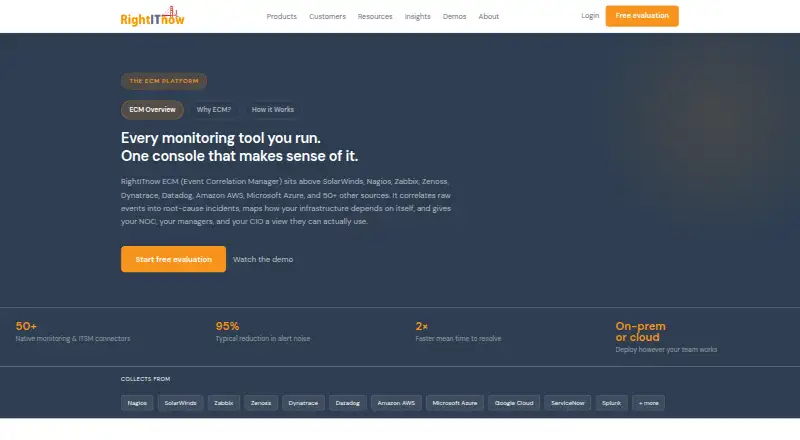
What RightITnow ECM is
RightITnow ECM brings events from monitoring tools into a shared incident-management view for network operations teams and managers. It correlates related alerts into root-cause incidents, using configurable rules to deduplicate, suppress, and group them. A live dependency graph draws on discovered topology and a CMDB, with critical paths highlighted to show cause and impact. Historical Trends lets teams review alert volumes over 7-day, 30-day, 90-day, and one-year periods and export data through a REST API.
The platform lists more than 50 connectors, including SolarWinds, Nagios, Zabbix, Zenoss, Dynatrace, Datadog, AWS, Azure, Google Cloud, and ServiceNow. It supports bidirectional ticket integration with ServiceNow, Jira Software 9.x, Jira Software Cloud, and BMC. Incident workflows can trigger remediation scripts, acknowledgements, or escalations when incidents are created or cleared. AI Incident Narrator creates plain-language summaries for NOC operators, IT managers, and CIOs. ECM is available as a cloud service or for on-premises deployment, with dedicated nodes across Azure, AWS, and Google Cloud. Its iOS app lets on-call engineers receive alerts and acknowledge, escalate, or resolve incidents.
Good
- Configurable rules deduplicate, suppress, and group related alerts.
- Live dependency graph highlights critical paths and incident impact.
- Historical Trends covers four periods and offers REST API export.
- More than 50 listed connectors include major monitoring and cloud services.
- Incident workflows can trigger scripts, acknowledgements, or escalations.
- iOS app supports on-call alert handling and incident resolution.
Watch out
- Free tier is limited to 100 managed entities.
- Paid pricing is quote-based on entity count.
- The Alert Console is available in English, French, and Japanese.
Who it suits
ECM suits network operations teams that need to correlate monitoring alerts, identify dependencies, and share incident context with management. It also fits organizations in financial services, MSPs and ISPs, government, and IT consulting that need ticket integrations or automated incident workflows.
Verdict
Choose RightITnow ECM if your team needs event correlation, dependency context, and shared incident handling across monitoring and ticketing systems. Its free tier covers up to 100 managed entities; larger deployments use quote-based pricing, and the Alert Console supports three listed languages.
Plans and prices
From RightITnow ECM's own pricing page, checked 8 Oct 2026.
| Plan | Price | What it gives you |
|---|---|---|
| Free tier | Free | Up to 100 managed entities |
| Paid plan | Priced on request | Quote based on entity count; no per-event licensing |
The facts
Each one read from RightITnow ECM's own pages, with the date it was checked.
What it does
- AI summaries
- AI Incident Narrator generates plain-language incident summaries for NOC operators, IT managers, and CIOs.checked 8 Oct 2026
- Analytics
- Historical Trends tracks alert volume over 7-day, 30-day, 90-day, and one-year periods and can export through a REST API.checked 8 Oct 2026
- Anomaly detection
- The product page says alerts can be exported to Elasticsearch Cloud for real-time anomaly detection and analysis of severity, priority, and source.checked 8 Oct 2026
- Audience
- The company lists financial services, MSPs and ISPs, government agencies, and IT consulting firms among industries using ECM.checked 8 Oct 2026
- Automation
- Automation workflows can trigger remediation scripts, acknowledgements, or escalations when incidents are created or cleared.checked 8 Oct 2026
- Deployment
- ECM is available as a cloud service or for on-premises deployment, with dedicated nodes also deployable across Azure, AWS, and Google Cloud.checked 8 Oct 2026
- Event correlation
- It groups related alerts using configurable rules for deduplication, suppression, and grouping.checked 8 Oct 2026
- Integrations
- The platform lists 50+ connectors, including SolarWinds, Nagios, Zabbix, Zenoss, Dynatrace, Datadog, AWS, Azure, Google Cloud, and ServiceNow.checked 8 Oct 2026
- ITSM
- ECM supports bidirectional ticket integration with ServiceNow, Jira Software 9.x and Jira Software Cloud, and BMC.checked 8 Oct 2026
- Language support
- The Alert Console is available in English, French, and Japanese.checked 8 Oct 2026
- Mobile
- The ECM iOS app lets on-call engineers receive alerts and acknowledge, escalate, or resolve incidents.checked 8 Oct 2026
- Purpose
- RightITnow ECM correlates events from monitoring tools into root-cause incidents and provides a shared NOC and management view.checked 8 Oct 2026
- Topology
- ECM builds a live dependency graph from discovered topology and a CMDB, with critical-path highlighting for cause and impact.checked 8 Oct 2026
The company
- Company history
- RightITnow says it was founded in January 2013.checked 8 Oct 2026
- Founded
- 2013checked 28 Sep 2026
- Headquarters
- San Francisco, California, USAchecked 28 Sep 2026
The full review of RightITnow ECM
RightITnow ECM turns monitoring alerts into correlated incidents, with a shared view for NOC operators and managers. It is a strong fit for operations teams that need dependency context and coordinated incident response across monitoring and ticketing tools. Its breadth is useful, but entity-based custom pricing makes fit and cost worth weighing before a larger deployment.
Overview
ECM is built to connect related alerts to likely root causes rather than leave responders to work through a stream of isolated notifications. Configurable rules deduplicate, suppress, and group events, while a live dependency graph draws on discovered topology and CMDB data to show critical paths and potential service impact. That combination favors teams managing interconnected infrastructure; a team needing only basic alert delivery may not need its additional context and workflow capabilities.
Key features
Correlation, topology, and analysis
Grouping and deduplication can reduce repeated alerts, and suppression rules help filter events that should not demand separate action. The dependency graph adds cause-and-impact context, which is especially valuable when an infrastructure issue affects multiple services. Historical Trends tracks alert volume across 7-day, 30-day, 90-day, and one-year windows, with export through a REST API. Alerts can also be sent to Elasticsearch Cloud for real-time anomaly detection and analysis by severity, priority, and source.
Integrations and response
ECM offers more than 50 connectors, including SolarWinds, Nagios, Zabbix, Zenoss, Dynatrace, Datadog, AWS, Azure, Google Cloud, and ServiceNow. Bidirectional ticket integration with ServiceNow, Jira Software 9.x and Jira Software Cloud, and BMC helps keep incident work connected to ITSM processes. Workflows can run remediation scripts, acknowledge incidents, or escalate them when incidents are created or cleared; that flexibility is useful for teams with established response procedures, though it depends on having appropriate workflows and scripts to trigger.
Operator tools
AI Incident Narrator produces plain-language summaries aimed at NOC operators, IT managers, and CIOs, giving different stakeholders a concise incident account. The iOS app lets on-call engineers receive alerts and acknowledge, escalate, or resolve incidents. The Alert Console supports English, French, and Japanese, a practical advantage for teams operating in those languages.
Pricing
The Free tier costs nothing and covers up to 100 managed entities. It gives smaller environments a way to use ECM without an upfront license charge, but the entity cap makes it a limited fit for larger estates. The paid plan uses custom pricing based on entity count, with no per-event licensing. That model avoids billing each alert, but teams need a quote to judge the cost as their managed environment grows.
RightITnow also offers a 45-day trial. Cloud service and on-premises deployment are available, and dedicated nodes can be deployed across Azure, AWS, and Google Cloud; these options suit organizations with different hosting requirements, but do not change the need to size the deployment against entity-based pricing.
Platforms
ECM supports API, iOS, Linux, macOS, self-hosted, web, and Windows. The mix accommodates teams working across desktop, mobile, and self-managed environments, while cloud service and on-premises deployment offer a choice in where the platform runs.
Who it's for
ECM is most relevant to NOCs and IT operations groups that need to correlate alerts, trace service dependencies, and coordinate work across monitoring and ticketing systems. Financial services, MSPs and ISPs, government agencies, and IT consulting firms are among the industries using it. Teams with fewer than 100 managed entities can start on the free tier; larger organizations should compare the value of topology and workflow capabilities with the custom quote. It is less compelling for teams seeking only a simple alert inbox or a low-cost per-user incident tool.
Pros and cons
- Pros: Event grouping, deduplication, and suppression address alert noise, while topology and critical-path views add service-impact context.
- Pros: More than 50 connectors, bidirectional ITSM integrations, and response workflows link detection to incident handling.
- Pros: Free access covers up to 100 managed entities, with cloud and on-premises deployment options.
- Cons: The free tier's entity ceiling limits its usefulness for larger environments.
- Cons: Paid pricing depends on entity count and requires a quote, so cost is harder to assess without a deployment estimate.
- Cons: Teams that do not need dependency mapping and coordinated workflows may find ECM broader than their alerting needs.
Alternatives
Browse alert management software to compare tools across the category.
- Grafana Cloud Application Observability is worth considering for teams that prefer an observability product with an always-free allowance of 2,232 host hours and a Pro option billed by host hour plus a monthly platform fee.
- Wazuh is a better fit for teams seeking free, open-source, self-hosted software, with a paid Small plan starting at $571 a month.
- TrueWatch Log Management may suit individual developers and small teams looking for a free log-management plan with usage quotas.
- AlertOps is an option for teams prioritizing alert routing and escalation policies, with a free plan for up to five users.
- PagerDuty may suit teams seeking a free incident-management starting point for five users, one on-call schedule, and one escalation policy.
- Prometheus is the alternative to consider for a free, open-source monitoring and alerting toolkit rather than a commercial incident-correlation platform.
- xMatters may fit teams that want a free plan for up to five users or a Starter plan for up to 25 users.
- MISP is a free, open-source option for teams seeking software released under the AGPL rather than ECM's incident-management focus.
Verdict
Choose RightITnow ECM if your operations team needs to turn noisy monitoring streams into incidents with dependency context and shared response across ITSM. Its standout strength is the link between correlation, topology, and workflows; its main trade-off is that larger deployments require a custom quote based on managed entities. Teams with simpler alerting needs or a strict, predictable budget should compare alternatives before committing.
Getting started
- Visit the RightITnow products website.
- Choose the cloud service or an on-premises deployment.
- Start with the free tier for up to 100 managed entities, or request paid pricing based on entity count.
- Use the listed connectors and bidirectional ticket integrations to connect supported tools.
- On-call engineers can use the iOS app to receive and manage alerts.
Limits worth knowing
The free tier supports up to 100 managed entities. Paid pricing is quoted based on entity count, with no per-event licensing.
Questions
Is RightITnow ECM free?
Yes. The free tier costs nothing and supports up to 100 managed entities. A 45-day trial is also listed.
How much does a paid plan cost?
Paid pricing is by quote based on entity count, with no per-event licensing.
What platforms are supported?
Listed platforms are API, iOS, Linux, macOS, self-hosted, web, and Windows.
Can ECM integrate with ticketing systems?
It supports bidirectional ticket integration with ServiceNow, Jira Software 9.x, Jira Software Cloud, and BMC.
Who makes RightITnow ECM?
RightITnow says it was founded in January 2013 and is headquartered in San Francisco, California, USA.
Can ECM be deployed on premises?
Yes. ECM is available as a cloud service or for on-premises deployment, and dedicated nodes can be deployed across Azure, AWS, and Google Cloud.
Alternatives to RightITnow ECM
- 1
Wazuh
Free planOpen sourceWebAPILinuxmacOS8.4From $571 a month - 2

PagerDuty
Free planAndroidiOSWebAPI8.3From $21 a month - 3

xMatters
Free planAndroidiOSWebAPI8.3From $15 a month - 4

AlertOps
Free planAndroidiOSWebAPI8.1From $8 a month - 5

MISP
Free planOpen sourceWebAPILinuxSelf-hosted7.9From €7.31 a year - 6

UTMStack
Open sourceWebAPILinuxmacOS7.9From $238.80 a month