Wazuh
Wazuh combines XDR and SIEM to analyze security data from endpoints, clouds, and networks for threat detection, incident response, and compliance work.
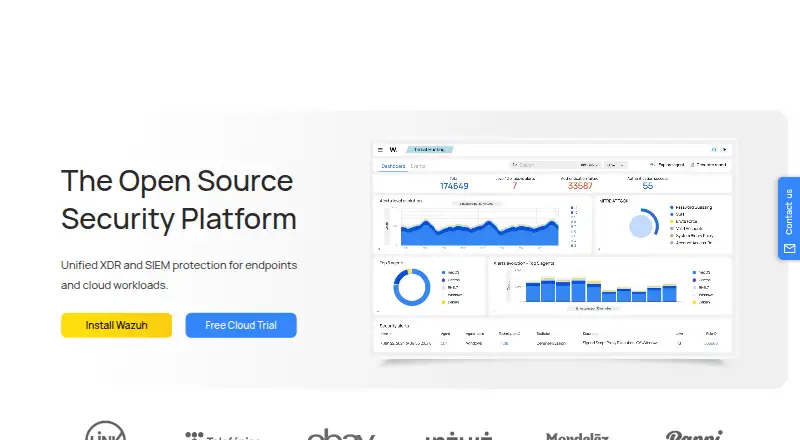
What Wazuh is
Wazuh combines XDR and SIEM to analyze security data from endpoints, clouds, and networks for threat detection, incident response, and compliance work. Its rules can flag errors, misconfigurations, malicious activity, and policy violations in operating system and application logs. File Integrity Monitoring tracks changes to file content, permissions, ownership, and other attributes. Vulnerability detection compares endpoint software inventories with updated CVE databases, while built-in active responses can take actions such as blocking network access from a threat source. Wazuh can monitor AWS, Microsoft Azure, Google Cloud, Microsoft 365, and GitHub services, virtual machines, and activity. Its integrations guide also covers Elastic Stack, OpenSearch, Splunk, and Amazon Security Lake. Agent software supports Linux, Windows, macOS, Solaris, AIX, and HP-UX, and requires an average of 35 MB of RAM. Compliance mappings support several standards but do not themselves certify compliance.
Good
- Free, self-hosted open-source plan.
- Tracks file content, ownership, permissions, and attribute changes.
- Vulnerability checks use updated CVE databases.
- Active responses can block access from a threat source.
- Monitors major cloud services and Microsoft 365.
Watch out
- Compliance mappings do not certify compliance.
- Agent software requires an average of 35 MB of RAM.
Who it suits
Wazuh may suit organizations and individuals seeking security monitoring across endpoints, cloud services, and networks. It offers a self-hosted free option as well as paid Cloud plans.
Verdict
Wazuh brings monitoring, vulnerability detection, and response capabilities together, with a free self-hosted plan and paid options. Its compliance mappings can assist compliance work but are not certification.
Plans and prices
From Wazuh's own pricing page, checked 30 Sep 2026.
| Plan | Price | What it gives you |
|---|---|---|
| Wazuh open source | Free | Free and open source · self-hosted |
| Small | $571 a month | Up to 100 active agents · 1 month indexed-data retention · 3 months archive retention · Standard support · Starting at $571/month |
| Medium | $923 a month | Up to 250 active agents · 3 months indexed-data retention · 1 year archive retention · Standard support · Starting at $923/month |
| Large | $1,467 a month | Up to 500 active agents · 3 months indexed-data retention · 1 year archive retention · Standard support · Starting at $1467/month |
| Custom | Priced on request | Custom agents, retention, support and settings |
The facts
Each one read from Wazuh's own pages, with the date it was checked.
Where it runs
- Agent platforms
- Official agent packages cover Windows XP or later, Intel and Apple-silicon macOS, Solaris, AIX and HP-UX, in addition to Linux/Unix agents.checked 15 Oct 2026
What it does
- Agent requirements
- The Wazuh agent supports Linux, Windows, macOS, Solaris, AIX, and HP-UX and requires an average of 35 MB of RAM.checked 30 Sep 2026
- API authentication
- API calls use HTTP Basic authentication to obtain a JWT bearer token, with a default token lifetime of 900 seconds.checked 15 Oct 2026
- API examples
- Official examples show cURL, Python and PowerShell clients, and the documentation points to OpenAPI specifications.checked 15 Oct 2026
- Architecture
- The platform combines a multi-platform endpoint agent with Wazuh server, indexer and dashboard components.checked 15 Oct 2026
- Central requirements
- Central components require a 64-bit Intel, AMD or ARM Linux processor; documented operating systems include Amazon Linux, CentOS Stream, RHEL and Ubuntu releases.checked 15 Oct 2026
- Cloud integrations
- Wazuh can monitor AWS, Microsoft Azure, Google Cloud, Microsoft 365, and GitHub services, virtual machines, and activity.checked 30 Sep 2026
- Cloud security
- Wazuh Cloud says it is compliant with PCI DSS and SOC 2 and independently audited to meet those standards.checked 30 Sep 2026
- Cloud service
- Wazuh Cloud environments are updated to the latest Wazuh version without manual maintenance or upgrades by the customer.checked 30 Sep 2026
- Compliance support
- Default rulesets support PCI DSS, HIPAA, NIST 800-53, TSC, and GDPR mappings, but Wazuh states these mappings do not by themselves certify compliance.checked 30 Sep 2026
- Configuration assessment
- Agents periodically scan operating-system and application settings for policy, standard and hardening-guide gaps.checked 15 Oct 2026
- Documentation depth
- The documentation includes quickstarts, installation, API reference, deployment guides, capability manuals, compliance use cases, integrations and release notes.checked 15 Oct 2026
- Enrollment networking
- Agent enrollment requires outbound manager connectivity, with configurable ports 1514/TCP for communications, 1515/TCP for configuration enrollment and 55000/TCP for API enrollment.checked 15 Oct 2026
- External integrations
- The Integrator module supports Slack, PagerDuty, VirusTotal, Shuffle, Maltiverse and custom integrations through webhooks, API keys and JSON alerts.checked 15 Oct 2026
- File integrity
- File Integrity Monitoring tracks file content, permissions, ownership, and attribute changes.checked 30 Sep 2026
- File integrity monitoring
- Its FIM module tracks file and directory creation, modification and deletion using checksums and attributes, with real-time or scheduled scans.checked 15 Oct 2026
- Incident response
- Built-in active responses can take countermeasures such as blocking network access from a threat source.checked 30 Sep 2026
- Intended users
- Wazuh says its platform is used by organizations ranging from small businesses to large enterprises, as well as individuals.checked 30 Sep 2026
- Latest documented release
- Release 4.13.0 dated 18 September 2025 added an IT Hygiene dashboard, global IT Hygiene queries, reliability improvements and multiple manager/API enhancements.checked 15 Oct 2026
- License
- Wazuh components are distributed under GNU GPL version 2 and Apache License 2.0, with the main repository code under GPLv2.checked 15 Oct 2026
The company
- Company facts
- LinkedIn lists Wazuh as privately held, founded in 2015, headquartered in Campbell, California, with 201–500 employees.checked 15 Oct 2026
- Company scale
- Wazuh says its team has more than 200 professionals, with over 30 million downloads per year and more than 15 million protected endpoints.checked 15 Oct 2026
- Founded
- 2015checked 28 Sep 2026
- Headquarters
- Campbell, California, United Stateschecked 28 Sep 2026
The full review of Wazuh
Wazuh suits individuals and organizations that want a broad security monitoring platform and can either run it themselves or pay for a managed cloud environment. Its appeal is the range of detection, vulnerability, file-integrity, and response capabilities in one platform; the trade-off is self-hosting work on the free plan and agent and retention limits on paid tiers.
Overview
Wazuh brings XDR and SIEM together to analyze security data across endpoints, clouds, and networks. It is a practical fit for teams seeking a shared platform for threat detection, incident response, and compliance support rather than a tool focused on just one of those jobs. Its compliance mappings can help organize work against recognized standards, but they do not certify compliance.
Key features
Detection and response
Rules examine operating-system and application logs for errors, misconfigurations, malicious activity, and policy violations. Active responses can take countermeasures such as blocking network access from a threat source, giving teams a way to act on detections within the platform. Routing, enrichment, and suppression rules support alert handling, but the lack of alert deduplication is a drawback where repeated alerts need consolidating.
Endpoint and cloud coverage
File Integrity Monitoring tracks changes to file contents, permissions, ownership, and other attributes, which helps teams monitor sensitive files for unexpected changes. Vulnerability detection compares endpoint software inventory with updated CVE databases to identify known vulnerable software. Agents support Linux, Windows, macOS, Solaris, AIX, and HP-UX and require an average of 35 MB of RAM, a modest stated memory requirement for endpoint monitoring.
Cloud integrations cover AWS, Microsoft Azure, Google Cloud, Microsoft 365, and GitHub services, virtual machines, and activity. The integrations guide also covers Elastic Stack, OpenSearch, Splunk, and Amazon Security Lake, making Wazuh relevant to organizations with existing tools in those ecosystems.
Compliance and managed service
Default rulesets support PCI DSS, HIPAA, NIST 800-53, TSC, and GDPR mappings. These can assist compliance work, but a mapping is not certification. Wazuh Cloud says its service is PCI DSS- and SOC 2-compliant and independently audited to meet those standards. Cloud environments are updated to the latest Wazuh version without customers handling manual maintenance or upgrades; support services and professional hours are also offered for Cloud environments, alongside free community support.
Pricing
The self-hosted open-source plan costs nothing. It avoids a subscription charge, but puts operation of the environment on the customer. Paid Wazuh Cloud plans start at $571/month and include standard support; their agent caps and retention periods make capacity and data history the key trade-offs.
| Plan | Price | Included limits |
|---|---|---|
| Open source | free | Free and open source; self-hosted |
| Small | Starting at $571/month | Up to 100 active agents; 1 month indexed data retention; 3 months archive data retention; standard support |
| Medium | Starting at $923/month | Up to 250 active agents; 3 months indexed data retention; 1 year archive data retention; standard support |
| Large | Starting at $1467/month | Up to 500 active agents; 3 months indexed data retention; 1 year archive data retention; standard support |
| Custom | Custom pricing | Customized settings and service |
Small is the entry point for Cloud customers with no more than 100 active agents who can work with a month of indexed history. Medium raises capacity to 250 and extends indexed retention to three months and archive retention to a year. Large keeps those retention periods but doubles the agent allowance to 500, so its higher starting price primarily buys more capacity. A 14-day trial is offered. Wazuh's paid plans are best judged against both the agent cap and the indexed-versus-archive retention distinction, not just the monthly price.
Platforms
Wazuh is available across API, Linux, macOS, self-hosted, web, and Windows. Its agent also supports Solaris, AIX, and HP-UX, extending endpoint coverage beyond the main platform list.
Who it's for
Wazuh can suit individuals, small businesses, and large enterprises, but the right deployment depends on appetite for operations. The open-source edition is the stronger fit for people able to self-host and maintain a security stack. Cloud is better for organizations that prefer Wazuh-managed updates and want support services, provided the paid agent limits and retention tiers fit their needs. It is less compelling for a team that requires alert deduplication or wants a free managed service.
Pros and cons
- Broad monitoring in one platform: combines XDR and SIEM with log-based detection, vulnerability identification, file-integrity monitoring, and response actions.
- Wide endpoint and cloud reach: agents cover several operating systems, while integrations span major cloud services and several security data platforms.
- Useful compliance mappings, with a clear boundary: default rulesets cover several named standards, but do not themselves certify compliance.
- Free self-hosted option: open-source access avoids a plan fee, though the customer must run the environment.
- Paid plans cap agents and retention: Small is limited to 100 active agents and one month indexed retention; larger tiers cost more to raise capacity and, for Medium, indexed retention.
- No alert deduplication: teams needing duplicate alerts consolidated will need to account for that gap.
Alternatives
Vigil is worth considering for a free, self-hosted option with unlimited events, Sigma detection rules, and threat hunting. Elastic Security is another freemium security analytics option if its platform and plan fit your requirements. nano SIEM may suit readers seeking an AGPL-3.0 open-source engine that can be self-hosted without an account or bill. Sumo Logic offers a free plan with 20 daily credits for logs, metrics, and traces, seven-day log retention, and up to three users.
CrowdStrike Falcon Surface is a paid alternative with a free trial. ManageEngine Log360 is a paid option with a free trial. Rapid7 Surface Command is a paid alternative with a free trial. UTMStack is a freemium-category alternative with a free trial.
Readers comparing category choices can browse SIEM Software, Alert Management Software, Intrusion Detection and Prevention Software, and File Integrity Monitoring Software.
Verdict
Choose Wazuh if you want broad security monitoring, vulnerability detection, file-integrity coverage, and response capabilities, and can either operate the open-source self-hosted edition or justify a Cloud tier. Its strongest reason to choose is breadth with a free self-hosted route; its clearest reasons to look elsewhere are the paid tiers' agent and retention limits and the absence of alert deduplication.
Getting started
- Visit https://wazuh.com/.
- Choose the free, open-source self-hosted plan or review the paid Cloud plans.
- Use the 14-day trial to evaluate a paid plan.
- Deploy agents on supported Linux, Windows, macOS, Solaris, AIX, or HP-UX systems.
Limits worth knowing
The free plan is self-hosted. The Small plan costs $571 a month and allows up to 100 active agents, one month of indexed data retention, and three months of archive retention.
Questions
Is Wazuh free?
Yes. Its open-source self-hosted plan costs nothing.
Is there a free trial?
Yes, a 14-day trial is listed.
Which platforms does Wazuh support?
The platform is listed for API, Linux, macOS, self-hosted, web, and Windows. Its agent also supports Solaris, AIX, and HP-UX.
Is Wazuh open source?
Yes. The free plan is described as free and open source, and self-hosted.
Which compliance frameworks are mapped?
Default rulesets support mappings for PCI DSS, HIPAA, NIST 800-53, TSC, and GDPR. These mappings do not by themselves certify compliance.
Alternatives to Wazuh
- 1

Comodo Advanced Endpoint Protection
Free planAndroidiOSWebAPI8.2From $18 a year - 2

FortiClient
Free planAndroidiOSLinuxmacOS7.8Free plan - 3

CrowdStrike Falcon for Mobile
AndroidiOSWebAPI7.7 - 4
Microsoft Defender for Business
AndroidiOSAPImacOS7.5 - 5

LimaCharlie
Free planWebAPILinuxmacOS7.2$3 usage-based - 6

Elastic Security
Free planWebAPILinuxSelf-hosted7.1From $0.09 a month