Vigil
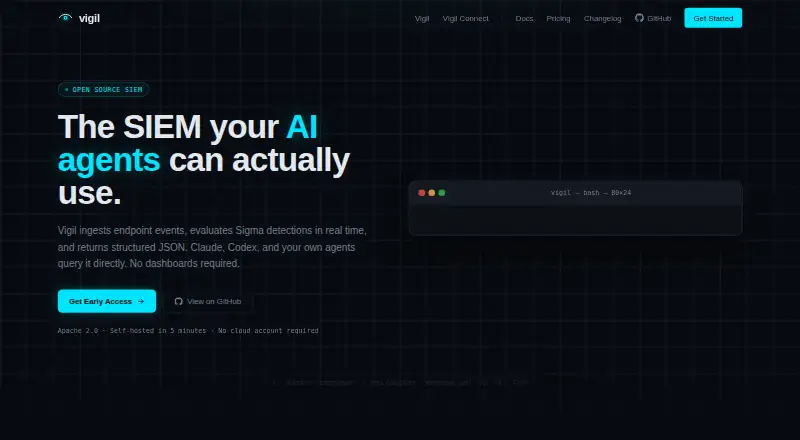
Vigil is a self-hosted, open-source system that ingests endpoint events, evaluates Sigma detections in real time, and returns structured JSON for AI agents.
What Vigil is
Vigil is a self-hosted, open-source system that ingests endpoint events, evaluates Sigma detections in real time, and returns structured JSON for AI agents. It runs without a cloud account and is released under the Apache 2.0 license. Its detection library contains 41 Sigma rules across 10 MITRE ATT&CK tactics. HQL can search event history with aggregations, timelines, endpoint filters, time ranges, and field values. A single binary collects Windows Event Logs or Linux journald and sends batches every five seconds; onboarding uses short-lived enrollment tokens. Vigil Connect supports Wazuh and Elastic, while Splunk and Microsoft Sentinel are listed as coming soon. For destructive actions, the CLI blocks and polls until a person approves. The Claude Code integration is deployed with npx @vigil/skill and does not require an MCP server or running process. The free Open Source plan lists unlimited events, multi-endpoint support, forensic collection, and JSON output. Cloud is listed as coming soon; Enterprise details require contacting the provider.
Good
- Self-hosted and requires no cloud account.
- Apache 2.0 licensed and open source.
- Includes 41 Sigma rules across 10 tactics.
- HQL searches full event history.
- Destructive actions require human approval.
Watch out
- Splunk and Microsoft Sentinel are listed as coming soon.
- Cloud is listed as coming soon.
- Enterprise pricing requires contacting the provider.
Who it suits
Vigil is aimed at teams that want self-hosted endpoint event detection and structured output for AI agents. It may suit users who need HQL event hunting and explicit human approval for destructive actions.
Verdict
Vigil provides self-hosted event collection, Sigma detections, and HQL hunting under a free open-source plan. Its listed current SIEM integrations are Wazuh and Elastic; two others are still marked as coming soon.
Plans and prices
From Vigil's own pricing page, checked 15 Oct 2026.
| Plan | Price | What it gives you |
|---|---|---|
| Open Source | Free | Unlimited events · Sigma rules · HQL hunting · Multi-endpoint · Windows/Linux agents · Forensics · JSON output · Forever |
| Cloud | Priced on request | Managed ClickHouse/Postgres · Automatic updates · 99.9% uptime SLA · Web dashboard · Email/Slack alerts · API keys · SSO/SAML · Dedicated infrastructure · Coming soon |
| Enterprise | Priced on request | Dedicated infrastructure · SSO/SAML · Custom SLA · On-premise deployment · Custom detections · Dedicated Slack channel · SOC 2 report · Custom integrations · Annual invoicing |
The facts
Each one read from Vigil's own pages, with the date it was checked.
What it does
- Agent collection
- The single binary collects Windows Event Logs or Linux journald and ships batches every five seconds.checked 2 Oct 2026
- AI-agent interface
- Every command can return JSON, and named playbooks cover triage, investigation, hunting, and forensic sweeps.checked 15 Oct 2026
- Backend technology
- The public repository describes a Python FastAPI backend, a TypeScript agent layer, React frontend, PostgreSQL, Redis, and ClickHouse-related services.checked 15 Oct 2026
- Built-in rules
- The homepage says Vigil ships 41 Sigma rules covering 10 MITRE ATT&CK tactics.checked 15 Oct 2026
- Claude Code
- The Claude Code integration is deployed with npx @vigil/skill and requires no MCP server or running process.checked 2 Oct 2026
- Deployment
- Vigil is self-hosted, open source, deployable in five minutes, and requires no cloud account.checked 2 Oct 2026
- Deployment model
- The product is presented as self-hosted, open source, and usable without a cloud account.checked 15 Oct 2026
- Desktop support
- The desktop build produces a macOS DMG or Linux AppImage, but Docker must be installed and running.checked 15 Oct 2026
- Detection latency
- The homepage advertises detection latency below 50 milliseconds.checked 15 Oct 2026
- Detection library
- Vigil ships with 41 Sigma rules across 10 MITRE ATT&CK tactics.checked 2 Oct 2026
- Endpoint collection
- The agent collects Windows Event Logs or Linux journald and sends batches every five seconds.checked 15 Oct 2026
- Event hunting
- HQL can query full event history with aggregations, timelines, endpoint filters, time ranges, and field values.checked 2 Oct 2026
- Event ingestion
- Events can be pushed from any source over HTTP, while the agent runs as a single static binary on Windows and Linux.checked 15 Oct 2026
- Independent feature report
- The Devpost project reports an AI voice agent using ElevenLabs, an AI chatbot, and Mailgun email notifications.checked 15 Oct 2026
- Independent implementation details
- The Devpost project used Next.js, Python FastAPI, SQLite, a middleware proxy, and Localtunnel for log delivery.checked 15 Oct 2026
- Independent limitation report
- The Devpost team listed additional themes and customizable dashboards as future quality-of-life work.checked 15 Oct 2026
- Independent project description
- A Devpost project named Vigil SIEM describes a local dashboard that parses logs from deployed websites.checked 15 Oct 2026
- Integrations
- The integration catalogue spans SIEM/log search, EDR/XDR, AWS/Azure/GCP, identity, threat intelligence, sandboxes, ticketing, chat, paging, network security, and data pipelines.checked 15 Oct 2026
- License
- The repository and pricing page identify the software as Apache License 2.0.checked 15 Oct 2026
- LLM providers
- The documented stack supports Anthropic, OpenAI, Google Vertex, and local Ollama models.checked 15 Oct 2026
Where it runs
- Human approval
- Destructive actions are blocked until a human explicitly approves them through the CLI or web interface.checked 15 Oct 2026
The company
- Maker founding year
- LinkedIn lists DeepTempo as founded in 2023.checked 15 Oct 2026
- Maker size
- LinkedIn lists DeepTempo at 11–50 employees.checked 15 Oct 2026
- Maker sponsorship
- LinkedIn identifies DeepTempo as the sponsor of Vigil and describes DeepTempo as a privately held computer and network security company.checked 15 Oct 2026
The full review of Vigil
Vigil is an open-source security event platform for teams that want to collect endpoint data and build detection or AI-agent workflows on infrastructure they control. It suits developers and security teams comfortable operating a self-hosted service. Its strongest case is a free, capable core; its main compromise is that the managed Cloud plan is not yet available.
Overview
Vigil ingests Windows Event Logs or Linux journald, evaluates Sigma detections in real time, and returns structured JSON for AI agents. Its single-binary collector sends event batches every five seconds, while short-lived enrollment tokens support secure agent onboarding. Self-hosting without a cloud account gives operators control over deployment, but also leaves them responsible for running the service.
The Apache 2.0 open-source release includes 41 Sigma rules spanning 10 MITRE ATT&CK tactics. That is a useful starting point rather than a complete detection program; custom rules let teams adapt coverage to their own environments.
Key features
Hunting and response controls
HQL searches full event history using aggregations, timelines, endpoint filters, time ranges, and field values. That gives analysts tools to investigate beyond an initial alert, though it favors users willing to work in a query language. Vigil returns structured JSON for AI agents, and destructive actions require explicit human approval: the CLI blocks and polls until a person responds. That safeguard is valuable where automated workflows must not take consequential action unchecked.
Integrations and collection
Vigil Connect currently supports Wazuh and Elastic. It extracts only the alert ID, severity, source SIEM, and untouched raw alert JSON, keeping the integration focused rather than enriching or reshaping alerts. Splunk and Microsoft Sentinel support are coming soon. The Claude Code integration is deployed with npx @vigil/skill and needs neither an MCP server nor a running process, making it a focused option for that workflow.
Pricing
Open Source — free
The free plan includes unlimited events on ClickHouse, Sigma rules, HQL threat hunting, multiple endpoints, Windows and Linux agents, forensic collection, and JSON output for AI agents. There is no event quota to constrain a growing deployment, but self-hosting means the operator takes on the service’s day-to-day upkeep.
Cloud and Enterprise
Cloud is billed as Coming soon, with managed ClickHouse and Postgres, automatic updates, a web dashboard, email and Slack alerts, API key management, SSO / SAML, dedicated infrastructure, and a 99.9% uptime SLA. It is the intended fit for teams that want managed operations, but it cannot serve as an available alternative today.
Enterprise uses custom pricing and adds dedicated infrastructure, SSO / SAML, custom SLAs, on-premise deployment, custom detection development, a dedicated Slack channel, annual invoicing, a SOC 2 report, and custom integrations. Those support and deployment options suit organizations with specific security or service requirements; the plan’s cost is not a fixed published price.
Platforms
Vigil supports API, Linux, macOS, self-hosted, web, and Windows. Its described endpoint collection specifically covers Windows Event Logs and Linux journald, so the broader platform list should not be read as a claim that every platform has the same agent coverage.
Who it's for
Vigil is a strong match for security teams and developers who want an open-source, self-hosted event pipeline with Sigma detection, historical hunting, and structured output for AI workflows. It is less suited to teams that need a managed service immediately, broad integrations beyond Wazuh and Elastic, or a solution that does not require operating infrastructure.
Pros and cons
- Pros: The free plan has unlimited events, multiple endpoints, forensic collection, and AI-ready JSON, avoiding a usage cap for self-hosted teams.
- Pros: HQL covers full-history searches with timelines and aggregations, while human approval gates destructive actions in CLI workflows.
- Pros: Apache 2.0 licensing and deployment without a cloud account give operators control over hosting.
- Cons: Self-hosting puts service operation on the team; the managed Cloud plan is still coming soon.
- Cons: Vigil Connect currently supports only Wazuh and Elastic, limiting teams that depend on other SIEM integrations.
- Cons: The included 41 rules across 10 tactics are a starting library, so teams may need custom detections for their own coverage.
Alternatives
For a wider SIEM shortlist, browse SIEM Software. Choose Wazuh instead if you want a freemium, free and open-source self-hosted option with a paid Small plan starting at $571 a month. Elastic Security is another freemium alternative with a free plan and a Security Analytics Essentials tier priced at $0.09 per m.
nano SIEM is worth considering for a self-hosted, account-free open-source engine under AGPL-3.0; its Hobby plan is $26 a month. Sumo Logic suits readers seeking a web-based option whose Free plan has 20 daily credits, seven-day log retention, and up to three users.
CrowdStrike Falcon Surface is a paid alternative with a free trial. ManageEngine Log360 is a paid option with a free trial. Rapid7 Surface Command is a paid option with a free trial. UTMStack is a freemium alternative with a free trial and a listed advanced plan for an average of 300 devices and 750 GB of hot storage.
Verdict
Choose Vigil if you want a free, self-hosted foundation for endpoint event collection, Sigma detection, HQL hunting, and AI-assisted workflows with a human gate on destructive actions. Look elsewhere if managed hosting or integrations beyond Wazuh and Elastic are essential now.
Getting started
- Visit the Vigil website.
- Choose the Open Source plan and deploy Vigil as a self-hosted system.
- Use the single binary to collect Windows Event Logs or Linux journald.
- Onboard agents with short-lived enrollment tokens.
- Use HQL to hunt event history, or deploy the Claude Code integration with npx @vigil/skill.
Questions
Is Vigil free?
Yes. The Open Source plan is free and lists unlimited events, Sigma detection rules, HQL hunting, multi-endpoint support, Windows and Linux agents, forensic collection, and JSON output.
Is Vigil open source?
Yes. Vigil is released under the Apache 2.0 license.
Where can Vigil run?
Vigil is self-hosted and is listed for Linux, macOS, Windows, web, and API use. It requires no cloud account.
Which SIEM integrations are available?
Vigil Connect supports Wazuh and Elastic now. Splunk and Microsoft Sentinel integrations are listed as coming soon.
Does Vigil offer managed Cloud or Enterprise plans?
Cloud is listed as coming soon. Enterprise is available by contacting the provider; listed features include dedicated infrastructure, custom integrations, and a SOC 2 report.
Alternatives to Vigil
- 1
Wazuh
Free planOpen sourceWebAPILinuxmacOS8.4From $571 a month - 2

Blumira
Free planAndroidiOSWebAPI8.2Free plan - 3

UTMStack
Open sourceWebAPILinuxmacOS7.9From $238.80 a month - 4

Sumo Logic
Free planWebAPILinuxmacOS7.6Free plan - 5
Microsoft Defender for Business
AndroidiOSAPImacOS7.5 - 6

Elastic Security
Free planWebAPILinuxSelf-hosted7.1From $0.09 a month