
nano SIEM
nano SIEM is an AI-powered security information and event management product for security teams handling detection, alerting, investigation, and response.
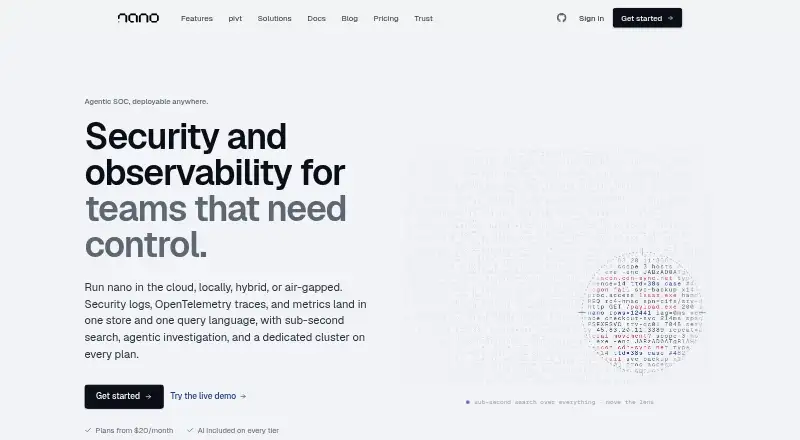
What nano SIEM is
nano SIEM is an AI-powered security information and event management product for security teams handling detection, alerting, investigation, and response. It stores security logs, OpenTelemetry traces, and metrics together and uses the nPL query language. The maker says it can run queries in under a second across billions of events using ClickHouse. Its pivt assistant can generate parsers, queries, detection rules, and investigation summaries from natural-language requests. Detection rules support MITRE ATT&CK mapping, entity risk scoring, and tracking rare or first-seen indicators. Ingestion options include HTTP, Syslog, HEC, and Vector, with parsers for products including Palo Alto, CrowdStrike, Okta, AWS CloudTrail, Microsoft Defender, and Zeek. Deployment options include managed service and BYOC; Enterprise lists cloud, on-premises, or air-gapped deployment. The engine is open source under AGPL-3.0 and can be self-hosted without an account or bill. Hobby includes 2 GB/day of ingest, 10 data sources, 300 AI requests per month, and three team members.
Good
- Stores logs, traces, and metrics in one place.
- Uses one query language, nPL.
- pivt generates queries and detection rules from natural language.
- Detection rules support MITRE ATT&CK mapping.
- Engine can be self-hosted without an account or bill.
Watch out
- Hobby includes 2 GB/day of ingest.
- Hobby is limited to 10 data sources.
- Hobby includes 300 AI requests per month.
- Hobby allows three team members.
Who it suits
nano SIEM is for security teams that need log analytics alongside detection and investigation tools. Its self-hosted engine may also suit teams seeking an open-source deployment option.
Verdict
nano SIEM combines security data in one store with search, detection, and investigation functions. The Hobby plan has ingest, source, AI request, and team limits; paid plans are listed from $29/mo.
Plans and prices
From nano SIEM's own pricing page, checked 29 Sep 2026.
| Plan | Price | What it gives you |
|---|---|---|
| Hobby | $26 a month | 2 GB/day · 365+ days retention · 10 data sources · 300 AI requests/mo · 3 team members · $204/yr · save $24; annual pricing shown |
| Startup | $116 a month | 5 GB/day · 365+ days retention · 20 data sources · 1k AI requests/mo · 8 team members · $1,392/yr · save $156; annual pricing shown |
| Growth | $269 a month | 10 GB/day · 365+ days retention · 30 data sources · 2.5k AI requests/mo · 12 team members · $3,228/yr · save $360; annual pricing shown |
| Team | $539 a month | 25 GB/day · 365 days retention · unlimited data sources · 5k AI requests/mo · high availability · 15 team members · $6,468/yr · save $720; annual pricing shown |
| Business | $1,440 a month | 50 GB/day · 365 days retention · unlimited data sources and team members · 15k AI requests/mo · SSO/SAML · priority support · $17,280/yr · save $1,920; annual pricing shown |
| Pro | $4,410 a month | 100 GB/day · 365 days retention · unlimited data sources and team members · 40k AI requests/mo · high availability · SSO/SAML · priority support · $52,920/yr · save $5,880; annual pricing shown |
| Enterprise | Priced on request | 200 TB+/day · unlimited retention, sources and seats · SSO/SAML and audit logs · cloud, on-prem or air-gapped · dedicated support and SLA · Custom |
The facts
Each one read from nano SIEM's own pages, with the date it was checked.
What it does
- AI assistant
- pivt can generate parsers, queries, detection rules, and investigation summaries from natural language.checked 29 Sep 2026
- Compliance
- The trust page labels GDPR active and SOC 2 Type II planned, stating the SOC 2 audit is in progress.checked 29 Sep 2026
- Deployment
- nano offers managed service and BYOC deployment, and the Enterprise plan lists cloud, on-prem, or air-gapped deployment.checked 29 Sep 2026
- Desktop availability
- pivt desktop offers native signed installers for macOS and Windows and requires a nano instance plus a locally installed coding agent.checked 29 Sep 2026
- Detection
- Detection rules support MITRE ATT&CK mapping, entity risk scoring, and prevalence tracking for rare or first-seen indicators.checked 29 Sep 2026
- Integrations
- The docs list HTTP, Syslog, HEC, and native Vector protocol for ingestion; the feature page highlights parsers for Palo Alto, CrowdStrike, Okta, AWS CloudTrail, Microsoft Defender, and Zeek.checked 29 Sep 2026
- Notable limits
- The Hobby plan includes 2 GB/day ingest, 10 data sources, 300 pivt AI requests per month, and 3 team members.checked 29 Sep 2026
- Open source
- The nano engine is open source under AGPL-3.0 and can be self-hosted without an account or bill.checked 29 Sep 2026
- Product
- nano describes itself as an AI-powered SIEM for security teams that need fast log analytics and covers detection, alerting, investigation, and response.checked 29 Sep 2026
- Search
- The maker says nano supports sub-second queries across billions of events using ClickHouse.checked 29 Sep 2026
- Security
- The trust page says connections use TLS 1.2+ and sensitive data is encrypted at rest using AES-256-GCM.checked 29 Sep 2026
- Support
- Pricing lists community support for Hobby, email support for Startup through Team, priority support for Business and Pro, and dedicated support plus SLA for Enterprise.checked 29 Sep 2026
- Unified data
- It stores security logs, OpenTelemetry traces, and metrics in one store with one query language.checked 29 Sep 2026
The company
- Headquarters
- Danbury, Connecticut, United Stateschecked 28 Sep 2026
The full review of nano SIEM
Overview
nano SIEM is a security analytics platform built around a shared store for logs, traces, and metrics. It will suit teams that want to bring investigation and detection into the same workflow, especially those comfortable with open-source software or choosing a managed deployment. Its breadth is appealing, but the hosted plans impose clear ingest, source, AI-request, and seat ceilings.
Key features
nano stores security logs, OpenTelemetry traces, and metrics together and queries them with nano Pipe Language (nPL). That unified approach can simplify investigations across different telemetry types. The maker says ClickHouse enables sub-second searches across billions of events; search performance is central to the pitch, though the claim does not remove the need to assess fit for a particular workload.
Custom detection rules support MITRE ATT&CK mapping, entity risk scoring, and prevalence tracking for rare or first-seen indicators, alongside real-time alerting. These capabilities help teams add context to detections rather than relying only on raw event searches.
The pivt assistant can generate parsers, queries, detection rules, and investigation summaries from natural-language requests. This could reduce repetitive setup and analysis work, but its usefulness is bounded by monthly request allowances on paid plans and the Hobby tier.
Ingestion supports HTTP, Syslog, HEC, and native Vector protocol. Highlighted parsers cover Palo Alto, CrowdStrike, Okta, AWS CloudTrail, Microsoft Defender, and Zeek, giving security teams several familiar sources to start from.
The nano engine is open source under AGPL-3.0 and can be self-hosted without an account or bill. Managed service and BYOC are also offered, while Enterprise adds cloud, on-premises, or air-gapped deployment. Connections use TLS 1.2+ and sensitive data is encrypted at rest with AES-256-GCM. GDPR is active; SOC 2 Type II is planned, with the audit in progress.
Pricing
The Hobby plan is $26 a month, billed $204/yr · save $24. It includes 2 GB/day ingest, 365+ days retention, 10 data sources, 300 AI requests per month, and 3 team members. Community support and the low ingest ceiling make it a sensible starting point for a small team evaluating the workflow, but not a generous shared service for larger deployments.
Startup costs $116 a month, billed $1,392/yr · save $156, and raises allowances to 5 GB/day, 20 sources, 1k AI requests, and 8 team members, with 365+ days retention. Growth is $269 a month, billed $3,228/yr · save $360, for 10 GB/day, 30 sources, 2.5k AI requests, and 12 members, also with 365+ days retention. Both include email support; Growth is the more capable step up for teams that outgrow Startup's quotas.
Team is $539 a month, billed $6,468/yr · save $720, and includes 25 GB/day, unlimited sources, 5k AI requests, 15 members, high availability, and 365 days retention. Business costs $1,440 a month, billed $17,280/yr · save $1,920, with 50 GB/day, unlimited sources and members, 15k requests, SSO/SAML, and priority support; retention is 365 days. Pro is $4,410 a month, billed $52,920/yr · save $5,880, for 100 GB/day, unlimited sources and members, 40k requests, high availability, SSO/SAML, and priority support, with 365 days retention. Those upper tiers target organizations whose ingest, access-control, or availability needs justify a steep increase in spend.
Enterprise has custom pricing and includes 200 TB+/day, unlimited retention, sources, and seats, SSO/SAML, audit logs, cloud, on-premises, or air-gapped deployment, plus dedicated support and an SLA. Paid plans from $29/mo is the entry price, while the listed annual plan prices above show the cost and quotas for specific tiers. Self-hosting the open-source engine avoids an account or bill, but the paid plans include differing support and service allowances.
Platforms
nano supports API, Linux, macOS, self-hosted, web, and Windows. pivt desktop has signed native installers for macOS and Windows, but requires a nano instance and a locally installed coding agent, so it is not a standalone desktop SIEM.
Who it's for
nano is a strong fit for security teams seeking one place to search logs, traces, and metrics, with custom detections and natural-language assistance. Its open-source engine also gives teams that can operate their own infrastructure a no-bill self-hosting route. Hobby's 2 GB/day ingest, 10-source, 300-request, and 3-member caps suit a small evaluation or modest team more than a growing security operation; larger teams should weigh the higher tiers against their actual quotas and support requirements.
Pros and cons
- Pros: Shared storage and one query language span logs, traces, and metrics, supporting investigations across telemetry types.
- Pros: Custom rules combine ATT&CK mapping, risk scoring, and prevalence tracking, with real-time alerting.
- Pros: Open-source self-hosting, managed service, and BYOC provide meaningful deployment choice.
- Cons: Hobby caps ingest at 2 GB/day and the team at 3 members, limiting its use beyond small deployments.
- Cons: pivt request quotas rise by tier, so teams relying heavily on AI assistance must account for that constraint.
- Cons: Business and Pro carry substantial annual costs, and Enterprise uses custom pricing.
- Cons: SOC 2 Type II is still planned, with the audit in progress.
Alternatives
SIEM Software is the broader category directory for comparing more products. Choose Wazuh if a free, open-source self-hosted option is the priority; its Small plan starts at $571 a month. Vigil is another free option, with unlimited events, Sigma detection rules, threat hunting, and multi-endpoint support.
Consider Elastic Security for a freemium alternative with a free trial. Seceon Open Threat Management is worth considering when licensing based on devices or users fits better. Sumo Logic offers a free plan with 20 daily credits, seven-day log retention, and up to three users; that can suit a smaller evaluation, though its retention is much shorter than nano's paid tiers.
CrowdStrike Falcon Surface is a paid product with a free trial. Rapid7 Surface Command is another paid option with a free trial. UTMStack is worth comparing for its listed 300-device average and 750 GB hot storage.
Verdict
Choose nano SIEM if your team wants unified telemetry, flexible deployment, and detection and investigation tools in one security platform. Its open-source engine makes self-hosting especially compelling, while the hosted tiers offer a defined path to higher quotas and enterprise controls. Look elsewhere if the Hobby ceilings are too restrictive, the paid tiers exceed your budget, or you need SOC 2 Type II assurance now.
Alternatives to nano SIEM
- 1
Wazuh
Free planOpen sourceWebAPILinuxmacOS8.4From $571 a month - 2

Blumira
Free planAndroidiOSWebAPI8.2Free plan - 3

UTMStack
Open sourceWebAPILinuxmacOS7.9From $238.80 a month - 4

Sumo Logic
Free planWebAPILinuxmacOS7.6Free plan - 5
Microsoft Defender for Business
AndroidiOSAPImacOS7.5 - 6
Vigil
Free planOpen sourceWebAPILinuxmacOS7.5Free plan