
Reteno
Reteno is an AI messaging platform designed to help mobile apps retain users through event-triggered campaigns.
What Reteno is
Reteno is an AI messaging platform designed to help mobile apps retain users through event-triggered campaigns. It supports mobile push, email, in-app messages, App Inbox, web push, SMS, and messengers, alongside automated workflows and customer journeys. Teams can create unlimited segments using contact data and complex conditions. Reteno also describes AI recommendations that predict individual needs and personalize content across channels.
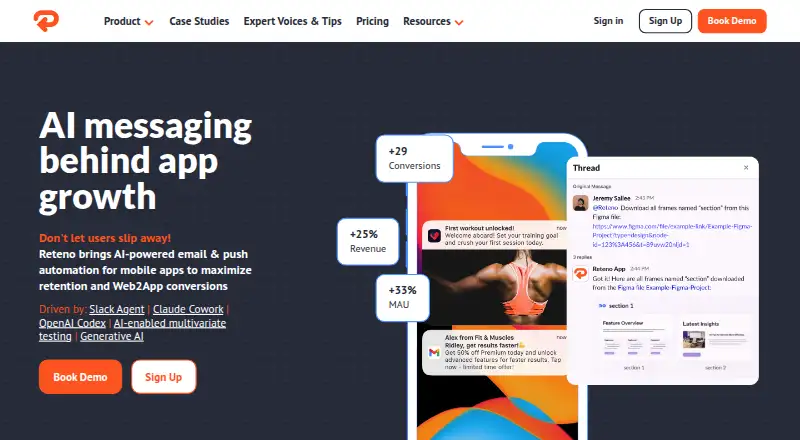
Its AI agents can manage contacts, segments, events, workflows, and reports through Slack, Claude Cowork, or OpenAI Codex. Data integrations include Google Sheets, BigQuery, and HTTP request sources. SDKs are listed for iOS, Android, React Native, Flutter, Unity, Cordova, and Ionic. The free Startup plan includes unlimited mobile pushes, 1,000 sends in each channel per month, and 20,000 workflow launches monthly. Growth costs $30 per month for up to 10,000 user profiles; SMS delivery fees vary by country and provider. Reteno says it supports GDPR compliance through a Data Processing Agreement and Privacy Policy, and recommends Yespo CDP for businesses without a mobile app.
Good
- Supports messaging across seven listed channel types.
- Unlimited segments are available.
- Free plan includes unlimited mobile pushes.
- SDKs are listed for several mobile frameworks.
Watch out
- Free plan allows 1,000 sends per channel monthly.
- SMS delivery may incur additional fees.
- Reteno recommends another product for businesses without an app.
- Enterprise pricing is custom.
Who it suits
Reteno is designed for businesses with mobile applications that want to send event-triggered messages and build automated user journeys. It is not positioned for businesses without an app.
Verdict
Reteno combines multi-channel messaging, behavioral triggers, segmentation, and automated journeys for mobile apps. Check channel limits and variable SMS fees before selecting a plan.
Plans and prices
From Reteno's own pricing page, checked 30 Sep 2026.
| Plan | Price | What it gives you |
|---|---|---|
| Startup | Free | Unlimited mobile pushes · 1,000 sends in each channel per month · 20,000 workflow launches/month · unlimited segments · email and chat support |
| Growth | $30 a month | Unlimited workflows · 8 channels included · dedicated Customer Success manager · SMS delivery fees vary by country and provider · $30/mo; up to 10K user profiles |
| Enterprise | Priced on request | Over 250K user profiles · custom machine learning algorithms · custom retention strategy · Custom |
The facts
Each one read from Reteno's own pages, with the date it was checked.
What it does
- AI tools
- Reteno says its AI agents can manage contacts, segments, events, workflows, and reports through Slack, Claude Cowork, or OpenAI Codex.checked 30 Sep 2026
- Automation
- Reteno supports automated workflows and journeys, including campaigns triggered by user events.checked 30 Sep 2026
- Channels
- The platform supports mobile push, email, in-app messages, App Inbox, web push, SMS, and messengers.checked 30 Sep 2026
- Integrations
- Reteno documentation describes data integrations with Google Sheets, BigQuery, and HTTP request sources.checked 30 Sep 2026
- Intended users
- Reteno says its platform is designed specifically for mobile applications and recommends Yespo CDP for businesses without an app.checked 30 Sep 2026
- Mobile SDKs
- Its app integration guide lists SDKs for iOS, Android, React Native, Flutter, Unity, Cordova, and Ionic.checked 30 Sep 2026
- Personalization
- Its feature page describes AI-based recommendations that predict individual needs and personalize content across channels.checked 30 Sep 2026
- Privacy
- Reteno states that it supports GDPR compliance through a Data Processing Agreement and Privacy Policy.checked 30 Sep 2026
- Product
- Reteno describes itself as an AI messaging platform for mobile app retention that uses event-triggered campaigns.checked 30 Sep 2026
- Security
- Reteno's DPA describes HTTPS encryption, encryption at rest, access controls, and security incident logging and response.checked 30 Sep 2026
- Segmentation
- Reteno says users can create unlimited segments using contact data and complex conditions.checked 30 Sep 2026
- Support
- The Startup plan includes email and chat support, while Growth includes a dedicated Customer Success manager.checked 30 Sep 2026
- Usage limits
- The free Startup plan allows unlimited mobile pushes and 1,000 messages in each channel per month; SMS delivery may incur additional fees.checked 30 Sep 2026
The full review of Reteno
Reteno is an AI messaging platform for mobile apps, aimed at teams that want campaigns to respond to user behavior across several channels. Its appeal is the mix of event-driven journeys, flexible segmentation, and app SDKs; the key trade-offs are tight free-plan send quotas and variable SMS fees.
Overview
Reteno focuses on app retention: user events can trigger automated workflows and journeys, while campaigns can reach people through mobile push, email, in-app messages, App Inbox, web push, SMS, and messengers. That breadth is useful for app teams coordinating messages around app activity rather than managing isolated channel campaigns.
This is an app-first product, not a general-purpose messaging choice for businesses without a mobile application. Reteno recommends Yespo CDP for businesses without an app.
Key features
Journeys and targeting
Behavioral triggers and a visual journey builder let teams organize campaigns around user actions. Unlimited segments based on contact data and complex conditions offer room for detailed audience rules, and A/B testing supports campaign comparison. The free Startup plan still caps workflow launches at 20,000 per month, so unlimited segments should not be mistaken for unlimited campaign activity.
Personalization and AI agents
Reteno describes AI recommendations that predict individual needs and tailor content across channels. Its AI agents can manage contacts, segments, events, workflows, and reports through Slack, Claude Cowork, or OpenAI Codex. These tools broaden the platform's automation scope, though teams should assess whether they want operational tasks handled through those integrations.
Integrations, SDKs, and safeguards
Data integrations include Google Sheets, BigQuery, and HTTP request sources. SDKs cover iOS, Android, React Native, Flutter, Unity, Cordova, and Ionic, giving teams several routes to connect an app to campaigns. Reteno describes HTTPS encryption, encryption at rest, access controls, and security incident logging and response; it also states that it supports GDPR compliance through a Data Processing Agreement and Privacy Policy.
Pricing
Reteno uses a freemium model. The free Startup plan costs nothing and includes unlimited mobile pushes, 1,000 sends in each channel per month, 20,000 workflow launches per month, unlimited segments, and email and chat support. This is a meaningful entry point for smaller app teams, but the per-channel send ceiling can constrain broader outreach, and SMS delivery may incur additional fees.
Growth costs $30 a month, billed $30/mo, and supports up to 10K user profiles. It includes unlimited workflows, 8 channels, and a dedicated Customer Success manager. For teams outgrowing Startup's workflow-launch cap, this removes that stated limit, but SMS fees still vary by country and provider.
Enterprise has custom pricing and is aimed at organizations with over 250K user profiles. It includes custom machine learning algorithms and a custom retention strategy, making it the tier for larger operations that need tailored retention work rather than a published fixed-price package.
Platforms
Reteno is available on Android, iOS, web, and API. Its mobile analytics, behavioral triggers, visual journey builder, A/B testing, and data export support a mobile-marketing workflow beyond sending messages alone.
Who it's for
Reteno is strongest for mobile app teams that want behavior-based messaging across several channels, need detailed audience segmentation, or are integrating through a range of mobile frameworks. It is less suitable for businesses without an app, and teams with high SMS volumes should account for delivery fees alongside subscription pricing.
Pros and cons
- Pro: Broad channel coverage lets app teams coordinate push, email, in-app, web, SMS, and messenger outreach in one platform.
- Pro: Unlimited segments and event-triggered journeys support detailed targeting and behavior-led campaigns.
- Pro: SDK support spans seven mobile frameworks and platforms, including React Native, Flutter, Unity, Cordova, and Ionic.
- Con: Startup limits each channel to 1,000 monthly sends and workflows to 20,000 launches, which may restrict campaigns as engagement grows.
- Con: SMS delivery is an additional variable cost, including on Growth, where fees depend on country and provider.
- Con: Its app-specific focus makes it a poor fit for businesses without a mobile application.
Alternatives
OneSignal is worth considering for teams seeking a freemium option with web, desktop, and mobile platform coverage; its Free plan includes 10,000 email sends per month and 1,000 monthly active contacts.
Pushwoosh may suit teams prioritizing a free tier with 1,000 MAU, 20,000 email sends per month, and unlimited push notifications.
EngageLab is a paid alternative with a free trial and a Marketing Automation plan described around omnichannel coverage, a 360° customer view, and a visual campaign builder.
Pulsate is another paid option for teams comparing mobile marketing platforms.
Airship Experimentation is a paid alternative whose Essentials plan includes self-service, no-code app and web experiences, automation, and real-time orchestration.
Repro offers custom-quote pricing for customers seeking a plan proposed around their service, goals, and challenges.
WebEngage is another paid option for teams comparing app and web marketing software.
Batch may fit teams looking for an enterprise plan with the full feature set, a dedicated account manager, and connectors for other MarTech tools.
For a broader category comparison, see Mobile Marketing Automation Software.
Verdict
Choose Reteno if your team has a mobile app and wants to link user behavior to automated, multi-channel campaigns, with segmentation and SDK coverage to support a range of app stacks. Its free plan makes it possible to start without subscription cost, but capped channel sends and variable SMS charges are meaningful constraints; teams without an app or with larger messaging needs should compare alternatives before committing.
Getting started
- Open the Reteno website.
- Choose the free Startup plan or the 30.00 USD-per-month Growth plan.
- Connect your app with the iOS, Android, or listed cross-platform SDK.
- Add event and data sources such as Google Sheets, BigQuery, or HTTP requests.
- Create segments, workflows, and event-triggered campaigns.
- Select channels such as push, email, in-app, web push, SMS, or messengers.
Limits worth knowing
Startup allows unlimited mobile pushes, 1,000 messages in each channel per month, and 20,000 workflow launches monthly. Growth supports up to 10,000 user profiles; SMS delivery fees vary by country and provider.
Questions
Is there a free plan?
Yes. The Startup plan is free and includes unlimited mobile pushes, 1,000 messages per channel each month, 20,000 workflow launches monthly, unlimited segments, and email and chat support.
How much does Growth cost?
Growth costs $30 a month and supports up to 10,000 user profiles. It includes unlimited workflows, eight channels, and a dedicated Customer Success manager.
Which platforms and SDKs are supported?
Reteno supports Android, iOS, web, and API use. SDKs are listed for iOS, Android, React Native, Flutter, Unity, Cordova, and Ionic.
Which messaging channels are available?
Channels include mobile push, email, in-app messages, App Inbox, web push, SMS, and messengers.
Does Reteno support GDPR and security controls?
Reteno states that GDPR support comes through a Data Processing Agreement and Privacy Policy. Its DPA describes HTTPS encryption, encryption at rest, access controls, and security incident logging and response.
Can it connect to external data sources?
Documentation describes integrations with Google Sheets, BigQuery, and HTTP request sources.