OSNEXUS QuantaStor
OSNEXUS QuantaStor is a software-defined storage platform for file, block and object storage managed in a single grid.
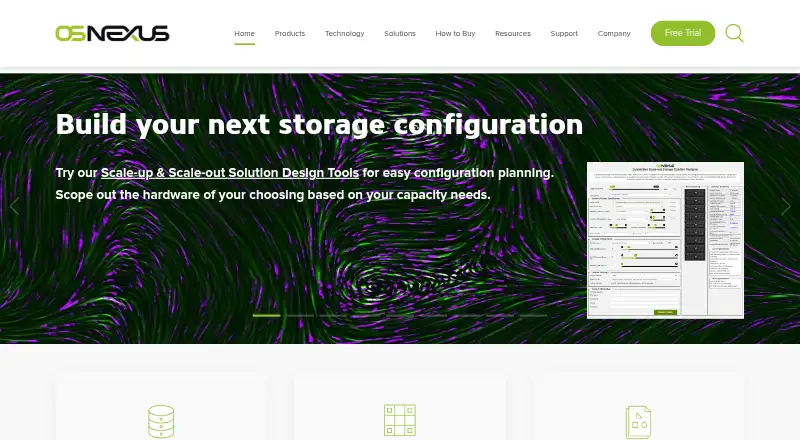
What OSNEXUS QuantaStor is
OSNEXUS QuantaStor is a software-defined storage platform for file, block and object storage managed in a single grid. It uses Ceph and OpenZFS and supports scaling storage up or out. Administrators can use a web management interface and configuration workflow designed for IT generalists, or manage Storage Grid servers through CLI tools and REST APIs. Deployment options include ISO media for bare-metal or virtual-machine installation and a VMware OVA virtual storage appliance. The Cloud Integration SDK supports provisioning, storage-cloud management, auditing and other tasks through RESTful APIs. OSNEXUS describes data protection on the wire and at rest. For Ceph users, listed security capabilities include AES-256 encryption, S3 Object Lock, MFA and RBAC; the Ceph page also lists alerts and hardware monitoring. Community Edition is free for non-commercial, educational and testing use, capped at 80TB raw capacity and four servers per grid. Trial Edition is free for 45 days, with 256TB raw capacity and Enterprise Edition features unlocked. Enterprise Edition pricing is by quote.
Good
- Manages file, block and object storage in one grid
- Supports CLI and REST API automation
- Offers ISO and VMware OVA deployment formats
- Free 45-day trial includes Enterprise Edition features
Watch out
- Community Edition capped at 80TB raw capacity
- Community Edition limited to four servers per grid
- Community Edition is for non-commercial, educational or testing use
- Enterprise Edition pricing requires a quote
Who it suits
QuantaStor suits organizations that need to manage file, block or object storage in a grid, including the listed industries such as healthcare, energy and government. Community Edition is specifically limited to non-commercial, educational and testing use.
Verdict
QuantaStor combines several storage types with grid management and multiple deployment formats. Its free editions have explicit capacity, server or time limits, while Enterprise pricing requires a quote.
Plans and prices
From OSNEXUS QuantaStor's own pricing page, checked 5 Oct 2026.
| Plan | Price | What it gives you |
|---|---|---|
| Community Edition | Free | 80TB raw capacity · maximum 4 servers per storage grid · non-commercial, educational, and testing use |
| Trial Edition | Free | 45 days · 256TB raw capacity · Enterprise Edition features unlocked |
| Enterprise Edition | Priced on request | Request a quote; sold through distributors, managed hosting providers, OEMs, VARs, and system integrators |
The facts
Each one read from OSNEXUS QuantaStor's own pages, with the date it was checked.
What it does
- Alerts and monitoring
- The Ceph page lists real-time alerts through email, Slack, SNMP, and other channels, and hardware monitoring for thermals, power, fans, and disk health.checked 5 Oct 2026
- Automation
- Storage Grid servers can be managed and automated through CLI and REST APIs.checked 5 Oct 2026
- Ceph security features
- The vendor lists AES-256 encryption, S3 Object Lock, MFA, and RBAC among QuantaStor security capabilities for Ceph users.checked 5 Oct 2026
- Deployment formats
- QuantaStor is offered as ISO installation media for bare-metal or virtual-machine installation and as a VMware OVA virtual storage appliance.checked 5 Oct 2026
- Integration SDK
- The Cloud Integration SDK supports automated provisioning, storage cloud management, auditing, and other tasks through RESTful APIs.checked 5 Oct 2026
- Intended users
- OSNexus says QuantaStor serves industries including healthcare, energy, media and entertainment, transportation, higher education, nonprofits, and government.checked 5 Oct 2026
- Management
- Its web management interface and configuration workflow are designed to simplify storage setup for IT generalists.checked 5 Oct 2026
- Security
- OSNexus describes QuantaStor as providing data protection on the wire and at rest for enterprise and cloud storage deployments.checked 5 Oct 2026
- Storage architecture
- It uses Ceph and OpenZFS and can scale up or out while managing storage in a single grid.checked 5 Oct 2026
- Support
- OSNexus lists support contact by phone and email and says it sells QuantaStor through partners including distributors, OEMs, VARs, and system integrators.checked 5 Oct 2026
- Unified storage
- QuantaStor provides scalable file, block, and object storage in a software-defined storage platform.checked 5 Oct 2026
The company
- Company
- OSNexus says it was founded in 2010 and lists its address in Bellevue, Washington.checked 5 Oct 2026
- Founded
- 2010checked 28 Sep 2026
- Headquarters
- Bellevue, Washington, USAchecked 28 Sep 2026
The full review of OSNEXUS QuantaStor
OSNEXUS QuantaStor is software-defined infrastructure for running file, block, and object storage across a managed server grid. It fits organizations with varied workloads and administrators comfortable operating self-hosted systems, while smaller home users may find its enterprise orientation excessive. The strongest case is consolidated storage management and automation; the main caution is strict limits on free editions and custom pricing for commercial use.
Overview
QuantaStor combines Ceph and OpenZFS in a platform that scales up within servers or out across servers while keeping administration in one Storage Grid. That architecture is useful when separate file, block, and object systems would create duplicated processes. It is also a substantial infrastructure commitment: you supply and operate the underlying environment rather than subscribing to a hosted storage service.
The product is positioned for sectors such as healthcare, energy, media and entertainment, transportation, higher education, nonprofits, and government. OSNEXUS was founded in 2010 and is headquartered in Bellevue, Washington.
Key features
- Unified storage: File, block, and object workloads share one software-defined platform. This is a practical advantage for organizations consolidating different application requirements under one operational model.
- Ceph and OpenZFS architecture: The combination supports scale-up and scale-out designs. Storage pools, snapshots, user management, and container support provide core controls for structuring and maintaining deployments.
- Web administration: A web interface and guided configuration workflow are designed for IT generalists, reducing the need to perform every setup task from specialist tooling. It remains infrastructure software, so generalist-friendly workflows do not remove the need for storage expertise.
- Automation interfaces: CLI and REST APIs can manage and automate Storage Grid servers. The Cloud Integration SDK extends REST-based automation to provisioning, storage-cloud management, auditing, and related operational tasks, making it a stronger fit for scripted or integrated environments.
- Deployment choices: ISO media supports bare-metal or virtual-machine installation, while a VMware OVA provides a virtual storage appliance format. Those options suit organizations standardizing on either physical servers or VMware-based infrastructure.
- Security and monitoring: OSNEXUS describes protection for data in transit and at rest. For Ceph users, named capabilities include AES-256 encryption, S3 Object Lock, multi-factor authentication, and role-based access control. Real-time alerts can use email, Slack, SNMP, and other channels, with hardware monitoring for thermals, power, fans, and disk health.
Pricing
| Plan | Price | Terms and limits |
|---|---|---|
| Community Edition | free | 80TB raw capacity, up to four servers per Storage Grid; non-commercial, educational, and testing use |
| Trial Edition | free | 45 days, 256TB raw capacity, Enterprise Edition features unlocked |
| Enterprise Edition | Custom pricing | Request a quote; sold through distributors, managed hosting providers, OEMs, and system integrators |
Community Edition is appropriate for labs, classrooms, evaluation, and other non-commercial deployments, but its 80TB and four-server ceilings rule it out for many production environments and its usage terms prohibit commercial operation. Trial Edition is the better route for a time-boxed proof of concept because it raises capacity to 256TB and unlocks Enterprise features, although access ends after 45 days. Organizations deploying commercially should plan for a quote and partner-led purchasing through Enterprise Edition.
Platforms
QuantaStor supports API, Linux, self-hosted, web, and Windows environments. ISO installation covers bare-metal and virtual machines, and the VMware OVA targets virtual-appliance deployments. The range is useful for mixed infrastructure, but the self-hosted model means hardware, virtualization, and ongoing administration remain your responsibility.
Who it's for
Choose QuantaStor when one team needs file, block, and object storage in a single grid, expects to scale across servers, and values CLI or REST automation. Its web workflow can help IT generalists, while the SDK and monitoring features appeal to teams integrating storage with broader operational systems. It is less suitable for a small personal NAS, a purely hosted-storage buyer, or a commercial organization seeking a published, fixed subscription price.
Pros and cons
Pros
- Broad workload coverage: File, block, and object storage share one management layer.
- Scale-oriented design: Ceph and OpenZFS support both scale-up and scale-out grids.
- Automation depth: CLI, REST APIs, and the Cloud Integration SDK support provisioning and operational integration.
- Flexible deployment: Bare-metal, virtual-machine, and VMware OVA formats cover common self-hosted setups.
- Operational controls: Snapshots, storage pools, user management, alerts, and hardware health monitoring address day-to-day administration.
Cons
- Free commercial use is excluded: Community Edition is restricted to non-commercial, educational, and testing use.
- Free-edition ceilings are material: Community Edition stops at 80TB and four servers, while Trial Edition expires after 45 days.
- Enterprise cost is opaque: Commercial buyers must request a quote and typically purchase through a partner.
- Self-hosted responsibility: You must provide and operate the physical or virtual storage environment.
Alternatives
For a broader directory of storage products, see NAS Software.
- ZimaOS is a freemium option spanning mobile, desktop, web, and self-hosted platforms, with a free plan that includes a Zima Client, Thunderbolt support, and Developer Mode.
- TrueNAS is the better fit if you want free software for any x86 hardware with community support.
- napp-it suits noncommercial home use with its free CS Home plan, three-server limit, no capacity limit, and no support.
- NovaNAS is a free, open-source NAS operating system requiring Debian 13 and specified minimum hardware.
- DPlaneOS is a free AGPLv3 community edition for hardware you own.
- OpenNAS is a free, open-source x86_64 beta installer for self-hosted hardware.
- PetaSAN offers an open-source platform under a self-support model.
- openmediavault is free GNU GPL v3 software for Linux self-hosting.
Verdict
QuantaStor is a strong choice for organizations that need one scalable grid for file, block, and object storage, with serious API automation and multiple deployment formats. Start with Community Edition for noncommercial labs or Trial Edition for a 45-day enterprise-feature evaluation; choose Enterprise Edition for commercial production. Look elsewhere if you need a small, consumer-focused NAS, unlimited free commercial capacity, or transparent subscription pricing.
Alternatives to OSNEXUS QuantaStor
- 1

TrueNAS
Free planOpen sourceAndroidiOSWebAPI7.9Free plan - 2
ZimaOS
Free planAndroidiOSWebAPI7.9$29 one-time - 3

Synology Active Backup for SaaS
Free planSelf-hosted6.7Free plan - 4

KitchenAsty
AndroidiOSWebAPI6.6 - 5
napp-it
Free planWebAPILinuxmacOS6.6Free plan - 6
SoftNAS
WebAPILinuxSelf-hosted6.6From $0.13 a month