
KitchenAsty
KitchenAsty is an open-source platform that restaurants host on their own server or cloud instance for online ordering, kitchen operations, reservations, and…
What KitchenAsty is
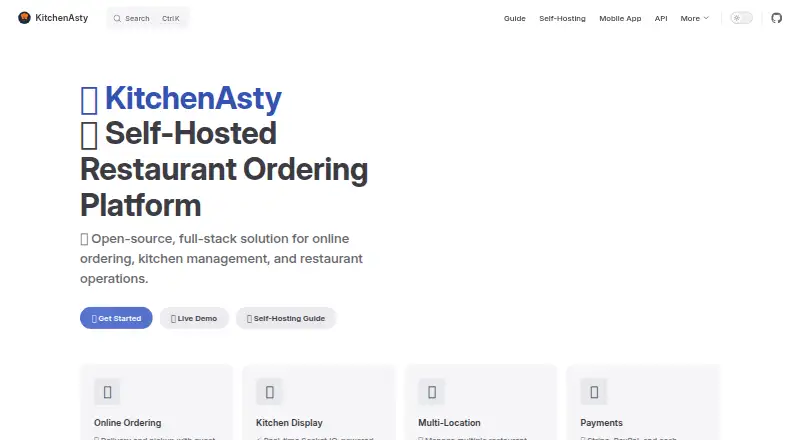
KitchenAsty is an open-source platform that restaurants host on their own server or cloud instance for online ordering, kitchen operations, reservations, and customer engagement. Customers can order delivery or pickup, check out as guests, and schedule orders; staff can track incoming orders on a real-time kitchen board. Multi-location tools support separate menus, hours, delivery zones, and staff, alongside reservations, reviews, loyalty points, coupons, automation, and analytics. Payments include Stripe, PayPal, and cash. A customer-facing app for iOS and Android supports menu browsing, orders, tracking, reservations, and order history. The project uses the MIT License and says it has no monthly SaaS fees. Self-hosting means restaurant operators are responsible for customer data and their privacy policy. The guide recommends 2 GB RAM and 1 vCPU for a single-location restaurant, and 4 GB RAM and 2 vCPU or more for heavy traffic or multiple locations. The software is provided as-is without warranty.
Good
- MIT-licensed, with no monthly SaaS fees.
- Supports delivery, pickup, guest checkout, and scheduling.
- Includes a real-time kitchen order board.
- Offers Stripe, PayPal, and cash payments.
- Customer app supports iOS and Android.
Watch out
- Restaurants manage hosting and customer-data privacy.
- Software is provided without warranty.
- API limit is 100 requests per 15-minute window per IP.
Who it suits
KitchenAsty suits restaurants prepared to host and manage their own ordering platform, especially those needing delivery or pickup orders and multi-location operations.
Verdict
KitchenAsty combines customer ordering with kitchen and restaurant operations, without monthly SaaS fees. Its self-hosted model puts deployment and customer-data responsibilities on the restaurant.
The facts
Each one read from KitchenAsty's own pages, with the date it was checked.
What it does
- API
- KitchenAsty exposes a RESTful JSON API with JWT authentication for protected endpoints.checked 5 Oct 2026
- Automation and analytics
- Event-driven rules can send email, webhook, and SMS notifications, and analytics cover revenue, orders, and customers.checked 5 Oct 2026
- Delivery orders
- Yeschecked 22 Sep 2026
- Deployment and security
- The self-hosting guide describes HTTPS with free Let's Encrypt certificates, database backups, firewall rules, and automatic container restarts.checked 4 Oct 2026
- Hosting and data
- Restaurants can host KitchenAsty on their own server or cloud instance; the self-hosting guide covers HTTPS, database backups, and firewall setup.checked 5 Oct 2026
- Integrations
- The documented stack includes Stripe and PayPal payments, Google and Facebook social login, and Docker deployment.checked 5 Oct 2026
- Languages
- The platform lists six built-in languages: English, Spanish, French, German, Italian, and Portuguese.checked 5 Oct 2026
- License and fees
- The project is released under the MIT License, and its introduction says it has no monthly SaaS fees.checked 4 Oct 2026
- License and support
- KitchenAsty is released under the MIT License, and the project directs questions to GitHub Issues or Discussions.checked 5 Oct 2026
- Notable limitation
- The project states that its software is provided as-is without warranty.checked 5 Oct 2026
- Notable requirements
- The guide recommends a 2 GB RAM and 1 vCPU server for a single-location restaurant, and 4 GB RAM and 2 vCPU or more for heavy traffic or multiple locations.checked 4 Oct 2026
- Operations
- The platform includes a real-time kitchen order board and multi-location management with separate menus, hours, delivery zones, and staff.checked 5 Oct 2026
- Ordering
- Customers can place delivery or pickup orders using guest checkout and scheduled ordering.checked 5 Oct 2026
- Ordering and kitchen
- Customers can place delivery or pickup orders with guest checkout and scheduling, while staff can view real-time orders on a Socket.IO-powered kitchen board.checked 4 Oct 2026
- Ordering channels
- website and appchecked 22 Sep 2026
- Payments
- Listed payment options are Stripe, PayPal, and cash, with webhook-driven status updates.checked 5 Oct 2026
- Payments and sign-in
- The platform supports Stripe, PayPal, and cash payments, plus Google and Facebook OAuth sign-in.checked 4 Oct 2026
- Privacy responsibility
- The project privacy policy applies to its documentation website; restaurant operators running their own instance are responsible for customer data and their own privacy policy.checked 4 Oct 2026
- Privacy scope
- The published privacy policy covers the documentation website and says restaurant operators running their own instances are responsible for their customers’ data and privacy policy.checked 5 Oct 2026
- Product
- KitchenAsty is an open-source, self-hosted restaurant ordering platform for online orders, kitchen operations, reservations, and customer engagement.checked 5 Oct 2026
- Reservations and engagement
- Features include table reservations, customer reviews and ratings, a points-based loyalty program, and discount coupons.checked 5 Oct 2026
- Restaurant operations
- Features include multi-location management, table reservations, reviews, loyalty points, coupons, automation, analytics, and an admin dashboard.checked 4 Oct 2026
Where it runs
- Branded mobile app
- Yeschecked 22 Sep 2026
- Mobile app
- KitchenAsty includes a customer-facing Expo app for iOS and Android with ordering, payments, real-time tracking, reservations, and push notifications.checked 5 Oct 2026
Alternatives to KitchenAsty
- 1

TrueNAS
Free planOpen sourceAndroidiOSWebAPI7.9Free plan - 2
ZimaOS
Free planAndroidiOSWebAPI7.9$29 one-time - 3

Synology Active Backup for SaaS
Free planSelf-hosted6.7Free plan - 4
napp-it
Free planWebAPILinuxmacOS6.6Free plan - 5
SoftNAS
WebAPILinuxSelf-hosted6.6From $0.13 a month - 6
NovaNAS
Free planWebAPILinuxSelf-hosted6.5Free plan