
openMAINT
openMAINT is an open-source CMMS for managing buildings, sites, plants, technical devices, mobile assets, and related logistics, economics, and maintenance.
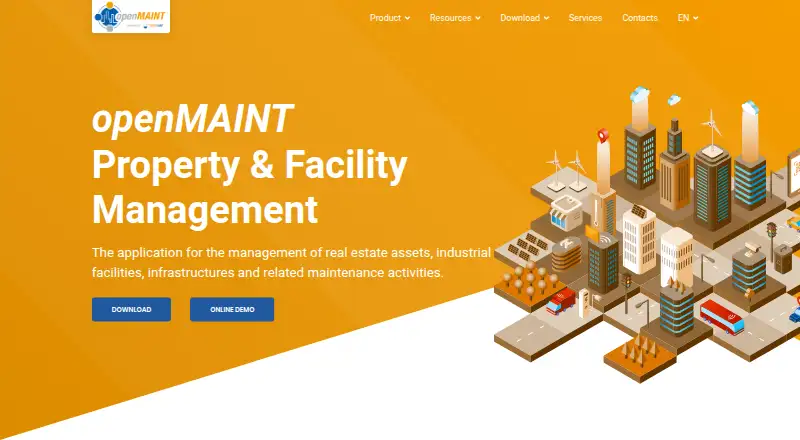
What openMAINT is
openMAINT is an open-source CMMS for managing buildings, sites, plants, technical devices, mobile assets, and related logistics, economics, and maintenance. Its Facility Management functions cover preventive and corrective work for sites and registered assets. The inventory module records real estate, plants, and components, including their status and technical characteristics. Assets can appear on territorial maps, in 2D GIS layouts made from DWG imports, and in 3D BIM models synchronized through IFC files. Users can configure data schemes, object types, attributes, workflows, reports, filters, and views. Integrations include web service interoperability, external-system connectors, CSV import and export, and CMIS-compatible document management. The web-based system runs on a server and is accessed through a browser; stated server platforms are Linux, OSX, and Windows. Requirements include PostgreSQL 17.x, Apache Tomcat 10, and Java 17, with PostGIS and Docker optional. A free Self-Service plan covers inventory, maintenance, logistics, economic management, energy and environment, and GIS and BIM, but excludes the self-service portal and mobile app. The annual subscription applies to one production instance, with price depending on instance complexity and SLA.
Good
- Free Self-Service plan covers inventory and facility management.
- Supports preventive and corrective maintenance.
- Assets can be represented in GIS and BIM views.
- AGPL license permits use, distribution, and editing.
Watch out
- Free Self-Service excludes the mobile app and portal.
- Mobile app use requires a maintenance service subscription.
- Annual subscription price depends on instance complexity and SLA.
- Subscription applies to one production instance.
Who it suits
openMAINT is aimed at organizations managing facilities, assets, and maintenance, including public administrations, healthcare organizations, schools, transport operators, and industrial companies. It may suit teams that need configurable workflows alongside GIS or BIM views.
Verdict
openMAINT combines asset inventory and maintenance processes with configurable workflows and spatial views. Check the free plan’s exclusions and the subscription requirements if mobile access or a self-service portal is needed.
Plans and prices
From openMAINT's own pricing page, checked 14 Oct 2026.
| Plan | Price | What it gives you |
|---|---|---|
| Self-Service | Free | SourceForge download · self-install · core modules excluding Self-Service Portal |
| Annual Subscription | Priced on request | OVF appliance · Mobile APP · Self-Service Portal · waterWAY connectors · help desk · SLA bug fixes · remote upgrades · annual, 12 months |
The facts
Each one read from openMAINT's own pages, with the date it was checked.
What it does
- API
- The product exposes REST and SOAP web services, and CMDBuild 4.2 news describes a REST API v4 with OpenAPI documentation.checked 14 Oct 2026
- Asset and space inventory
- The inventory module records real estate assets, plants, components, their status, and technical characteristics.checked 8 Oct 2026
- Changelog
- The 30 April 2025 openMAINT 2.4 changelog adds configurable maintenance SLAs, surveys, process timing logs, GIS room selection, notifications, checklist import/export and mobile checklist management.checked 14 Oct 2026
- Configurability
- Users can model data schemes, define object types and attributes, customize workflows and reports, and create filters and views.checked 8 Oct 2026
- Core features
- The platform includes version history, analytical search, attachments, permissions, multitenancy, CSV import/export, task automation, email notifications and barcode or QR recognition.checked 14 Oct 2026
- Customisation
- Administrators can model new classes, attributes and relationships and configure workflows, reports, dashboards, filters, views and custom pages.checked 14 Oct 2026
- Deployment
- openMAINT is web-based, runs on a web server, and can be accessed with a browser; the maker says it runs on Linux, OSX, and Windows.checked 8 Oct 2026
- Documentation depth
- Installation instructions defer to the CMDBuild technical manual and expect substantial enterprise web-server expertise.checked 14 Oct 2026
- Economic management
- Economic Management handles budgets, maintenance costs, suppliers, contracts, purchase orders and related property-management administration.checked 14 Oct 2026
- Energy and environment
- The Energy and Environment module records building energy information, consumption and meter readings.checked 14 Oct 2026
- Facility maintenance
- Facility Management supports preventive and corrective maintenance for sites and registered assets.checked 14 Oct 2026
- GIS and BIM
- GIS and BIM support provides georeferencing, DWG-based 2D layouts and IFC-synchronised 3D models.checked 14 Oct 2026
- Independent assessment
- Field Service Software rated openMAINT 6.5/10 and said it fits internal facilities and asset maintenance better than contractor dispatch, quoting, payments or marketing.checked 14 Oct 2026
- Integrations
- Its documented stack includes PostgreSQL, PostGIS, GeoServer, OpenLayers, BIMServer, BIMSurfer, Alfresco or CMIS, Liferay, JasperReports and RIVER or Enhydra Shark.checked 14 Oct 2026
- Intended users
- The maker lists public administrations, banks, healthcare organizations, schools, service companies, transport operators, industrial companies, and businesses among the intended users.checked 8 Oct 2026
- Latest release
- The download page identifies openMAINT 2.4 with CMDBuild core 4.2.checked 14 Oct 2026
- License
- The core software may be used, distributed and edited under the GNU Affero GPL, with legal-notice and clickable-logo requirements for modified interfaces.checked 14 Oct 2026
- Limit: documentation complaints
- SourceForge reviewers complained about missing installation guidance, broken or outdated manuals and insufficient technical documentation.checked 14 Oct 2026
- Limit: installation and usability
- Capterra reviewers described installation as troublesome, the interface as outdated or unintuitive, and reporting as insufficient for some asset analyses.checked 14 Oct 2026
- Limit: reliability and login
- The same G2 reviewer reported occasional stalls or lost connections and slow login.checked 14 Oct 2026
- Logistics
- Logistic Management tracks warehouses, stock items and materials used in maintenance.checked 14 Oct 2026
Where it runs
- App data practices
- Google Play says the app shares no data with third parties, may collect photos, videos, files and device identifiers, and encrypts data in transit.checked 14 Oct 2026
- App-store availability
- The Google Play CMDBuild app supports openMAINT, shows 1,000-plus downloads and displays no user rating on the opened listing.checked 14 Oct 2026
The company
- Founded
- 2013checked 28 Sep 2026
The full review of openMAINT
openMAINT is an open-source CMMS for organizations managing buildings, equipment, and the maintenance and logistics around them. It suits teams that need configurable asset records and maintenance workflows, especially when sites and technical assets must be viewed spatially. Its strongest case is the breadth of inventory, maintenance, and GIS/BIM tools; the trade-off is that mobile access and the self-service portal require a paid annual subscription.
Overview
openMAINT brings property and facility management into a web-based system. Teams can record real estate, plants, components, status, and technical characteristics, then manage preventive and corrective maintenance for sites and registered assets. Spare-parts inventory, logistics, economic management, and energy and environment functions extend it beyond a simple work-order tracker.
Its open-source AGPL license permits use, distribution, and modification. That flexibility comes with a substantial technical footprint: the stated stack includes PostgreSQL 17.x, Apache Tomcat 10, and Java 17, with PostGIS and Docker optional. Organizations without the capacity to run a web server and manage that stack should weigh the subscription support carefully.
Key features
Asset records and spatial views
Inventory covers properties, plants, and components, while GIS and BIM options can place assets on territorial maps, 2D layouts from DWG imports, and 3D models synchronized through IFC files. This is a meaningful advantage for estates where location and building context matter; it is more capability than a small team tracking a short list of repairs may need.
Configurable processes and connections
Users can model data schemes, object types, attributes, workflows, reports, filters, and views. Web services, external-system connectors, CSV import and export, and CMIS-compatible document management give larger or more varied environments routes to fit openMAINT into existing processes. That configurability broadens its reach, but also makes it better suited to organizations prepared to shape and administer their system than to buyers seeking a narrowly prescribed tool.
Maintenance and mobile access
Preventive and corrective maintenance are both supported, alongside spare-parts inventory. The native CMDBuild mobile app supports Android 5.1 or higher and iOS 11 or higher, but requires a maintenance service subscription. Mobile access is therefore not part of the free plan, despite the app’s broad platform footprint.
Pricing
Self-Service — free
The free plan includes Space & Asset Inventory, Facility Management, Logistics, Economic Management, Energy & Environment, and GIS & BIM. Facility Management excludes the Self Service Portal, and the plan also excludes the Mobile APP. It is the sensible starting point for organizations that can operate the system themselves and do not need those two paid-access features; the AGPL license also allows modification and distribution.
Annual Subscription — custom pricing
Billed annually for 12 months, renewable yearly with no automatic renewal. The subscription covers one production instance, with price based on instance complexity and SLA. It includes a certified appliance, help desk, bug fixes with guaranteed SLA, platform updates, the Mobile APP, and Self-Service Portal. Complexity takes account of users, buildings or units, assets, workflows, connectors, clustering, and multitenancy, so this is a tailored service rather than a predictable per-seat price. It fits organizations that need vendor support, updates, or the excluded mobile and portal capabilities.
Platforms
openMAINT is web-based and accessed in a browser; the maker says it runs on Linux, OSX, and Windows. The listed platform range also includes Android, iOS, API access, and self-hosting. The native mobile app’s subscription requirement matters more than platform availability for teams deciding whether they can use mobile access at no cost.
Who it's for
The intended audience spans public administrations, banks, healthcare organizations, schools, service companies, transport operators, industrial companies, and other businesses. In practice, openMAINT is most compelling where a broad asset register, facility maintenance, configurable workflows, and spatial or BIM context justify operating a full CMMS. It is less compelling for a small property team that needs a lightweight request tool without server administration or paid mobile access.
Pros and cons
- Pro: One system covers asset and space inventory, preventive and corrective maintenance, logistics, and economic management, which suits organizations coordinating more than repairs alone.
- Pro: GIS maps, DWG-based 2D layouts, and IFC-synchronized 3D BIM views give location-aware estates useful context for their records.
- Pro: AGPL licensing and configurable data, workflows, reports, and integrations offer room to adapt the system to organizational processes.
- Con: The free plan excludes both the mobile app and self-service portal, limiting direct mobile and requester access without a subscription.
- Con: The PostgreSQL, Tomcat, and Java requirements make deployment a technical responsibility, not a simple app install.
- Con: Subscription cost depends on instance complexity and SLA, which makes budget comparison harder than a fixed per-seat plan.
Alternatives
For a simpler property-maintenance workflow, FlowServIQ offers a free plan with unlimited work orders and preventive maintenance, a tenant request portal, asset tracking, and one team member; choose it when that focused feature set matters more than openMAINT’s deeper GIS/BIM and configurable facility-management scope.
Platuni Maintenance has a free Starter plan for up to one unit with maintenance requests, basic work orders, and email support. It is a better fit for a very small operation that can work within that one-unit cap.
TaskEstate is worth considering when a web-only property workflow and explicit small-account limits—one user, one property, one building, and up to 25 units on its free plan—match the need better than a self-hosted CMMS.
Consider Visitt if you want a paid alternative for Android, iOS, API, and web. One by Lessen is another paid option across Android, iOS, API, and web.
Fentrica may suit buyers who prefer modular pricing: its listed plan is €85 a month, with pricing varying by modules and portfolio and enterprise packages available. Latchel is a paid alternative with a flat monthly subscription per door and portfolio pricing on demo; its Autopilot AI package includes Outbound Voice. NetVendor is a paid option when vendor enrollment is the relevant need, with an annual enrollment fee typically ranging from $49 to $149 per property management company or contractor, if applicable.
Compare openMAINT with Property Maintenance Software, CMMS Software, Work Order Management Software, Facilities Management Software, and Enterprise Asset Management Software if you are still deciding which category best matches your work.
Verdict
Choose openMAINT if your organization needs a configurable, open-source system that unites facility maintenance with detailed asset records and GIS/BIM context—and has the technical capacity to run it. Its free plan is substantial, but organizations that need the mobile app, self-service portal, or guaranteed support must budget for a custom-priced annual subscription. Look elsewhere for a simpler property workflow or a fixed, straightforward price.
Getting started
- Visit the openMAINT website.
- Choose the free Self-Service plan or an annual subscription.
- For browser access, run openMAINT on a web server and open it in a browser.
- Prepare PostgreSQL 17.x, Apache Tomcat 10, and Java 17 for the stated setup.
- For mobile app access, use a maintenance service subscription and an Android 5.1+ or iOS 11+ device.
Limits worth knowing
The free Self-Service plan excludes the Self-Service Portal and mobile app. The mobile app requires a maintenance service subscription; the annual subscription covers one production instance, with pricing based on instance complexity and SLA.
Questions
Is openMAINT free?
Yes. Its Self-Service plan is listed as free. An annual subscription is also available, with no price listed.
Is openMAINT open source?
Yes. It is available under the GNU Affero GPL, which permits use, distribution, and editing.
Which platforms does it support?
It is web-based and accessed through a browser, and the maker says it runs on Linux, OSX, and Windows. Its mobile app supports Android 5.1 or higher and iOS 11 or higher.
What does the free plan include?
It includes Space & Asset Inventory, Facility Management excluding the Self-Service Portal, Logistics, Economic Management, Energy & Environment, and GIS & BIM. It excludes the mobile app and Self-Service Portal.
What does the annual subscription add?
It covers one production instance and includes help desk support, bug fixes with guaranteed SLA, platform updates, the mobile app, and the Self-Service Portal.
What technical requirements are listed?
The stated requirements include PostgreSQL 17.x, Apache Tomcat 10, and Java 17. PostGIS and Docker are optional.
Alternatives to openMAINT
- 1
Platuni Maintenance
Free planAndroidiOSWebAPI8.1From $1.39 a month - 2
FlowServIQ
Free planAndroidiOSWebAPI7.9From $149 a month - 3

MagicDoor
AndroidiOSWebAPI7.5From $1.50 a month - 4

Property Meld
AndroidiOSWebAPI7.4From $1.50 a month - 5
TaskEstate
Free planWeb7.4From $4.99 a month - 6
UpKeep
AndroidiOSWebAPI7.2From $24 a month