NMI
NMI provides an embedded payments platform for accepting and managing transactions online, in stores, on mobile devices, and through self-service channels.
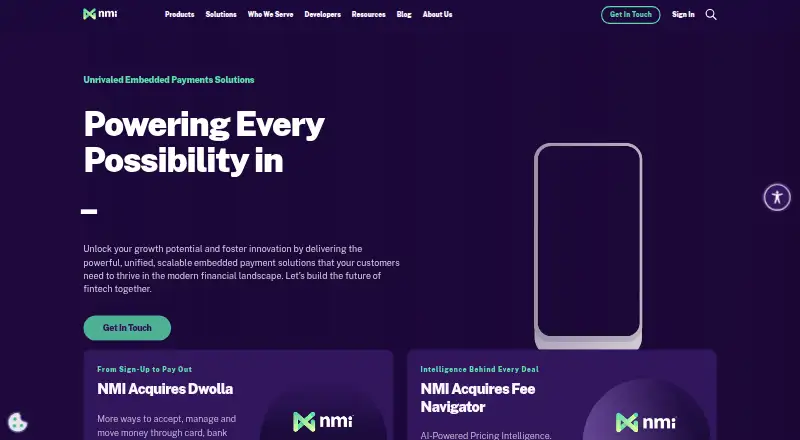
What NMI is
NMI provides an embedded payments platform for accepting and managing transactions online, in stores, on mobile devices, and through self-service channels. Its gateway supports recurring billing, batch processing, webhooks, QR code payment links, transaction routing, and a virtual terminal. Checkout choices include a customizable Payment Component, hosted payment pages, and a REST API for custom checkout experiences. The Payment Component tokenizes payment details in the browser so sensitive data does not reach the integrator's servers. Supported methods include major card brands, Apple Pay, and Google Pay, with payments in USD, CAD, and other currencies depending on the processor. NMI describes its platform as serving ISOs, software companies, and payment facilitators; merchants generally work through a certified reseller or ISO that configures the gateway and handles the account. Partners can brand the gateway and portals, and Merchant Central combines CRM and underwriting tools for merchant onboarding and lifecycle management. Developer resources include web APIs, hosted pages, and SDKs for iOS, Android, Windows, and Linux. Pricing is available on request.
Good
- Accepts payments across online, in-store, mobile, and self-service channels
- Supports recurring billing and transaction routing
- Customizable checkout component tokenizes payment details in-browser
- Partners can apply their own branding
- Provides API, hosted pages, and SDKs
Watch out
- Pricing is available only on request
- Merchants generally need a certified reseller or ISO partner
- Merchants using the Payment API should pass a PCI vulnerability scan first
- NMI does not develop or support listed third-party integrations
Who it suits
NMI is aimed at ISOs, software companies, and payment facilitators building payment services. Merchants typically need to work through a certified reseller or ISO partner to configure and access the gateway.
Verdict
NMI offers payment acceptance, checkout, and developer tools for partners serving merchants across several channels. Factor in the reseller relationship and PCI scan requirement for Payment API use when assessing fit.
The facts
Each one read from NMI's own pages, with the date it was checked.
What it does
- Accounting integrations
- Bill Connect integrates payment acceptance with accounting software including QuickBooks and Xero.checked 4 Oct 2026
- Checkout options
- NMI offers a customizable Payment Component, hosted payment pages, and a REST API for custom checkout experiences.checked 4 Oct 2026
- Developer tools
- NMI offers a payment API, hosted payment pages, SDKs for iOS, Android, Windows, and Linux, and a browser-based customer-present solution that runs on any operating system.checked 4 Oct 2026
- Integrations
- NMI lists integrations with more than 125 shopping carts and connections to more than 150 processors.checked 4 Oct 2026
- Merchant access
- NMI says merchants generally work with a certified reseller or ISO that configures the gateway and handles the account.checked 4 Oct 2026
- Merchant tools
- Merchant Central combines CRM and underwriting tools to help partners manage merchant onboarding and lifecycle.checked 4 Oct 2026
- Payment features
- The gateway supports recurring billing, batch processing, webhooks, QR code payment links, transaction routing, and a virtual terminal.checked 4 Oct 2026
- Payment methods
- The gateway supports major card brands, Apple Pay, Google Pay, and payments in USD, CAD, and other currencies depending on the processor.checked 4 Oct 2026
- Payments
- The gateway supports online, in-store, self-service, and mobile payments, including EMV and contactless payments.checked 4 Oct 2026
- PCI compliance
- NMI says it has maintained PCI DSS Level 1 certification since 2005 and is audited annually by independent security assessors.checked 4 Oct 2026
- PCI scope limit
- NMI says merchants using its Payment API should have passed a PCI vulnerability scan before using that integration method.checked 4 Oct 2026
- Pricing
- NMI directs pricing inquiries to its sales team; the pages reviewed do not state a standard public price.checked 4 Oct 2026
- Pricing model
- NMI describes partner gateway pricing in terms of a buy rate and partner-defined merchant fees, and says applicable fees are set out in a proposal or fee schedule.checked 4 Oct 2026
- Security
- NMI says it has maintained PCI DSS Level 1 certification since 2005 and undergoes annual independent security assessments.checked 4 Oct 2026
- Security features
- Gateway security options include point-to-point encryption, remote key injection, and remote terminal management.checked 4 Oct 2026
- Support
- NMI provides a support portal for answers and support requests, with sales inquiries handled separately by its sales team.checked 4 Oct 2026
- Third-party support limit
- NMI says the third-party integrations listed in its documentation are not developed, maintained, or supported by NMI.checked 4 Oct 2026
- Tokenization
- NMI's Payment Component tokenizes payment details in the browser so sensitive payment data does not touch the integrator's servers.checked 4 Oct 2026
- What it does
- NMI provides an embedded payments platform with payment gateway, merchant onboarding, underwriting, and management tools.checked 4 Oct 2026
- White labeling
- Partners can brand the gateway and portals with their own logos, colors, and custom URLs.checked 4 Oct 2026
The company
- Company history
- NMI says its payment gateway has been a cornerstone of its payments offering since 2001.checked 4 Oct 2026
- Founded
- 2001checked 28 Sep 2026
- Headquarters
- Schaumburg, Illinois, United Stateschecked 28 Sep 2026
Where it runs
- Developer platforms
- NMI publishes payment device SDKs for Windows and Linux, mobile SDKs for iOS and Android, and web-based APIs.checked 4 Oct 2026
The full review of NMI
NMI is an embedded payments platform for software companies, ISOs, and payment facilitators building payment acceptance into merchant services. It is strongest for partners that need branded checkout and a broad mix of online, in-person, and self-service payment tools; merchants generally access it through a certified reseller or ISO.
Overview
NMI brings gateway functions, checkout components, developer tools, and merchant-management tools together across online, in-store, mobile, and self-service channels. Its roots in payment gateways go back to 2001, and the platform supports both recurring and marketplace payments.
For partners, white labeling is a practical advantage: the gateway and portals can use the partner’s logo, colors, and custom URLs. Merchant Central adds CRM and underwriting tools for onboarding and managing merchants. This partner-centered model is less direct than buying a standalone merchant app: merchants typically rely on a certified reseller or ISO to configure the gateway and handle the account.
Key features
Checkout and payment operations
NMI supports recurring billing, batch processing, webhooks, transaction routing, a virtual terminal, and QR-code payment links. Checkout options range from hosted payment pages and a customizable Payment Component to a REST API for custom builds. That range suits partners serving merchants with different sales channels, though a custom API integration asks more of the development team than a hosted page.
The gateway accepts major card brands, Apple Pay, and Google Pay, with USD, CAD, and other currencies depending on the processor. It supports EMV and contactless payments as well as online, mobile, in-store, and self-service transactions. NMI says it integrates with more than 200 payment processors and over 125 shopping carts, giving partners a wide field of potential connections. Bill Connect connects payment acceptance with accounting software such as QuickBooks and Xero.
Developer and security tools
Developers can use the payment API, hosted pages, and SDKs for iOS, Android, Windows, and Linux. A browser-based customer-present option runs on any operating system. The Payment Component tokenizes payment details in the browser, so sensitive payment data does not pass through the integrator’s servers; that can reduce the burden of handling payment data directly.
NMI says it has maintained PCI DSS Level 1 certification since 2005 and undergoes annual assessments by independent security assessors. Gateway security options include point-to-point encryption, remote key injection, and remote terminal management. There is an important qualification for direct integrations: merchants using the Payment API should pass a PCI vulnerability scan before using that method.
NMI’s support portal lets users search for answers, submit support requests, and track existing requests. Third-party integrations in NMI’s documentation are not developed, maintained, or supported by NMI, so partners should account for separate support ownership when building around them.
Pricing
NMI is paid software with custom pricing; prospective partners must contact its sales team. There is no standard public plan price to compare, so organizations should confirm the full commercial terms with NMI before committing. That sales-led approach may fit a partner configuring payments for a portfolio of merchants, but it gives individual buyers no straightforward way to estimate cost from a monthly list price.
Platforms
NMI covers web, API, Android, iOS, Linux, and Windows. Its SDKs target iOS, Android, Windows, and Linux, while the browser-based customer-present experience works across operating systems. This breadth is useful to software companies integrating payments into varied products, including mobile and desktop applications.
Who it's for
NMI is best suited to ISOs, software companies, and payment facilitators that want to embed and brand payment services, connect to processors and shopping carts, and manage merchant onboarding. It can also fit merchants whose reseller or ISO provides the gateway account and configuration. It is a weaker fit for a merchant seeking a direct, self-serve product with transparent public pricing, or for a team unable to meet the Payment API scan requirement.
Pros and cons
- Pro: White-label branding and Merchant Central let partners present payment services as part of their own offering while managing merchant onboarding and lifecycle.
- Pro: Hosted checkout, a tokenizing Payment Component, APIs, and SDKs provide multiple integration paths across web, mobile, and desktop.
- Pro: Broad channel support, recurring billing, marketplace payments, and processor and shopping-cart integrations can serve varied merchant setups.
- Con: Custom pricing requires a sales conversation, making initial cost comparisons harder for buyers.
- Con: Merchant access generally depends on a certified reseller or ISO, rather than a direct merchant relationship with NMI.
- Con: Payment API use carries a PCI vulnerability scan prerequisite, and documented third-party integrations remain outside NMI’s development and support responsibility.
Alternatives
Choose Helcim if a free plan and published $0.00 USD monthly account fee matter more than NMI’s partner-oriented embedded platform; Helcim’s processing rates vary by volume. Consider EBizCharge Virtual Terminal for a web-based virtual terminal with customized fees dependent on card types, no contracts, and unlimited support.
CoreGateway Virtual Terminal is a more price-transparent option for buyers who want a virtual terminal with hosted pages, invoicing, recurring payments, vault, surcharging, L2/L3, and reporting for $15 a month, month-to-month. PayJunction Virtual Terminal may suit buyers comparing card-present and ACH pricing: its Standard plan cites card rates as low as 1.49% + $0.15 and ACH as low as 0.75%, with additional fees possible.
SwipeSimple offers a $0.00 free plan for eligible businesses where card-paying customers cover a 3.5% card fee, so consider it when that processing model fits. Authorize.net is another option for buyers who want published monthly pricing: its All-in-one plan is $25 a month with a merchant account and payment gateway, plus 2.9% + $0.30 per transaction.
myPOS Virtual Terminal MO/TO offers a free plan with no monthly fee and per-transaction fees, subject to service eligibility approval. Payline Virtual Terminal is another virtual-terminal option to compare.
For category-level comparisons, browse Virtual Terminal Software, Embedded Payments Platforms, and Payment Gateways.
Verdict
NMI is a strong fit for payment partners and software companies that need white-label gateway services, flexible checkout integrations, and tools to manage merchant onboarding across multiple channels. Its combination of embedded payment options and developer coverage is the main reason to choose it. Look elsewhere if you need a direct merchant product with clear public pricing, or if the Payment API scan requirement and partner-led account model do not fit your operation.
Getting started
- Visit https://www.nmi.com/.
- Contact NMI's sales team for pricing inquiries.
- Work with a certified reseller or ISO to configure the gateway and merchant account.
- Choose a checkout route such as the Payment Component, hosted payment pages, or REST API.
- Use the relevant web API or SDK; SDKs are available for iOS, Android, Windows, and Linux.
- If using the Payment API, pass a PCI vulnerability scan before using that integration method.
Questions
How much does NMI cost?
NMI directs pricing inquiries to its sales team; no standard public price is stated.
Which payment methods and currencies does NMI support?
The gateway supports major card brands, Apple Pay, and Google Pay, along with EMV and contactless payments. It supports USD, CAD, and other currencies depending on the processor.
Which platforms have NMI developer tools?
NMI offers payment device SDKs for Windows and Linux, mobile SDKs for iOS and Android, and web-based APIs. Its browser-based customer-present solution runs on any operating system.
How do merchants access NMI?
Merchants generally work with a certified reseller or ISO, which configures the gateway and handles the account.
Does NMI integrate with other payment services?
NMI says it integrates with more than 200 payment processors and 125+ shopping carts. Its documentation notes that listed third-party integrations are not developed, maintained, or supported by NMI.
What PCI security information does NMI provide?
NMI says it has maintained PCI DSS Level 1 certification since 2005 and is audited annually by independent security assessors. Merchants using its Payment API should have passed a PCI vulnerability scan before using that integration method.
Alternatives to NMI
- 1

Stripe Connect
AndroidiOSWebAPI8.0From $20.25 a month - 2

Checkout.com
Free planAndroidiOSWebAPI7.7Free plan - 3

Adyen
AndroidiOSWebAPI7.5$0.13 one-time - 4

Airwallex Platform APIs and Embedded Finance
Free planAndroidiOSWebAPI7.3Free plan - 5
Rainforest
AndroidiOSWebAPI7.3From $0.20 a month - 6

Rapyd
AndroidiOSWebAPI6.8From $99 a month