Mailmunch
Mailmunch is a web service from Mailmunch, headquartered in San Francisco, that combines website lead capture, email marketing, and automation.
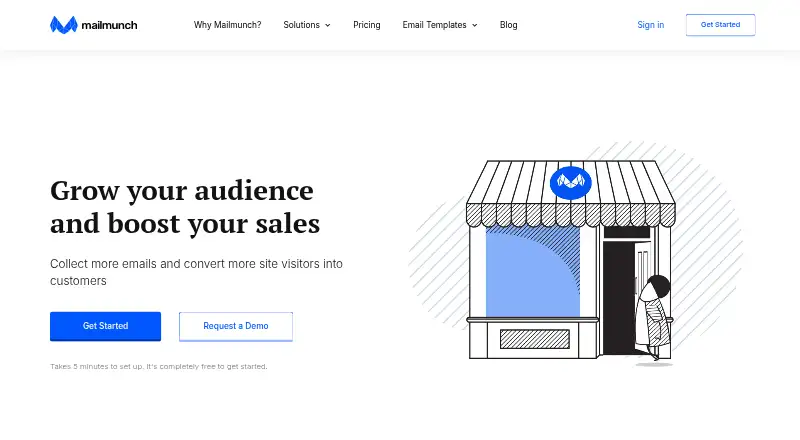
What Mailmunch is
Mailmunch is a web service from Mailmunch, headquartered in San Francisco, that combines website lead capture, email marketing, and automation. It lets online stores, bloggers, coaches, and creators collect subscribers through popups, spin wheels, and signup forms, then send newsletters and other campaigns with templates and an email builder. Automated messages include welcome emails, cart reminders, and thank-you emails. Audience segmentation and A/B testing support targeted campaigns and experiments. Reporting covers opens, clicks, and which emails generated revenue, while Mailmunch AI can draft subject lines and copy for editing before sending. The service lists 18 native integrations, including Shopify, Wix, WordPress, ActiveCampaign, Mailchimp, and Zapier. Mailmunch says it can work on any website where a small code snippet can be added, although available features can depend on the platform. It is offered on the web with a free plan and free trial. Paid plan descriptions range from subscriber allowances to multi-site administration, team management, whitelabel options, and expanded campaign capacity.
Good
- Free plan includes forms, popups, and landing pages
- Email automation covers welcome, cart reminder, and thank-you messages
- Audience segmentation and A/B testing are included
- Reports opens, clicks, and revenue-generating emails
- Lists 18 native integrations
- Works on websites that allow a code snippet
Watch out
- Free plan includes only one welcome email
- Free plan adds Mailmunch branding
- Premium charges $19.99 monthly per additional 5,000 contacts
- Large lists over 200,000 contacts require custom onboarding
Who it suits
Mailmunch suits online stores, bloggers, coaches, and creators building an audience through website forms and email campaigns. It is also relevant to teams needing segmentation, automation, integrations, or management across multiple sites.
Verdict
Choose Mailmunch if you need website capture, email campaigns, and automation in one web service. Its free plan is a starting point for forms, landing pages, and one welcome email. Look elsewhere if you need a different platform or more capacity than the listed allowances without custom onboarding.
Plans and prices
From Mailmunch's own pricing page, checked 20 Sep 2026.
| Plan | Price | What it gives you |
|---|---|---|
| Free | Free | Forms & popups · Landing pages · 1 welcome email · Basic analytics · Mailmunch branding |
| Essential | — | 500 subscribers · 10 autoresponders |
| Pro | — | 1,000 subscribers |
| Agency | — | Unlimited sites · Team management · Whitelabel notifications · Free installation · Priority support |
| Premium | $29.99 a month | 1,000 contacts included · Above that, add $19.99/mo for each 5,000 contacts, rounded up · Unlimited forms, landing pages, and campaigns · Billed monthly; Up to 1,000 contacts |
| Team Management | — | Unlimited team members · Manage multiple sites |
| Whitelabel | — | Unlimited team members · Manage multiple sites |
The facts
Each one read from Mailmunch's own pages, with the date it was checked.
What it does
- A/B testing
- Yeschecked 20 Sep 2026
- AI
- Mailmunch AI can draft email subject lines and copy for users to edit and send.checked 9 Oct 2026
- Analytics
- Mailmunch reports email opens, clicks, and which emails generated revenue.checked 9 Oct 2026
- Audience segmentation
- Yeschecked 20 Sep 2026
- Automation
- The homepage lists welcome emails, cart reminders, and thank-you emails as automations.checked 9 Oct 2026
- Email automation
- Yeschecked 20 Sep 2026
- Email campaigns
- Users can send newsletters and other email campaigns using templates and an email builder.checked 9 Oct 2026
- Forms
- It offers popups, spin wheels, and signup forms for collecting subscribers on a website.checked 9 Oct 2026
- Integrations
- Its integrations page lists Shopify, Wix, WordPress, ActiveCampaign, AWeber, Campaign Monitor, Constant Contact, GetResponse, Keap, Mailchimp, MailerLite, Sendlane, and Zapier.checked 9 Oct 2026
- Landing pages
- Yeschecked 20 Sep 2026
- Native integrations
- 18checked 20 Sep 2026
- Pricing limit
- For lists over 200,000 contacts, the pricing page directs customers to contact support for custom onboarding.checked 9 Oct 2026
- Privacy
- The privacy policy says Mailmunch acts as a data processor for customer contact lists and email campaigns, with the customer as data controller.checked 9 Oct 2026
- Product
- Mailmunch combines website lead capture, email marketing, and automation tools.checked 9 Oct 2026
- Security
- Mailmunch says it uses commercially reasonable physical, electronic, and procedural safeguards, while noting that no security measures are perfect.checked 9 Oct 2026
- Support
- The pricing page says its support team is available to help users set up and use the product.checked 9 Oct 2026
- Target users
- The site describes the product for online stores, bloggers, coaches, and creators who want to grow an audience and send newsletters.checked 9 Oct 2026
- Website compatibility
- Mailmunch says it works on any website where a small code snippet can be added, with some features depending on the platform.checked 9 Oct 2026
Money
- Free plan
- Yeschecked 20 Sep 2026
The company
- Headquarters
- San Francisco, California, United Stateschecked 28 Sep 2026
The full review of Mailmunch
Mailmunch is a web service that combines website subscriber capture, email campaigns, and automated messages. It is a strong fit for small online businesses and audience-led creators who want those jobs in one place, while larger lists and teams need to examine its quotas and custom arrangements carefully.
Overview
Mailmunch connects on-site conversion tools with outbound email. Popups, signup forms, spin wheels, and landing pages turn website visits into contacts, while templates and an email builder support newsletters and other campaigns. That combination is useful when the same team manages acquisition and follow-up; it is less compelling if you only need a narrowly focused analytics product.
The service is web-based and can be added to any site that accepts a small code snippet, although platform-specific features vary. Mailmunch is based in San Francisco and says its support team helps customers set up and use the product. It acts as a data processor for customer contact lists and campaigns, with the customer retaining controller responsibility.
Key features
- Lead capture: Popups, spin wheels, signup forms, and landing pages provide several ways to ask for a subscription. This variety suits stores and publishers with different page layouts, but implementation details can depend on the website platform.
- Campaigns and automation: Newsletter templates and an email builder cover regular broadcasts. Welcome, cart-reminder, and thank-you automations handle common follow-ups; segmentation, A/B testing, and email automation make the service more capable than a form-only tool.
- Measurement: Reports include opens, clicks, and which emails generated revenue. Those measures help connect campaigns with sales, although they do not replace a broader marketing-analytics stack for every organization.
- AI assistance: Mailmunch AI drafts subject lines and email copy that users can edit before sending. It can reduce first-draft work, but review remains necessary for accuracy and brand voice.
- Integrations: The service lists 18 native integrations, including Shopify, Wix, WordPress, ActiveCampaign, AWeber, Campaign Monitor, Constant Contact, GetResponse, Keap, Mailchimp, MailerLite, Sendlane, and Zapier.
Pricing
Mailmunch uses a freemium model and offers a free trial. The Free plan costs nothing and includes forms and popups, landing pages, one welcome email, basic analytics, and Mailmunch branding. It is suitable for validating a signup flow or running a very small welcome sequence; the single-email allowance and branding make it a poor long-term choice for a polished, multi-step program.
Essential has custom pricing and supports 500 subscribers plus 10 autoresponders. It fits a small list that needs more automated follow-up than Free provides. Pro also has custom pricing and raises the allowance to 1,000 subscribers, a sensible step for a growing audience, though the published plan summary does not add further quotas.
Premium costs $29.99 a month, billed monthly. It includes up to 1,000 contacts, with 1,000 contacts included; each additional 5,000 contacts costs $19.99 a month, rounded up. Unlimited forms, landing pages, and campaigns make this the clearest option for an active program, but contact growth can increase the monthly bill quickly. Lists above 200,000 contacts require support for custom onboarding.
Agency, Team Management, and Whitelabel use custom pricing. Agency adds unlimited sites, team management, whitelabel notifications, free installation, and priority support. Team Management provides unlimited team members and multiple-site management; Whitelabel offers the same team and site scope for organizations that need a branded client-facing setup. Seat and site requirements should determine whether these tiers justify a sales conversation.
Platforms
Mailmunch runs on the web. A code snippet enables use on compatible websites, with some capabilities varying by platform; listed integrations cover major storefront, site-builder, email, and automation services.
Who it's for
Online stores can pair capture forms with cart reminders and revenue reporting. Bloggers, coaches, and creators get landing pages, newsletters, and welcome messaging for audience growth. It is less suitable for teams that need a generous permanently free automation allowance, a purely analytics-led product, or straightforward published pricing at every tier.
Pros and cons
Pros
- Combines forms, landing pages, campaigns, and automation instead of requiring separate capture and email tools.
- Revenue-linked reporting, segmentation, A/B testing, and 18 integrations support more deliberate optimization.
- Premium provides unlimited forms, landing pages, and campaigns for a fixed base monthly price.
Cons
- The Free plan permits only one welcome email and displays Mailmunch branding.
- Essential, Pro, Agency, Team Management, and Whitelabel require custom pricing, making comparisons harder.
- Premium contact overages add $19.99 a month per 5,000 contacts, so a growing list needs budget monitoring.
Alternatives
Choose LeadGenius instead when API access and paid, on-demand lead records are the priority. involve.me is a better fit for funnel experiences with a free tier capped at 50 submissions or 500 visits per month. Pick ActiveProspect when you want API and web access with a self-service plan starting at $10 a month.
ConvertFlow suits funnel campaigns, with a free allowance of five campaigns and paid integrations. Formsort is the alternative for flow-based forms, offering 100 flow starts per month free. Hello Bar is preferable for popup-focused work, with a free 5,000-view Starter plan. Leadberry is another web lead-generation option. Marketing Optimizer is worth considering when a free plan with 5,000 stored leads and 2,500 emails per month matches your outreach model.
For broader category browsing, see Lead Generation Software, Email Marketing Analytics Software, and Email Marketing Software.
Verdict
Choose Mailmunch if you want website capture, email sending, and practical automations managed together, especially for a store, blog, coaching business, or creator brand. Its strongest case is the breadth from popup to revenue-aware campaign. Look elsewhere if the free tier must support a substantial sequence, if every plan needs transparent pricing, or if contact-volume charges would strain a rapidly expanding list.
Getting started
- Open the Mailmunch website
- Choose the free plan or review paid plans
- Add Mailmunch's code snippet to a compatible website
- Create forms, popups, or landing pages
- Connect listed integrations such as Shopify, Wix, WordPress, or Zapier
- Build and send an email campaign
Limits worth knowing
The free plan includes forms and popups, landing pages, one welcome email, basic analytics, and Mailmunch branding. Premium includes up to 1,000 contacts, with $19.99 per month added for each 5,000 contacts above that allowance.
Questions
Is Mailmunch free?
Yes. A free plan costs nothing and includes forms and popups, landing pages, one welcome email, basic analytics, and Mailmunch branding.
Does Mailmunch offer a free trial?
Yes, a free trial is listed.
Which platforms does Mailmunch support?
The listed platform is web. It can work on websites where a small code snippet can be added, with some features depending on the platform.
What integrations are available?
Mailmunch lists 18 native integrations, including Shopify, Wix, WordPress, Mailchimp, and Zapier.
What does Premium cost?
Premium costs $29.99 a month, billed monthly, for up to 1,000 contacts; additional 5,000-contact blocks cost $19.99 per month each.
Who makes Mailmunch?
Mailmunch is made by Mailmunch, headquartered in San Francisco, California, United States.
Alternatives to Mailmunch
- 1

Mailchimp
Free planAndroidiOSWebAPI8.3From $13 a month - 2

SendPulse
Free planAndroidiOSWebAPI8.2From $9.60 a month - 3

Substack
Free planAndroidiOSWebAPI8.2$50 one-time - 4

Zoho Campaigns
Free planAndroidiOSWebAPI8.2From $4 a month - 5

Brevo Conversations
Free planAndroidiOSWebAPI8.1From $15 a month - 6

E-goi
Free planAndroidiOSWebAPI8.1From $11.75 a month