
LINK Mobility RCS
LINK Mobility RCS is a business messaging service that lets companies send rich, interactive messages to customers’ default messaging apps.
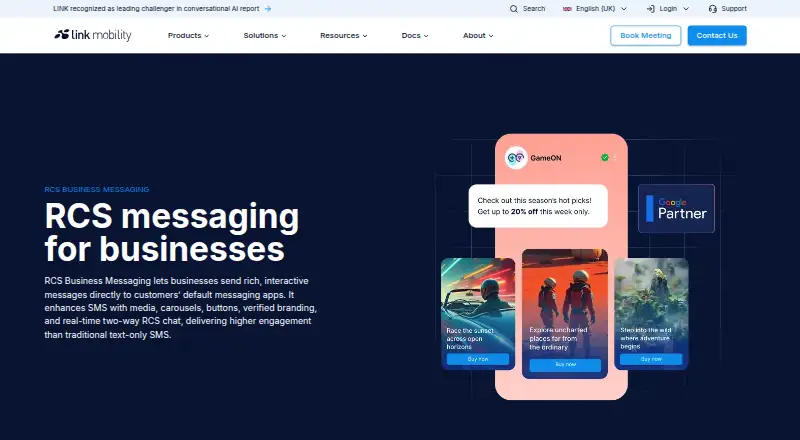
What LINK Mobility RCS is
LINK Mobility RCS is a business messaging service that lets companies send rich, interactive messages to customers’ default messaging apps. Messages can contain images, videos, files, carousels and buttons, with read receipts and verified business profiles. Businesses can use RCS Basic text messages, one-way Single campaigns or two-way Conversation sessions that last 24 hours. LINK describes its API as RESTful and offers access through documentation, guides or sending platforms. RCS can also work with MyLINK Connect for automated replies, guided journeys and handover to human agents. When a recipient’s device does not support RCS, LINK says its platform falls back to SMS. RCS availability depends on country, carrier and device, and businesses must obtain explicit user opt-in before campaigns. LINK highlights use cases in retail, travel, finance, telecommunications, healthcare and the public sector. Pricing is on request and varies by message type; RCS Basic is limited to 160 characters. The service is available through API and web access.
Good
- Supports images, videos, files, carousels and buttons
- Offers two-way sessions lasting 24 hours
- Can automate replies and guided journeys
- Falls back to SMS when RCS is unsupported
- Local teams guide verification, setup and integration
Watch out
- Pricing is available on request
- RCS Basic is limited to 160 characters
- Availability varies by country, carrier and device
- Campaigns require explicit user opt-in
Who it suits
It suits businesses that want to send interactive customer messages, including retailers, travel providers, financial services and public-sector organizations. Teams should account for varying RCS availability and the opt-in requirement.
Verdict
LINK Mobility RCS combines rich messaging, automation and an SMS fallback for business communications. Its availability and opt-in requirements are important considerations before choosing it.
Plans and prices
From LINK Mobility RCS's own pricing page, checked 2 Oct 2026.
| Plan | Price | What it gives you |
|---|---|---|
| RCS Business Messaging | Priced on request | Pricing varies by message type · RCS Basic is limited to 160 characters · RCS Conversation uses a 24-hour session |
The facts
Each one read from LINK Mobility RCS's own pages, with the date it was checked.
What it does
- API
- LINK describes its RCS API as RESTful and says customers can connect through API documentation, guides or sending platforms.checked 2 Oct 2026
- API channels
- LINK’s API reference describes the MyLINK Multichannel API as supporting SMS, RCS, Viber, WhatsApp and other channels.checked 2 Oct 2026
- Audience
- The page highlights retail and e-commerce, travel and hospitality, banking and finance, telecommunications, healthcare and public sector use cases.checked 2 Oct 2026
- Automation
- RCS can be paired with MyLINK Connect for automated replies, guided journeys and handover to human agents.checked 2 Oct 2026
- Availability limit
- RCS availability varies by country, carrier and device, and the page says businesses must obtain explicit user opt-in before sending campaigns.checked 2 Oct 2026
- Fallback
- LINK says its platform automatically falls back to SMS when a customer’s device does not support RCS.checked 2 Oct 2026
- Message formats
- It supports images, videos, files, carousels, buttons, read receipts and verified business profiles.checked 2 Oct 2026
- Message types
- The page describes RCS Basic text messages, one-way RCS Single campaigns and two-way RCS Conversation sessions lasting 24 hours.checked 2 Oct 2026
- Onboarding and support
- LINK says its local team guides customers through verification, setup and integration, and its support page offers technical assistance and local support teams.checked 2 Oct 2026
- What it does
- RCS Business Messaging lets businesses send rich, interactive messages to customers’ default messaging apps.checked 2 Oct 2026
The company
- Company
- LINK Mobility describes itself as a CPaaS provider headquartered in Oslo, Norway, with more than 25 years of history.checked 2 Oct 2026
- Founded
- 2001checked 28 Sep 2026
- Headquarters
- Oslo, Norwaychecked 28 Sep 2026
The full review of LINK Mobility RCS
Overview
LINK Mobility RCS is a business messaging service for sending interactive messages to customers’ default messaging apps. It suits organizations that want rich customer conversations through an API or web-based sending platform, with automated replies and SMS fallback. Its broad message formats are compelling, but country, carrier and device coverage—and explicit opt-in—shape where it can be used.
Key features
RCS supports images, video, files, carousels and buttons, alongside delivery and read receipts and verified business profiles. Those formats let businesses put more context and interactive choices in a message than text alone, making the service relevant to customer journeys where a response or next step matters.
It offers three message types: Basic text messages, Single one-way campaigns and Conversation sessions that support two-way messaging for 24 hours. Basic messages are limited to 160 characters; the session window gives businesses a defined period for back-and-forth exchanges rather than an unrestricted ongoing chat.
The RESTful RCS API connects through API documentation, guides or sending platforms. For automated journeys, RCS can pair with MyLINK Connect for automated replies, guided flows and handover to human agents. The MyLINK Multichannel API also supports SMS, RCS, Viber, WhatsApp and other channels, which may suit teams managing more than one messaging route.
When a customer’s device does not support RCS, the platform automatically falls back to SMS. That provides a text-based route for those recipients, but RCS itself varies by country, carrier and device. Businesses must also obtain explicit user opt-in before sending campaigns, a material requirement for any planned rollout.
Pricing
RCS Business Messaging has custom pricing, with charges based on usage and varying by message type. There is no published fixed price to compare against a campaign budget. RCS Basic is limited to 160 characters, while RCS Conversation uses a 24-hour session; those limits matter when estimating the messaging format and usage a program will need.
This paid plan is best suited to organizations ready to discuss volume and message mix with LINK rather than buyers seeking a self-serve price. LINK’s local team guides customers through verification, setup and integration, and its support page offers technical assistance and local support teams.
Platforms
Access is available through API and web. The API route fits teams connecting messaging to their own systems, while web access offers a sending-platform route. The product’s RCS reach still depends on country, carrier and device support.
Who it's for
LINK highlights retail and e-commerce, travel and hospitality, banking and finance, telecommunications, healthcare and public sector organizations. The combination of rich media, suggested actions, two-way sessions and automation is most relevant where customer messages need to guide a task or service interaction. It is a less straightforward choice for businesses whose audiences or campaign plans cannot accommodate RCS coverage variation and opt-in requirements.
Pros and cons
- Pros: Rich media, carousels, buttons and verified profiles support more expressive customer messages than plain text.
- Pros: Two-way sessions, automated journeys and human-agent handover cover both self-service and assisted interactions.
- Pros: Automatic SMS fallback offers a text route when a recipient’s device does not support RCS.
- Cons: Reach varies by country, carrier and device, so RCS availability cannot be assumed across an audience.
- Cons: Campaigns require explicit user opt-in, which businesses need to account for before sending.
- Cons: Custom, usage-based pricing and message-type variation make costs harder to compare without a quote.
Alternatives
For a broader comparison, see RCS Business Messaging Software.
- Gupshup is worth considering for buyers who want a free plan; its messaging fee is free, with a standard 0.001 USD per message fee.
- Google RCS for Business is another paid option, with carrier rate-card billing that depends on destination region and billing category.
- Infobip RCS for Business uses custom pricing based on destination, carrier, message type, volume and features.
- Zenvia RCS for Business may suit Brazil-focused buyers comparing a listed RCS Basic rate of R$0.08 per contact for up to 24,213 sends with the USD 400 channel pack; that tier has no multimedia.
- Sinch RCS for Business is a paid alternative with pricing that varies by region and carrier, and carrier fees and setup costs may apply.
- Helo.ai is a paid alternative with a free trial and custom enterprise pricing.
- Esendex RCS Business Messaging is a paid alternative with a free trial and bespoke multichannel packages.
- smsmode RCS API offers fixed monthly tiers, including Basic at €9 a month excluding taxes for 500 messages per month or more.
Verdict
LINK Mobility RCS is a strong fit for businesses that want rich, interactive messaging, automation and a fallback to SMS, and can work within RCS coverage and opt-in requirements. Its broad formats and combination of API, web access and assisted onboarding make it a credible choice for customer communications. Choose another service if a published price or more predictable coverage is essential before committing.
Alternatives to LINK Mobility RCS
- 1

nativeMsg RCS Business Messaging
Free planAndroidiOSWebAPI8.0From $199 a month - 2

SimplyRCS
Free planOpen sourceWebAPISelf-hosted7.8From $20 a month - 3

Gupshup
Free planWebAPI7.2Free plan - 4

Auronix RCS
WebAPI6.5From $3,000 a month - 5
Concepto Móvil RCS API
AndroidWebAPI6.5 - 6
Dotgo RCS
AndroidiOSWebAPI6.5