
Gupshup
Gupshup provides conversational AI for marketing, commerce, and customer support automation.
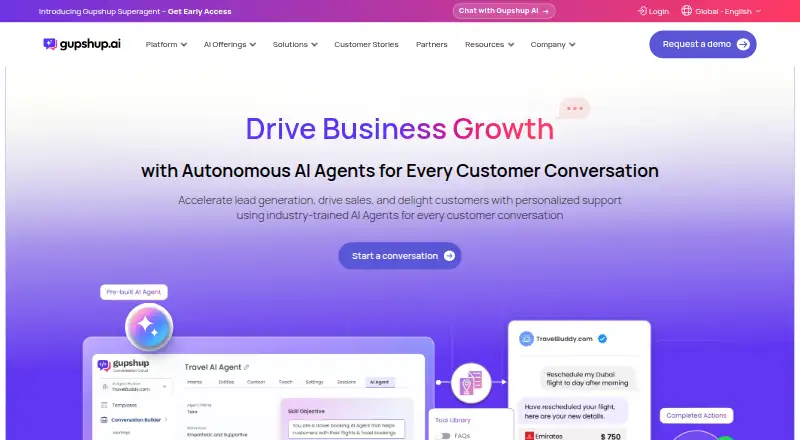
What Gupshup is
Gupshup provides conversational AI for marketing, commerce, and customer support automation. Its agents can use real-time conversational context to perform actions such as booking appointments, cancelling tickets, and making EMI payments. Teams can set engagement rules, connect business tools, add guardrails, and define a trusted source of truth; complex cases can be handed to human support. Listed channels include WhatsApp, Instagram, SMS, web and app, RCS, and voice. The platform also supports trigger campaigns and drip journeys, with metrics for measuring their performance. Features include a visual flow builder, AI bot generation, knowledge-base answers, and conversation routing. Gupshup lists more than 500 plug-and-play integrations across support, payments, CRM, and commerce, as well as custom integrations. It is available through web and API. A free plan is listed, and self-serve WhatsApp pricing includes a Gupshup charge of $0.001 per message; WhatsApp fees are billed at actuals. Enterprise pricing requires contacting Gupshup.
Good
- Agents can take actions using conversation context
- Human handoff for complex cases
- Channels include WhatsApp, SMS, RCS, and voice
- More than 500 plug-and-play integrations
Watch out
- WhatsApp fees are billed at actuals
- Enterprise pricing requires contacting Gupshup
- Self-serve Gupshup charge is $0.001 per message
Who it suits
Gupshup suits marketing, commerce, growth, and customer support teams that want to automate conversations across multiple channels. It may also suit teams that need agent controls and human handoff for complex cases.
Verdict
Gupshup brings agent automation, campaigns, and broad channel support into one platform. Teams should account for message charges and separate WhatsApp fees when considering self-serve use.
Plans and prices
From Gupshup's own pricing page, checked 20 Sep 2026.
| Plan | Price | What it gives you |
|---|---|---|
| Gupshup messaging fee | Free | Applicable to all messages · Gupshup charges a standard 0.001 USD per message fee; WhatsApp fees are billed at actuals. |
| WhatsApp API Self Serve | Priced on request | Template messages: $0.001 each · Session messages: $0.001 each · Media over 64KB: free · WhatsApp fees vary by message type and country · $0.001 per message; WhatsApp message fees are billed at actuals |
| WhatsApp API Self-Serve | Free | Template outgoing text $0.0010/message · session outgoing/incoming text $0.0010/message · voice $0.0001/second · first 1,000 service messages free of WhatsApp fees · per message; WhatsApp fees billed at actuals |
| Enterprise | Priced on request | Enterprise features and pricing require contacting Gupshup · contact Gupshup for enterprise pricing |
The facts
Each one read from Gupshup's own pages, with the date it was checked.
What it does
- Agent controls
- Users can configure agents with engagement rules, business tools, guardrails, and a trusted source of truth.checked 30 Sep 2026
- AI agents
- Its AI agents automate customer conversations, qualify leads, recommend products, support bookings and escalate complex cases to people.checked 14 Oct 2026
- AI bot generation
- Yeschecked 20 Sep 2026
- API
- The WhatsApp API exposes a POST endpoint for sending text, image and other message types, with API-key authentication.checked 14 Oct 2026
- Campaign automation
- Campaign Manager can target audiences and trigger journeys from events such as reads, clicks, carts and orders.checked 14 Oct 2026
- Campaigns and analytics
- It supports trigger campaigns and drip journeys and provides metrics for measuring campaign and journey performance.checked 30 Sep 2026
- Channels
- The platform supports omnichannel conversations through WhatsApp, Instagram, SMS and RCS.checked 14 Oct 2026
- Commercial limits
- Terms state that fees and API limits can vary by usage, may change, and that Gupshup may throttle or stop API access.checked 14 Oct 2026
- Conversation Builder
- Conversation Builder is a no-code tool with prompts, guardrails and drag-and-drop journey design for several industry templates.checked 14 Oct 2026
- Deployment channels
- multichannelchecked 20 Sep 2026
- Developer documentation
- The documentation hub includes product guides, API references, changelogs, WhatsApp Self-Serve, Bot Platform, Bot Studio, analytics, SMS, RCS and integration guides.checked 14 Oct 2026
- Funding 2021
- BusinessWire reported a $100 million Tiger Global investment in April 2021 at a $1.4 billion valuation.checked 14 Oct 2026
- Funding 2025
- Gupshup announced more than $60 million of equity and debt funding from Globespan Capital Partners and EvolutionX on July 23, 2025.checked 14 Oct 2026
- Hosted service
- The documentation describes WhatsApp Self-Serve as a web application accessed by signing in, with no self-hosting instructions.checked 14 Oct 2026
- Human handoff
- Yeschecked 20 Sep 2026
- Human support
- AI conversations can escalate complex cases to human support teams.checked 30 Sep 2026
- Integration options
- Gupshup describes custom integrations with any platform and lists over 500 plug-and-play integrations across support, payments, CRM, and commerce.checked 30 Sep 2026
- Integrations
- Gupshup advertises more than 500 plug-and-play integrations covering CRMs, support, payments and commerce.checked 14 Oct 2026
- Knowledge-base answers
- Yeschecked 20 Sep 2026
Where it runs
- App-store result
- A Google Play listing titled “GupShup: Talk to make friend” is published by avente and is a consumer chat app, not Gupshup's business platform.checked 14 Oct 2026
The company
- Company size
- LinkedIn lists Gupshup as a privately held company with 1,001–5,000 employees and San Francisco headquarters.checked 14 Oct 2026
- Founded
- Gupshup identifies 2004 as its founding year and says it was born in India.checked 14 Oct 2026
- Headquarters
- Cupertino, California, United Stateschecked 23 Sep 2026
Money
- Free plan
- Nochecked 20 Sep 2026
The full review of Gupshup
Gupshup is a conversational AI platform for marketing, commerce, and customer support automation. It best suits teams that need to coordinate agents, campaigns, and customer conversations across channels. Its broad toolkit is compelling, but message charges and WhatsApp fees make costs worth weighing before self-serve use.
Overview
Gupshup combines AI agents with campaign tools and multichannel messaging. Agents can use live conversation context to take actions such as booking appointments, cancelling tickets, or making EMI payments. Teams can set engagement rules, connect business tools, establish guardrails, and define a trusted source of truth. Complex conversations can be escalated to human support, making the platform a fit for workflows that need both automation and a human fallback.
Campaigns include triggers and drip journeys, with metrics to track their performance. Gupshup says it supports more than 50,000 businesses in over 130 countries and powers 120 billion conversations annually. That stated scale may reassure organizations planning substantial messaging programs, though it does not by itself establish fit for a particular workflow.
Key features
- Agent building and control: A visual flow builder, AI bot generation, knowledge-base answers, and lead qualification support both guided flows and context-aware agents. Rules, tools, guardrails, and a trusted source of truth provide ways to shape agent behavior; human handoff covers cases automation should not finish alone.
- Broad channel coverage: Channels include WhatsApp, Instagram, SMS, web and app, RCS, and voice. This suits teams reaching customers in different environments, while the range also means channel-specific fees and requirements should factor into cost planning.
- Campaign journeys: Trigger campaigns and drip journeys, paired with performance metrics, support teams running ongoing customer communications rather than isolated conversations.
- Integrations: Gupshup lists integrations including Salesforce Marketing Cloud, MoEngage, CleverTap, Oracle Responsys, WebEngage, Bloomreach, and Braze. It also describes custom integrations with any platform and more than 500 plug-and-play integrations across support, payments, CRM, and commerce, useful for teams connecting messaging to existing systems.
- Security and compliance: Its security materials display ISOQAR, AICPA, RBI, GDPR, CCPA, and LGPD marks and describe a periodically reviewed security compliance program. Organizations should assess these against their own compliance requirements.
Pricing
Gupshup’s pricing model is paid, with a free plan and a displayed starting price of $0.00. The self-serve WhatsApp offer has no monthly platform charge in the listed plans, but it is not cost-free messaging: Gupshup charges $0.001 per message, and WhatsApp fees are billed at actuals. WhatsApp fees vary by message type and country.
- Gupshup messaging fee: free, billed with a standard 0.001 USD Gupshup fee per message, applicable to all messages; WhatsApp fees are billed at actuals. This is a low-commitment entry point for teams evaluating self-serve messaging, but usage charges still apply.
- WhatsApp API Self Serve: priced on request, billed at $0.001 per message. Template and session messages are each $0.001; media over 64KB is free, and WhatsApp fees are billed at actuals. The free platform charge can suit teams starting with WhatsApp, but it does not remove variable WhatsApp costs.
Enterprise pricing is custom and requires contacting Gupshup. The self-serve prices are specific to WhatsApp; teams using other channels should not assume the same charges apply.
Platforms
Gupshup is available via API and web. The API suits teams integrating messaging into their own systems, while the web platform provides a route for managing work without building every interaction into an application.
Who it's for
Gupshup targets marketing, performance marketing, commerce and growth, and customer support and CX teams. It is strongest for organizations combining conversational automation with campaigns and customer messaging across channels. Teams seeking a narrow, predictable-cost WhatsApp tool may find the per-message charge plus variable WhatsApp fees less straightforward.
Pros and cons
Pros
- Agents can take useful actions: Appointment booking, ticket cancellation, and EMI payments extend automation beyond answering questions.
- Human escalation is built into the offering: Complex cases can pass to support teams rather than being forced through automation.
- Campaigns and channels sit alongside agent tools: Teams can combine journeys, metrics, and messaging across several customer channels.
- Integration options are broad: Named marketing integrations and plug-and-play options across business systems can reduce the need to treat messaging as a silo.
Cons
- WhatsApp use carries variable costs: The per-message charge is joined by WhatsApp fees billed at actuals, which vary by country and message type.
- Enterprise pricing requires a sales conversation: Organizations needing enterprise terms cannot assess that price from the self-serve plans.
- Its breadth may be unnecessary for narrow needs: Teams looking only for a single messaging channel may not need the agent, campaign, and integration scope.
Alternatives
For RCS-focused or messaging needs, the following options may fit better depending on channel and pricing priorities.
- SimplyRCS is a freemium API and web option with a $0 platform pay-as-you-go plan that includes the full builder and API, with messaging at published rates and AI credits available to buy. Its Starter plan is $20 a month for about 400 AI conversations monthly, a clearer fit for teams seeking an RCS-oriented builder with a defined lower-tier AI allowance.
- Telesign Communications Platform is an API and web alternative with a free plan and free trial; choose it for consideration when those entry options matter, while its listed plan requires contacting sales for pricing.
- BuzZync RCS Messaging is an API and web option designed and developed by Zorya Technologies; its pay-as-you-go pricing varies with monthly messaging volume.
- Bandwidth Messaging API is an API and web option with a free trial but no free plan. Its U.S. 10DLC SMS outbound plan is free, billed per message, while U.S. short code SMS outbound is $0.01, paid once, billed per message; it may suit teams comparing specific U.S. SMS routes.
- LINK Mobility RCS is an API and web RCS option with pricing that varies by message type; RCS Basic is limited to 160 characters, while RCS Conversation uses a 24-hour session.
- Yup Chat RCS API is a paid API and web alternative for readers comparing RCS API options.
- Esendex RCS Business Messaging offers bespoke multichannel packages and a free trial, with RCS pricing available by quote.
- Route Mobile RCS is an Android and API RCS alternative with pricing dependent on service provider, message volume, and requirements.
Browse RCS Business Messaging Software, Customer Service Automation Software, RCS Messaging Platforms, Transactional SMS Software, Conversational Marketing Software, and WhatsApp Business API Providers for category comparisons.
Verdict
Choose Gupshup if your team wants agents that can act, campaigns that can be measured, and messaging across multiple channels in one platform. Its human handoff and integration breadth strengthen the case for complex customer workflows. Look elsewhere if your priority is a narrowly scoped channel tool or predictable WhatsApp costs: the per-message fee and actual WhatsApp charges remain part of the equation.
Getting started
- Open the Gupshup website
- Choose web or API access
- Select the free plan or a WhatsApp self-serve option
- Configure an agent with rules, tools, guardrails and a trusted source
- Connect channels and integrations
- Build campaigns or journeys and define human handoff
Limits worth knowing
The self-serve WhatsApp option charges $0.001 for each message, while WhatsApp fees vary by message type and country and are billed at actuals. Enterprise pricing requires contacting Gupshup.
Questions
Is there a free plan?
Yes. Gupshup lists a free plan.
What does WhatsApp messaging cost?
The Gupshup fee is $0.001 per message. WhatsApp fees are billed at actuals.
Which channels are supported?
Listed channels include WhatsApp, Instagram, SMS, web and app, RCS and voice.
Does it support human escalation?
Yes. Complex AI conversations can be escalated to human support teams.
What integrations are available?
Gupshup lists Salesforce Marketing Cloud, MoEngage, CleverTap, Oracle Responsys, WebEngage, Bloomreach and Braze, plus custom and more than 500 plug-and-play integrations.
Alternatives to Gupshup
- 1
Sinch Verification API
AndroidiOSWebAPI6.9 - 2

MSG91
AndroidiOSWebAPI6.6₹1,250 one-time - 3
Twilio Verify
WebAPI6.3 - 4
2Factor.in OTP API
Free planWeb6.2From ₹4,999 a month - 5

Bird Verify
Free planWebAPI6.2Free plan - 6

Plivo Verify
Free planWebAPI6.2Free plan