Bandwidth Messaging API
Bandwidth Messaging API lets companies send and receive SMS and MMS through HTTP.
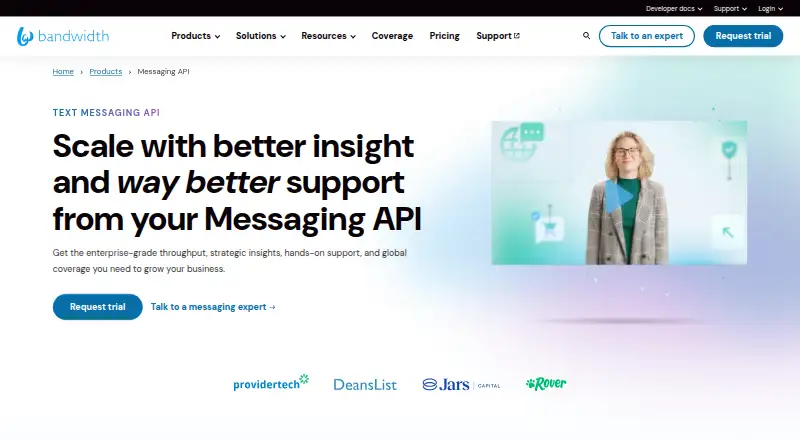
What Bandwidth Messaging API is
Bandwidth Messaging API lets companies send and receive SMS and MMS through HTTP. It supports 10DLC, short code, toll-free, alphanumeric, and global mobile number texting, with messaging options reaching 120+ countries. Two-way messaging, inbound webhooks, delivery analytics, and traffic monitoring help teams track messages; monitoring can surface unregistered traffic and messages blocked by carriers or Bandwidth, with email or webhook alerts. Registration Center can autofill customer and campaign data for Short Code and 10DLC, while RCS is described as coming soon. Developer documentation includes integration guides for ServiceNow, Zendesk, and Salesforce. New accounts default to an outbound testing rate of 1 message per second, while A2P traffic can go up to the account limit. Webhook deliveries without an HTTP 2xx response are retried several times over 24 hours, then stop. Bandwidth says it retains message metadata for queries after successful webhook delivery, not message text, and encrypts data in transit and at rest. A free trial is listed, but there is no free plan; pricing is on request, with U.S. outbound message rates also listed.
Good
- Supports SMS and MMS over HTTP.
- Messaging options reach 120+ countries.
- Offers inbound webhooks and delivery analytics.
- Supports multiple SDK languages and platforms.
- Lists SOC 2 Type II compliance.
Watch out
- No free plan is listed.
- New accounts default to 1 message per second for testing.
- Webhook retries stop after 24 hours.
- Pricing is also available on request.
Who it suits
It is aimed at companies that have outgrown a one-size-fits-all provider and need global scale and high throughput. Teams integrating messaging into services can use its API, SDKs, and listed integrations.
Verdict
Bandwidth Messaging API covers multiple messaging routes and includes tools for delivery monitoring and integration. Check the per-message routes and account rate limits against your needs before choosing it.
Plans and prices
From Bandwidth Messaging API's own pricing page, checked 30 Sep 2026.
| Plan | Price | What it gives you |
|---|---|---|
| U.S. 10DLC SMS outbound | Free | U.S. 10DLC · SMS outbound · per message |
| U.S. Short code SMS outbound | $0.01, paid once | U.S. Short code · SMS outbound · per message |
| U.S. Toll-free SMS outbound | $0.01, paid once | U.S. Toll-free · SMS outbound · per message |
| U.S. 10DLC MMS outbound | $0.02, paid once | U.S. 10DLC · MMS outbound · per message |
| U.S. Short code MMS outbound | $0.02, paid once | U.S. Short code · MMS outbound · per message |
| U.S. Toll-free MMS outbound | $0.02, paid once | U.S. Toll-free · MMS outbound · per message |
The facts
Each one read from Bandwidth Messaging API's own pages, with the date it was checked.
What it does
- Compliance
- Bandwidth lists SOC 2 Type II compliance and says it meets HIPAA security requirements for eligible services.checked 30 Sep 2026
- Global reach
- The product page says its messaging options reach 120+ countries.checked 30 Sep 2026
- Inbound webhooks
- Yeschecked 24 Sep 2026
- Integrations
- Bandwidth's developer documentation provides Messaging API integration guides for ServiceNow, Zendesk, and Salesforce.checked 30 Sep 2026
- Intended users
- The product is aimed at companies that have outgrown a one-size-fits-all provider and need global scale and high throughput.checked 30 Sep 2026
- Message data
- Bandwidth says it does not store message text content and retains only metadata for message queries after webhook delivery succeeds.checked 30 Sep 2026
- Messaging options
- Bandwidth lists 10DLC, Short Code, Toll-free, Alphanumeric, and Global Mobile Number texting options.checked 30 Sep 2026
- MMS support
- Yeschecked 24 Sep 2026
- Monitoring
- Traffic monitoring shows unregistered traffic and messages blocked by carriers or Bandwidth, while alerts can be sent by email or webhook.checked 30 Sep 2026
- Rate limit
- New accounts have a default outbound rate limit of 1 message per second for testing; A2P traffic can go up to the account limit.checked 30 Sep 2026
- Registration
- Registration Center can autofill customer and campaign data across Short Code and 10DLC channels, with RCS described as coming soon.checked 30 Sep 2026
- SDK languages
- Node.js,Python,Java,C#,PHP,Rubychecked 24 Sep 2026
- Security
- Bandwidth says data is encrypted in transit and at rest using protocols including TLS, SIPS, and SRTP.checked 30 Sep 2026
- Short code support
- Yeschecked 24 Sep 2026
- Support
- Messaging customers receive Signature support and can opt for Premium support packages with on-call, ongoing assistance.checked 30 Sep 2026
- Two-way SMS
- Yeschecked 24 Sep 2026
- Webhook retries
- If a webhook does not receive an HTTP 2xx response, Bandwidth retries delivery multiple times over the next 24 hours, then stops.checked 30 Sep 2026
- What it does
- The Messaging API sends SMS and MMS messages over HTTP.checked 30 Sep 2026
The company
- Founded
- 1999checked 28 Sep 2026
- Headquarters
- Raleigh, North Carolina, USAchecked 28 Sep 2026
Money
- Toll-free numbers
- Yeschecked 24 Sep 2026
The full review of Bandwidth Messaging API
Bandwidth Messaging API is an HTTP API for sending SMS and MMS, aimed at companies that need configurable messaging routes and room to scale. It suits teams building messaging into their own systems; the default testing rate and route-specific charges make throughput planning and channel choice central to the decision.
Overview
Bandwidth supports two-way SMS, MMS, inbound webhooks, and messaging options including 10DLC, short codes, toll-free numbers, alphanumeric IDs, and global mobile numbers. The company says these options reach more than 120 countries. That breadth gives teams flexibility to match a route to a campaign, but it also means costs depend on the route and message type rather than one simple outbound rate.
Registration Center can autofill customer and campaign data for Short Code and 10DLC registration. Traffic monitoring highlights unregistered traffic and messages blocked by carriers or Bandwidth, with email or webhook alerts. These tools help operations teams spot registration and delivery problems, but they still need processes to investigate and act on them.
Key features
New accounts have a default outbound limit of one message per second for testing; A2P traffic can reach the account limit. That testing cap is modest for teams validating high-volume workloads, so the account limit matters when planning production throughput.
When a webhook endpoint fails to return an HTTP 2xx response, Bandwidth retries delivery multiple times over the following 24 hours, then stops. Integrations should therefore handle retries safely and account for events that remain undelivered after that window. The API documentation includes integration guides for ServiceNow, Zendesk, and Salesforce, and SDK languages include Node.js, Python, Java, C#, PHP, and Ruby.
Bandwidth says it does not store message text and retains metadata for message queries after successful webhook delivery. It encrypts data in transit and at rest using protocols including TLS, SIPS, and SRTP. The company lists SOC 2 Type II compliance and says it meets HIPAA security requirements for eligible services. Messaging customers receive Signature support, with optional Premium packages offering on-call, ongoing assistance.
Pricing
Pricing is pay-as-you-go per message, with pricing on request for the broader service. The published U.S. outbound rates are:
| Route | SMS outbound | MMS outbound |
|---|---|---|
| 10DLC | free | $0.02, paid once |
| Short code | $0.01, paid once | $0.02, paid once |
| Toll-free | $0.01, paid once | $0.02, paid once |
The 10DLC SMS rate is the lowest listed U.S. option, while short-code and toll-free SMS cost more per message; MMS costs more than SMS on each route. These rates make route selection material to campaign budgets. There is no free plan, but a free trial is available. The service is a better fit for organizations prepared to pay for usage than for teams seeking an ongoing free allowance.
Platforms
The product is available through API and web access. SDK platforms also include iOS, Android, and browser environments, alongside Node, Python, Java, PHP, Ruby, and C#. Messaging is part of a broader communications offering that also supports voice, emergency calling, WebRTC, and RCS; RCS registration support is described as coming soon.
Who it's for
Bandwidth is aimed at companies that have outgrown a one-size-fits-all provider and need global reach or high throughput. It is most compelling for engineering and operations teams that can integrate an API, manage route and registration choices, and work within account-level rate limits. Smaller teams wanting a ready-made messaging product or a free plan may find the usage-based model less suitable.
Pros and cons
- Pros: Multiple U.S. and international messaging routes give teams options for sender type and campaign needs.
- Pros: Traffic monitoring, alerts, and registration autofill support operational oversight across key channels.
- Pros: Webhook retries, SDKs, and named CRM and service-desk integration guides give developers several integration paths.
- Cons: The default testing limit of one message per second may slow realistic throughput testing until account limits are established.
- Cons: MMS and some SMS routes carry higher listed U.S. per-message rates than 10DLC SMS, making route mix a budget concern.
- Cons: No free plan means there is no continuing zero-cost tier for light or experimental use.
Alternatives
For a free RCS option with a stated 100-session monthly allowance, consider RCS-Box. SimplyRCS offers a free pay-as-you-go plan with a full builder and API, so it may suit teams looking for an RCS-focused starting point. Gupshup has a free plan and a stated 0.001 USD per-message standard fee, with WhatsApp fees billed at actuals.
Orbit by Devotel offers pay-as-you-go credits and a free entry plan. Google RCS for Business uses carrier rate-card billing that varies by destination and agent billing category, while Sinch RCS for Business uses custom pricing with possible carrier fees and setup costs. For a published monthly entry price, smsmode RCS API starts at €9 a month for 500 messages or more. 360dialog starts at $59 a month and includes 24/7 human support, a direct Meta escalation path, and automation-platform integrations.
Compare providers across Communications Platforms as a Service and Transactional SMS Software. For RCS-specific options, see RCS Messaging Platforms and RCS Business Messaging Software; teams focused on voice infrastructure can also browse SIP Trunking Providers.
Verdict
Choose Bandwidth Messaging API if your company needs configurable SMS and MMS routes, operational monitoring, and API integration at scale. Its route variety and delivery oversight are the main reasons to choose it; look elsewhere if you need a continuing free tier or cannot plan around account limits and per-route message costs.
Getting started
- Visit https://www.bandwidth.com/products/messaging-apis/ to review the API offering.
- Request pricing or review the listed per-message U.S. outbound rates.
- Use the API or web platform and select a listed messaging route.
- Choose an SDK language: Node.js, Python, Java, C#, PHP, or Ruby.
- Use the developer documentation integration guides for ServiceNow, Zendesk, or Salesforce if relevant.
Limits worth knowing
New accounts default to 1 outbound message per second for testing; A2P traffic can go up to the account limit. If a webhook fails to receive an HTTP 2xx response, Bandwidth retries delivery multiple times over 24 hours before stopping.
Questions
Is there a free plan or trial?
There is no free plan, and a free trial is listed. Pricing is also available on request.
What are the listed U.S. outbound rates?
10DLC SMS is free; short code SMS and toll-free SMS are each $0.01, paid once. The listed 10DLC, short code, and toll-free MMS routes are each $0.02, paid once.
Which messaging channels and routes are supported?
The Messaging API sends SMS and MMS and supports two-way messaging, inbound webhooks, short codes, and toll-free numbers. Listed texting options include 10DLC, short code, toll-free, alphanumeric, and global mobile number texting; RCS is described as coming soon.
Which SDK languages are available?
Listed SDK languages include Node.js, Python, Java, C#, PHP, and Ruby.
What integrations are covered in the documentation?
Bandwidth's developer documentation provides Messaging API integration guides for ServiceNow, Zendesk, and Salesforce.
Who makes Bandwidth Messaging API?
Bandwidth was founded in 1999 and is headquartered in Raleigh, North Carolina, USA.
Alternatives to Bandwidth Messaging API
- 1

Telnyx SMS API
Free planWebAPI8.2From $500 a month - 2
MSG91
Free planAndroidiOSWebAPI8.1From ₹2,000 a month - 3

Plivo SMS API
WebAPI7.7From $0.50 a month - 4

Gupshup
Free planWebAPI7.7Free plan - 5
Vonage SMS API
AndroidiOSWebAPI7.6 - 6

Messente
Free planWebAPI7.6Free plan