LibreBooking
LibreBooking is free, open-source software for organizations that schedule reservations for shared resources.
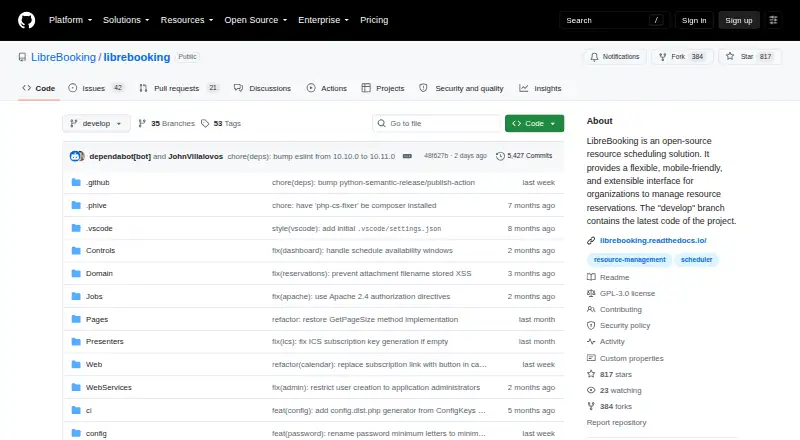
What LibreBooking is
LibreBooking is free, open-source software for organizations that schedule reservations for shared resources. It supports bookings across multiple resources and waitlists, with role-based access control, reservation quotas and credits, and detailed usage reports. Its interface is described as responsive and mobile-friendly, with custom themes and color schemes. Calendar integration with Outlook and Thunderbird uses ICS. The documentation lists LDAP, Active Directory, OAuth2 and SAML authentication; OAuth2 can work with compatible identity providers such as authentik or Keycloak. An optional RESTful JSON API can support integrations, automation or client applications. The project documents both manual installation and Docker deployment. Manual setup requires PHP 8.2 or later, Apache 2.4 or later, and MySQL 8.0 or MariaDB 10.6 or later; other web servers are not currently supported or tested. LibreBooking is licensed under GPL-3.0 and provides plugin documentation. The project warns that versions before 7.0.0 have a critical vulnerability that could allow unauthenticated administrator account takeover, and says to upgrade to 7.0.0 or later.
Good
- Supports multiple resource bookings and waitlists
- Includes role-based access and usage reports
- Integrates with Outlook and Thunderbird calendars
- Offers Docker deployment and an optional REST API
Watch out
- Manual setup requires specified PHP, Apache and database versions
- Other web servers are not currently supported or tested
- Versions before 7.0.0 have a critical vulnerability
Who it suits
LibreBooking suits organizations that need to schedule shared resources with access controls, quotas and usage reporting. It is intended for teams able to deploy the software on its documented stack or through Docker.
Verdict
LibreBooking provides reservation management with access controls, calendar connections and deployment choices for organizations running their own software. The project specifically warns users to upgrade any version earlier than 7.0.0.
Plans and prices
From LibreBooking's own pricing page, checked 11 Oct 2001.
| Plan | Price | What it gives you |
|---|---|---|
| LibreBooking | Free | Open-source resource scheduling software · GPL-3.0 |
The facts
Each one read from LibreBooking's own pages, with the date it was checked.
What it does
- Access and usage
- Features include role-based access control, reservation quotas and credits, and granular usage reports.checked 10 Oct 2001
- Access controls
- It includes role-based access control.checked 11 Oct 2001
- API
- An optional RESTful JSON API can support third-party integration, automation, or client applications.checked 10 Oct 2001
- Authentication
- The documentation links configuration guides for LDAP, Active Directory, OAuth2, and SAML authentication.checked 11 Oct 2001
- Authentication integrations
- The documentation describes OAuth2 authentication with compatible identity providers such as authentik or Keycloak.checked 10 Oct 2001
- Bookings
- It supports multi-resource booking and waitlists.checked 11 Oct 2001
- Calendar integration
- LibreBooking lists Outlook and Thunderbird integration through ICS.checked 10 Oct 2001
- Deployment
- LibreBooking can be installed from a prebuilt release or deployed as a Docker container.checked 11 Oct 2001
- Deployment options
- The project documents manual installation and Docker deployment.checked 10 Oct 2001
- Deployment requirements
- The README lists PHP 8.2 or later, Apache 2.4 or later, and MySQL 8.0 or MariaDB 10.6 or later for manual installation; it says other web servers are not currently supported or tested by the project.checked 10 Oct 2001
- Extensibility
- The project describes its architecture as plugin-ready and provides custom plugin documentation.checked 11 Oct 2001
- Integrations
- The project lists Outlook and Thunderbird integration through ICS.checked 11 Oct 2001
- Interface
- The interface is responsive, uses Bootstrap 5, and supports custom themes and color schemes.checked 11 Oct 2001
- License
- The project is licensed under GPL-3.0.checked 11 Oct 2001
- Purpose
- LibreBooking is an open-source resource scheduling solution for managing resource reservations.checked 11 Oct 2001
- Requirements
- Manual installation requires PHP 8.2 or later, Apache 2.4 or later, and MySQL 8.0 or MariaDB 10.6 or later; other web servers are not currently supported or tested by the project.checked 11 Oct 2001
- Reservation management
- It supports reservation quotas and credits, plus granular usage reporting.checked 11 Oct 2001
- Security
- The project warns that versions before 7.0.0 have a critical vulnerability allowing unauthenticated administrator account takeover and says security fixes are not backported to 6.x or earlier.checked 11 Oct 2001
- Security update
- The README warns that versions before 7.0.0 contain a critical vulnerability that could let an unauthenticated attacker take over an administrator account, and says to upgrade to 7.0.0 or later immediately.checked 10 Oct 2001
- Support
- The project lists Discord, documentation, GitHub issues, and discussions as community support channels.checked 11 Oct 2001
The full review of LibreBooking
LibreBooking is an open-source reservation system for organizations coordinating shared rooms, equipment, or other resources. It suits teams prepared to operate their own web stack and needing firm booking rules, identity integration, and usage oversight. The trade-off is that hosting, upgrades, and security maintenance remain the operator’s responsibility.
Overview
LibreBooking covers the core reservation workflow while adding controls that matter when capacity is contested. Multiple-resource bookings, waitlists, recurring reservations, check-in, quotas, and credits give administrators more control than a basic calendar. Role-based permissions and granular reports are useful for departments that must distinguish who may reserve what and review consumption.
It is released under GPL-3.0 and costs nothing to license. That makes it attractive to organizations wanting ownership of their deployment or the ability to modify the software. It is less suitable for teams seeking a vendor-managed service with minimal infrastructure work.
Key features
Users can reserve several resources in one process, join waitlists, and schedule recurring bookings. Reservation quotas and credits help ration scarce capacity, while role-based access control separates administrative duties from ordinary booking. Granular usage reports support audits and planning rather than leaving utilization to guesswork.
Outlook and Thunderbird connect through ICS, and calendar synchronization is supported. Authentication documentation covers LDAP, Active Directory, OAuth2, and SAML; OAuth2 can work with compatible providers including authentik and Keycloak. Single sign-on can reduce separate credentials, while booking check-in adds an attendance-oriented step for organizations that need it.
The interface is described as responsive and mobile-friendly. Custom themes and color schemes allow a deployment to match an organization’s presentation. An optional RESTful JSON API supports automation, third-party integrations, and custom clients. The plugin-ready architecture and plugin documentation provide an extension route when built-in behavior is not enough.
Pricing
LibreBooking: free (open-source resource scheduling software, GPL-3.0). There are no paid tiers or user quotas stated, so it fits organizations that can supply their own hosting and administration. The zero license price does not remove the operational work of deployment, updates, backups, or security management.
Platforms
LibreBooking is offered as a web application with an API and self-hosted deployment on Linux environments. Manual installation requires PHP 8.2 or later, Apache 2.4 or later, and MySQL 8.0 or MariaDB 10.6 or later. The project says other web servers are not currently supported or tested. Installation is documented both from a prebuilt release and through Docker, giving experienced administrators a container option.
Support is directed through the GitHub repository and Gitter chat room, so organizations should be comfortable with community-based assistance rather than a commercial support desk.
Who it's for
LibreBooking is a strong match for schools, nonprofits, offices, and other organizations that manage shared resources, need differentiated permissions, and have staff able to run PHP, Apache, and a supported database. Its quotas, credits, reporting, API, and authentication integrations reward a structured deployment.
It is a weaker choice for a small team that wants an immediately hosted booking service, broad turnkey support, or a server platform outside the documented stack.
Pros and cons
Pros
- Free and GPL-3.0 licensed: no software subscription and the freedom to operate or adapt the code.
- Detailed reservation governance: quotas, credits, waitlists, check-in, role-based access, and reports address controlled shared capacity.
- Integration options: ICS calendars, directory protocols, SSO, REST API, and plugins can connect it to existing systems.
- Flexible deployment: manual installation and Docker support suit organizations with different administration practices.
Cons
- Infrastructure burden: operators must provide and maintain the supported PHP, Apache, and database stack.
- Limited server compatibility: other web servers are not currently supported or tested.
- Security upkeep is critical: versions before 7.0.0 have a vulnerability that can permit unauthenticated administrator takeover, and fixes are not backported to 6.x or earlier.
- Community-led support: help is routed through GitHub and Gitter rather than a stated commercial service.
Alternatives
desk.ly is a better fit when a hosted, freemium service is preferable, with a free plan for up to 15 users and Android, iOS, web, and API access.
Flexopus suits buyers wanting a paid cloud product with a 30-day demo and mobile apps.
Officely is worth choosing for a small free deployment of up to five users or straightforward desk booking.
Roomzilla fits organizations wanting a free tier for up to three resources and paid resource-based expansion.
Seatsurfing is an alternative for self-hosting or a managed European cloud plan, with a free tier for up to 10 users.
BookingONE is a paid option spanning Android, iOS, macOS, web, and Windows.
Roomer offers free, self-hosted AGPL v3 software for a single organization.
classroombookings is aimed at self-hosted web deployments, with a free forever plan and a cloud option.
For broader browsing, see Room Booking Software and Terminal Multiplexers.
Verdict
Choose LibreBooking if your organization needs governed resource reservations, identity and calendar integration, and the control of self-hosting without license fees. Look elsewhere if you want managed hosting, simpler administration, or a server environment outside its documented requirements; whichever route you take, use version 7.0.0 or later.