Okena
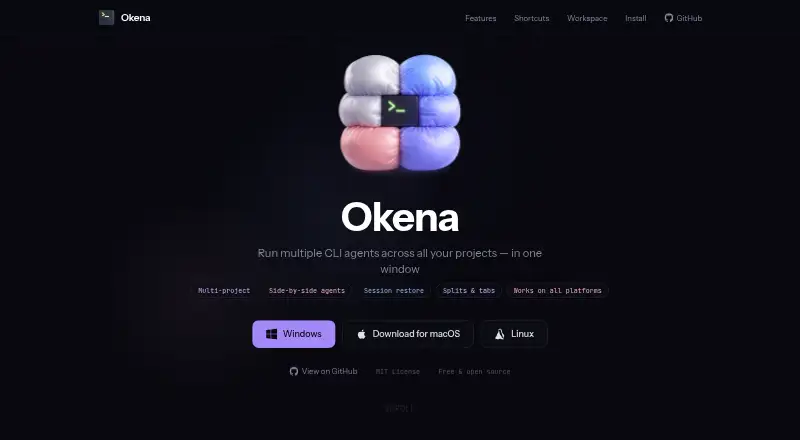
Okena is a native terminal multiplexer for running multiple command-line agents and projects in one window.
What Okena is
Okena is a native terminal multiplexer for running multiple command-line agents and projects in one window. Workspaces can use side-by-side project columns, tabs, split panes, detachable terminal windows, or fullscreen mode. Its terminal offers GPU-accelerated rendering and scrollback of up to 100,000 lines, and it can save and restore workspace layouts and terminal sessions across restarts; persistence is local. Users can manage Git worktrees as projects and view branches and change statistics. Documented integrations include Claude Code and OpenAI Codex status or usage information, Docker Compose project services, and opening files in editors. Remote access is available through a local HTTP and WebSocket API, a browser client, and iOS and Android companion apps. Okena is free and open source under the MIT License, with macOS, Linux, and Windows installation options and instructions for building from source. The listed plan is free. The maker says Okena was made by the creators of Contember.
Good
- Supports tabs, split panes, columns, and detachable windows.
- Saves and restores sessions across app restarts.
- Git worktrees show branches and change statistics.
- Free and open source under the MIT License.
Watch out
- Session persistence is local.
- Remote control is documented as a local API.
- Installation methods vary by operating system.
Who it suits
Okena suits people who work with multiple CLI agents or projects and want their terminal sessions arranged in one workspace. It also fits users who want to manage Git worktrees or access a workspace from companion apps.
Verdict
Okena combines terminal workspace management with local session restoration and Git worktree views. It is free and open source, with remote access options documented for browsers and mobile companion apps.
Plans and prices
From Okena's own pricing page, checked 3 Oct 2001.
| Plan | Price | What it gives you |
|---|---|---|
| Free and open source | Free | MIT License · macOS, Linux, Windows |
The facts
Each one read from Okena's own pages, with the date it was checked.
What it does
- Customization
- Users can customize shortcuts, themes, shell settings, per-project preferences, and lifecycle hooks.checked 3 Oct 2001
- Git integration
- Users can manage Git worktrees as projects and view project branches and change statistics.checked 3 Oct 2001
- Installation
- The maker provides shell installation commands for macOS and Linux and a PowerShell command for Windows, and also documents building from source.checked 3 Oct 2001
- Integrations
- The repository documents Claude Code and OpenAI Codex status or usage integrations, Docker Compose project services, and editor file opening.checked 3 Oct 2001
- Layouts
- It supports side-by-side project columns, tabs, split panes, detachable terminal windows, and fullscreen mode.checked 3 Oct 2001
- License
- The maker describes Okena as free and open source under the MIT License.checked 3 Oct 2001
- Remote access
- The repository documents a local HTTP and WebSocket remote control API, a browser client, and iOS and Android companion apps.checked 3 Oct 2001
- Security
- The repository says remote pairing uses HMAC-SHA256 token authentication and rate-limited pairing codes, and downloaded updates are SHA256 verified.checked 3 Oct 2001
- Session persistence
- Okena can save and restore workspace layouts and terminal sessions across app restarts.checked 3 Oct 2001
- Terminal history
- The terminal supports GPU-accelerated rendering and scrollback of up to 100,000 lines.checked 3 Oct 2001
- What it does
- Okena is a native terminal multiplexer for running multiple CLI agents and projects in one window.checked 3 Oct 2001
The company
- Maker
- The maker site says Okena was made by the creators of Contember; it does not state headquarters or founding year on the page.checked 3 Oct 2001
Where it runs
- Platforms
- The maker lists macOS, Linux, and Windows support, including PowerShell and WSL on Windows.checked 3 Oct 2001
The full review of Okena
Okena suits developers who coordinate several command-line projects or coding agents and want them arranged in a persistent desktop workspace. Its appeal is the combination of session restoration and project-aware Git views; readers who need only a lightweight terminal multiplexer may prefer a simpler alternative.
Overview
Okena brings multiple CLI agents and projects into one terminal workspace. Columns, tabs, split panes, detachable windows and fullscreen mode make it possible to shape that workspace around parallel tasks rather than juggling separate terminal windows.
It goes beyond layout: workspaces and terminal sessions can be restored after an app restart, and Git worktrees can be managed as projects with branch and change statistics. Okena is free and open source under the MIT License.
Key features
Flexible project workspace
Side-by-side project columns, tabs and split panes let users keep related work visible together. Detaching terminals and switching to fullscreen add options for changing focus, while custom pane layouts support repeatable arrangements. This is useful for agent-driven work or several active projects; users who prefer a conventional single terminal gain less from the extra organization.
Scrollback and session restoration
GPU-accelerated rendering and scrollback of up to 100,000 lines give long-running command sessions room for substantial output. Okena can save and restore layouts and terminal sessions across restarts, reducing the need to rebuild a workspace after closing the app. Persistence is local, so this should not be mistaken for cloud session synchronization.
Git and development integrations
Git worktrees become manageable projects, with branches and change statistics visible in the workspace. Repository documentation also covers Claude Code and OpenAI Codex status or usage integrations, Docker Compose project services and opening files in an editor. That breadth connects terminal work to common project workflows, though the integrations described are focused on those tools and tasks.
Remote access and safeguards
A local HTTP and WebSocket remote-control API, browser client, and iOS and Android companion apps extend access beyond the desktop. Pairing uses HMAC-SHA256 token authentication and rate-limited pairing codes; downloaded updates are SHA256 verified. These safeguards are relevant for users enabling remote control, but the documented API is local rather than a claim of hosted access.
Customization and installation
Shortcuts, themes, shell settings, per-project preferences and lifecycle hooks can be customized. Shell installation commands are provided for macOS and Linux, with a PowerShell command for Windows; building from source is also documented. This offers flexibility for users willing to configure their environment, while installation options are centered on those three desktop systems.
Pricing
Free and open source: free. The MIT-licensed plan covers macOS, Linux and Windows, with no paid tier stated. It is the straightforward choice for individuals or teams evaluating Okena without a subscription commitment. Session persistence is local, so the free plan should not be read as including hosted synchronization or a cloud workspace.
Platforms
The desktop app supports macOS, Linux and Windows. Web, Android and iOS access is provided through a browser client and mobile companion apps. The documented local API also supports remote control, but desktop availability remains the core of the workspace.
Who it's for
Okena is a strong fit for developers running multiple CLI agents, Git worktrees or project services in parallel, especially those who want their terminal layout to survive restarts. It is less compelling for someone seeking only a basic shell or a hosted, synchronized workspace: its persistence is local, and its value comes from managing a richer desktop setup.
Pros and cons
- Pro: Restores layouts and sessions after app restarts, avoiding repeated workspace setup.
- Pro: Combines worktree management and branch/change visibility with terminal layouts, useful for parallel Git work.
- Pro: Free, MIT-licensed software spans three desktop platforms, with companion access on web and mobile.
- Con: Persistence is local, so sessions are not described as syncing across devices.
- Con: Its many layout, customization and integration options are more than needed for a user who simply wants a terminal.
Alternatives
Zellij is another free, open-source choice with Linux, macOS, Windows, iOS and web platforms; choose it if you want a multiplexer without an account requirement. Its Zellij.online hosted session-sharing option is paid, has a free tier and is in closed beta.
muxel is a free GPL-3.0 alternative for Linux, macOS and Windows. p2pmux is a free MIT-licensed option for Linux and macOS.
Quil is free with no paid tier or hosted version; consider it if a no-hosted local option suits your needs. Ferrix is another free option for Linux and macOS.
tmux is a free open-source option for Linux, macOS and self-hosted setups, with no paid tiers or usage limits stated. Plux and Byobu are also free options for Linux and macOS. Browse more choices in Terminal Multiplexers.
Verdict
Choose Okena if your terminal is the control room for several CLI projects or agents: its strongest case is a configurable workspace that restores locally and brings Git worktrees into view. Look elsewhere if you need hosted cross-device persistence or only want a minimal terminal multiplexer.
Getting started
- Open the Okena website.
- Choose the installation route for macOS, Linux, or Windows.
- Run the provided shell command on macOS or Linux, or PowerShell command on Windows.
- Alternatively, follow the documented steps to build from source.
- Arrange projects with columns, tabs, panes, or detachable terminal windows.
Limits worth knowing
Okena is free under the MIT License. Saved workspace layouts and terminal sessions persist locally.
Questions
How much does Okena cost?
Okena is free and open source under the MIT License.
Which platforms can I use it on?
Native installation is documented for macOS, Linux, and Windows. Web, Android, and iOS are available for companion access.
Can Okena restore a workspace after a restart?
Yes. It can save and restore workspace layouts and terminal sessions across app restarts, with local persistence.
Does it integrate with Claude Code or OpenAI Codex?
The repository documents status or usage integrations for Claude Code and OpenAI Codex.
How can I install Okena?
The maker provides shell installation commands for macOS and Linux and a PowerShell command for Windows. Building from source is also documented.